
Unveiling the Future: Purmundus 3D Printing Design Award Winners Push Boundaries of Additive Manufacturing
The world of additive manufacturing continues to evolve at an astonishing pace, constantly pushing the boundaries of what’s possible. A prime example of this relentless innovation was showcased at Formnext, the premier global exhibition for additive manufacturing and industrial 3D printing. Amidst the flurry of new technologies and groundbreaking applications, the seventh edition of the Purmundus 3D Printing Design Award took center stage. This prestigious award celebrates cutting-edge designs and forward-thinking solutions that truly leverage the transformative power of 3D printing, highlighting projects that move the industry forward.
This year, the Purmundus Award adopted the compelling theme, “Beyond 3D Printing.” This theme challenged designers and engineers to envision applications that not only utilize additive manufacturing but also transcend conventional limitations, offering functionalities and possibilities previously unattainable. It’s about looking beyond merely fabricating objects layer by layer and instead focusing on the intelligent integration of materials, processes, and design principles to create truly novel solutions. From a highly competitive field of submissions, 38 projects and companies distinguished themselves to make it onto the finalists’ esteemed list, each showcasing a unique vision for the future of manufacturing.
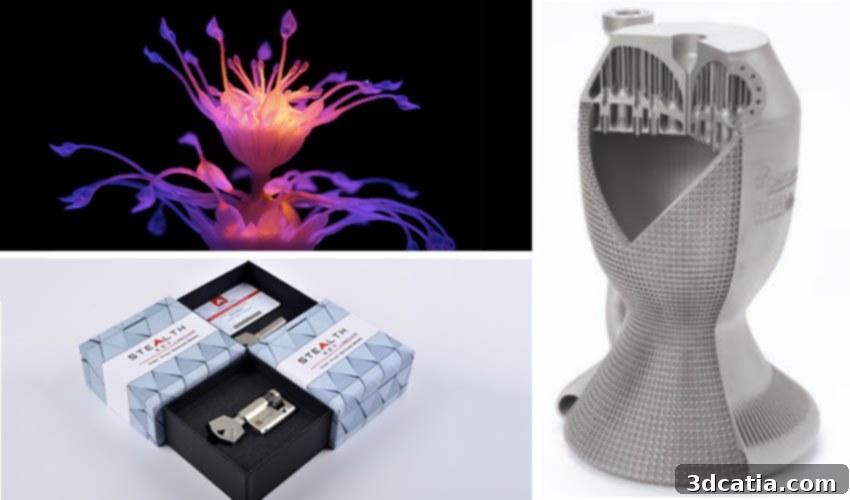
An international jury comprised of leading additive manufacturing professionals meticulously evaluated each submission, considering criteria such as innovation, design quality, technological advancement, and market relevance. Ultimately, they selected three visionary winners whose projects exemplify the spirit of innovation and the promise of a future shaped by advanced manufacturing techniques. The top honor, the first prize, was proudly claimed by Stealth Keys, a revolutionary concept poised to redefine security. Following closely, the second prize was awarded to the captivating Hydrophytes project, which ventures into the exciting realm of 4D printing and biomimicry. Last but certainly not least, the third place recognized the monumental achievement of Dr. Paul Schüler and Andreas Krüger for their groundbreaking monolithic combustion chamber of a rocket engine, a testament to additive manufacturing’s critical role in aerospace. Let’s delve deeper into these award-winning submissions and explore how they are driving the industry “beyond 3D printing.”
Stealth Keys: Redefining Security with Additive Manufacturing
Winning the highly coveted first prize, Stealth Keys represents a paradigm shift in physical security. Developed by UrbanAlps, a company renowned for its expertise in designing and manufacturing high-strength components for demanding industries, Stealth Keys addresses a fundamental and age-old vulnerability in traditional lock and key systems: the ease of unauthorized duplication. For centuries, physical keys have been susceptible to illicit copying through various methods, from simple molds and impressions to advanced optical scanning techniques. UrbanAlps’ mission is to eradicate this threat by creating keys that are inherently uncopyable, leveraging the unparalleled precision and complexity afforded by additive manufacturing.
The secret behind Stealth Keys lies in its innovative manufacturing process: Laser Powder Bed Fusion (LPBF) technology. This advanced form of 3D printing enables the creation of incredibly intricate internal geometries and hidden features that are impossible to replicate using conventional machining methods or even the sophisticated scanning and 3D printing techniques available to unauthorized parties. As the CEO and Co-Founder of Stealth Keys articulated in an earlier discussion: “[The Stealth Key] hides its mechanical security functions inside its structure, making it impossible to scan: the copy is therefore protected. Our objective is to transform a century-old industry that is used to drilling holes in metal sheets by offering an additive manufacturing solution.” This compelling statement perfectly encapsulates the revolutionary approach UrbanAlps has taken to challenge and advance a traditionally static industry.
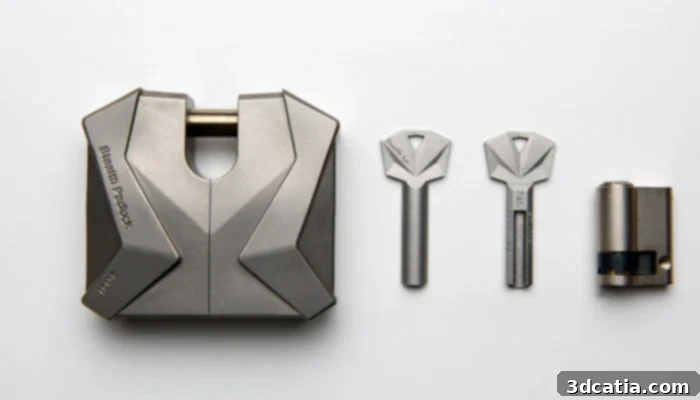
The core innovation of Stealth Keys is its ability to embed complex, hidden security features directly within the key’s internal structure. Unlike traditional keys where security elements are external cuts that can be visually inspected, measured, or scanned, Stealth Keys conceal these critical components deep within their metallic body, rendering them invisible and inaccessible without specialized knowledge and equipment. This makes it virtually impossible for unauthorized individuals to scan, photograph, or duplicate the key using conventional means, thereby providing an unprecedented level of physical security. Furthermore, these high-security keys operate entirely independently of digital systems, ensuring robust physical protection even in scenarios where digital infrastructure might be compromised or vulnerable to cyber-attacks, offering peace of mind in an increasingly connected world.
UrbanAlps’ extensive background in manufacturing high-strength, high-performance components for demanding applications such as satellites, jet engines, and gas turbines has been instrumental in the rapid and effective development of Stealth Keys. Their deep understanding of advanced materials science, complex manufacturing processes, and rigorous engineering principles allowed them to apply this expertise to a seemingly mundane object – a key – and elevate it to a state-of-the-art security device. This project truly embodies the “Beyond 3D Printing” theme by transforming a well-established industry with a century-old heritage, demonstrating how additive manufacturing can introduce not just incremental improvements, but truly disruptive innovation to fundamental aspects of daily life, ultimately enhancing safety and protection for individuals and organizations alike.
Hydrophytes: The Mesmerizing World of 4D Printed Aquatic Plants
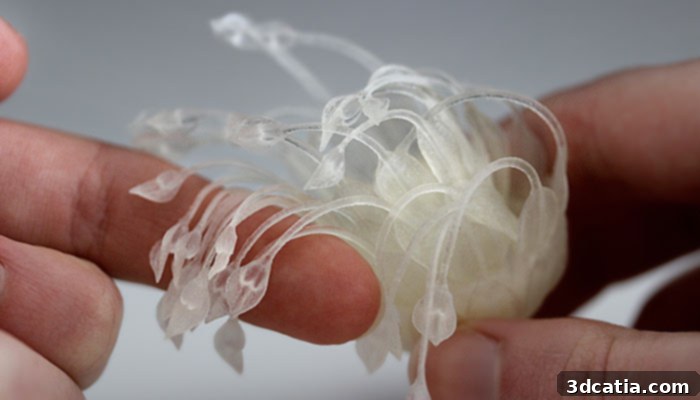
The recipient of the second prize, the captivating Hydrophytes project, plunges us into the fascinating and relatively nascent field of 4D printing. This visionary series comprises five distinct, futuristic aquatic plants, meticulously designed and brought to life as part of an industrial design master’s thesis by New Zealand industrial designer Nicole Hone. Unlike traditional 3D printing, which focuses on creating static, three-dimensional objects, 4D printing introduces the crucial element of time. It allows objects to transform, change shape, or move autonomously post-production in response to external stimuli such as water, heat, light, air pressure, or even electrical currents.
Nicole Hone’s Hydrophytes brilliantly showcase this transformative potential. Created using intelligent, stimulus-responsive manufacturing materials, these structures are precisely engineered to develop movements uncannily similar to their real aquatic counterparts. This biomimetic approach is at the heart of the project, aiming to replicate the organic fluidity, graceful responsiveness, and intricate self-organization found in nature. The chosen manufacturing technology, Stratasys’ PolyJet, was absolutely crucial for this endeavor. PolyJet allows for the simultaneous printing of multiple materials with varying properties – specifically, blends of rigid and flexible resins – within a single object. This multi-material printing capability is essential for creating complex geometries that can flex, bend, and change shape in a controlled and predictable manner, providing the lifelike motion observed in the Hydrophytes without any external motors or complex mechanisms.
In an insightful interview with 3Dnatives, Nicole Hone expressed her deep connection to her inspiration and the broader implications of her work: “I have always been fascinated by nature, it inspires me a lot in design and aesthetics. For this project, I was particularly interested in botany and marine life […] 4D printing allows us to create objects that can move and change shape or appearance. This provides additional functionality in designing objects that can be controlled and digitally tested.” Her passion for the natural world, combined with her innovative application of technology, has yielded objects that elegantly blur the lines between artificial constructs and organic life, hinting at a future where manufactured items can interact with their environment in sophisticated ways.
While 4D printing is still an emerging technology with fewer widespread commercial applications compared to its 3D counterpart, its potential is undeniably vast and transformative. The Hydrophytes project serves as a compelling proof-of-concept, demonstrating how responsive materials and dynamic design can lead to breakthroughs in various fields. Imagine self-assembling structures for architecture, adaptive medical devices that conform to the human body, soft robotics that mimic biological organisms, smart textiles that change properties based on environmental conditions, or even dynamic furniture that adjusts to user needs. This segment of additive manufacturing, focused on time-dependent transformations and intelligent material response, is undoubtedly one to watch, promising to unlock new dimensions of functionality and design that truly extend “beyond 3D printing” and redefine our interaction with manufactured objects.
Monolithic Rocket Engine: Propelling Aerospace Innovation
Securing third place, the project by CellCore GmbH and SLM Solutions Group AG represents a monumental leap in aerospace engineering. They collaborated to develop a highly complex rocket engine demonstrator featuring a monolithic combustion chamber. A monolithic design, in this context, means that what would traditionally be multiple separate components are ingeniously integrated into a single, seamless, and structurally optimized structure. This demonstrator brilliantly combines critical elements such as a fuel inlet, an injection head, the main thrust chamber, and an innovative structural cooling concept into one integral design, showcasing the profound potential and unparalleled benefits of metallic, powder bed-based 3D printing for demanding space flight applications.
Rocket engines are among the most complex and critically engineered components in any propulsion system, operating under extreme pressures, temperatures, and dynamic loads. Traditionally, these engines are assembled from numerous individual parts, each requiring precise machining, intricate welding, and laborious assembly, which often leads to increased weight, potential points of failure, and higher manufacturing costs. Additive manufacturing, specifically metallic powder bed fusion, revolutionizes this process by enabling the creation of intricate internal geometries and complex channels that are impossible to achieve with conventional subtractive methods. This allows for the radical consolidation of multiple components into a single, highly optimized part, significantly reducing part count, assembly time, logistical complexities, and overall weight – all crucial factors in space applications where every gram directly impacts launch costs and mission capability.
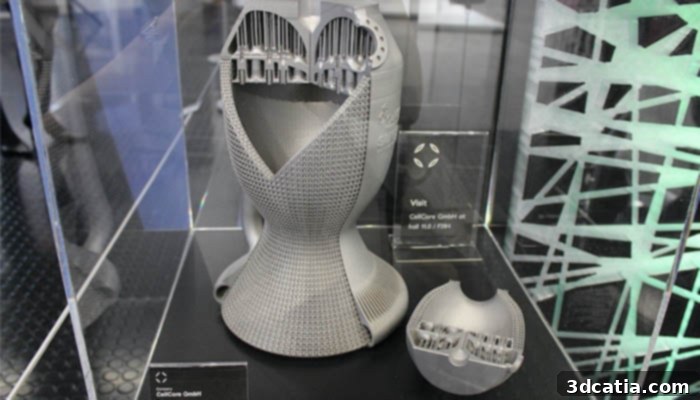
Design for Additive Manufacturing (DfAM) techniques are making a real and transformative difference in industries like aerospace, as compellingly demonstrated by this groundbreaking rocket engine. The part’s functionality is significantly enhanced by an optimized lattice structure seamlessly integrated into the chamber wall. This advanced internal lattice provides exceptional structural stability and mechanical integrity while simultaneously optimizing thermal management. It enables highly efficient cooling by actively circulating liquid hydrogen, effectively conducting extreme heat away from the thrust chamber’s internal wall, which is subjected to combustion temperatures. This structural cooling represents a significant and sophisticated improvement over conventional approaches, which often rely on less efficient concentric milled cooling channels that are inherently constrained by manufacturing limitations and geometry complexity.
The ability to directly print these complex internal cooling channels and intricate lattice structures within a monolithic component not only boosts efficiency, performance, and heat dissipation capabilities but also enhances the overall reliability and longevity of the engine. By reducing the number of interfaces and welded joints, potential failure points are minimized, leading to more robust and dependable systems. This innovative approach promises lighter, more powerful, and significantly more reliable rocket engines, paving the way for more ambitious, safer, and cost-effective space missions, including lunar and Martian exploration. The project is a shining example of how additive manufacturing isn’t just about making parts faster or cheaper, but about enabling designs and functionalities that were once confined to theoretical models, truly pushing the boundaries of engineering and propelling humanity further into space – a clear and inspiring testament to going “beyond 3D printing.”
Beyond these three outstanding winners, Formnext and the Purmundus 3D Printing Design Award showcased an incredible breadth of innovation from numerous other companies and projects, collectively demonstrating the dynamic and constantly evolving nature of the 3D printing industry. The creativity, engineering prowess, and forward-thinking applications on display underscored how additive manufacturing is not merely a production method but a powerful catalyst for groundbreaking design across diverse sectors, from medical to consumer goods, automotive to energy.
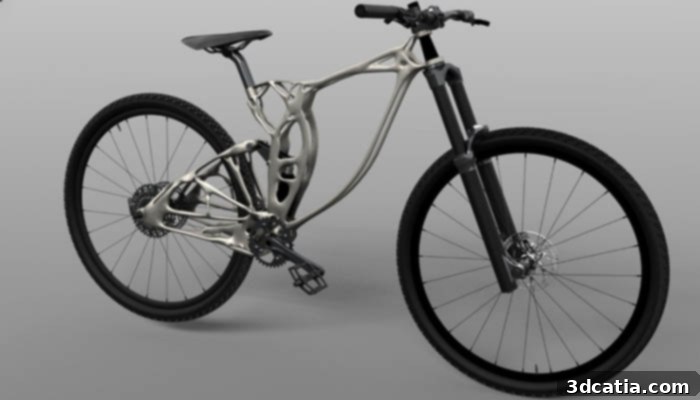
We must also acknowledge the public’s choice award, which was deservedly bestowed upon NMU ECO-CAR for its remarkable 3D printed mountain bike frame. This project, among many others, highlighted the practical and recreational applications of additive manufacturing, emphasizing its versatility from highly technical aerospace components to personalized sporting equipment. Such diverse applications truly demonstrate the widespread impact of additive technologies. For those eager to explore the full spectrum of innovation presented, including all the remarkable concepts that made it to the final stages, the complete list of this year’s finalists can be found HERE.
The Purmundus 3D Printing Design Award serves as a vital platform for recognizing and celebrating the ingenuity that defines the additive manufacturing landscape. The winners, Stealth Keys, Hydrophytes, and the monolithic rocket engine, along with all the talented finalists, represent the vanguard of design and engineering. They not only harness the existing capabilities of 3D printing but also pioneer new applications, materials, and processes that truly embody the theme of “Beyond 3D Printing.” These innovations promise a future where manufacturing is more adaptive, secure, functional, environmentally conscious, and creatively boundless, pushing the boundaries of what humans can design and create.
What are your thoughts on these groundbreaking Purmundus 3D Printing Design Award winners? Which projects do you believe are truly pushing the boundaries and moving “Beyond 3D Printing” in unexpected ways, paving the path for future advancements? We encourage you to share your insights, opinions, and engage in the conversation by leaving a comment below or by connecting with us on our Facebook and Twitter pages! And for all the latest news, trends, and innovations in the dynamic and rapidly expanding world of 3D printing, remember to sign up for our free weekly Newsletter, delivered straight to your inbox to keep you informed.