
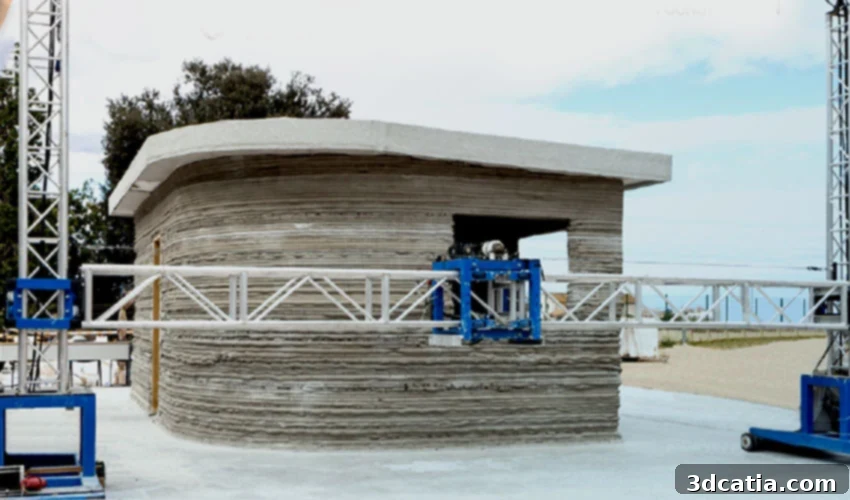
Revolutionizing Construction: Be More 3D Builds Africa’s First 3D Printed House in Morocco
The global construction industry is undergoing a significant transformation, with 3D printing emerging as a disruptive force set to redefine traditional building methods. This innovative approach, often referred to as additive manufacturing, is experiencing an unprecedented boom, with market analysts like SmarTech Publishing projecting its value in the construction sector to skyrocket to an impressive $40 billion by 2027. This burgeoning growth signifies a pivotal shift towards more efficient, sustainable, and cost-effective building solutions. Companies worldwide are rapidly embracing this new wave of manufacturing, attracted by its myriad benefits, including substantial savings in materials, significant reductions in project costs, and dramatically shorter construction timelines. Beyond economic advantages, 3D printing in construction also holds immense promise for humanitarian efforts, particularly in assisting developing regions by providing rapid and affordable housing solutions.
At the forefront of this pioneering movement is Be More 3D, a dynamic and innovative company based in Valencia, Spain. As one of the earliest pioneers in Spain to venture into 3D printing buildings, Be More 3D has quickly established itself as a key player in the European market. Their foundational project in Spain involved the successful 3D printing of a 24-square-meter house, a collaborative effort with the prestigious Polytechnic University of Valencia. This initial success not only demonstrated the viability of their technology but also broadened the spectrum of market players engaged in this transformative field. Building on this foundation, Be More 3D has now set its sights on a new frontier, embarking on the ambitious construction of Africa’s first 3D printed house, a landmark project situated in Morocco. This initiative marks a significant milestone, underscoring the global reach and potential impact of additive manufacturing in addressing pressing housing challenges across continents.
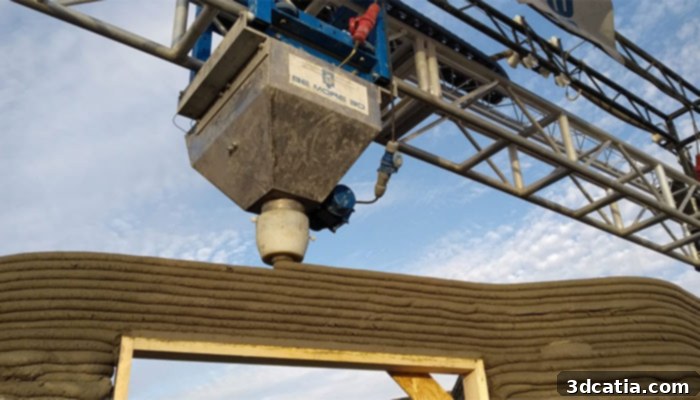
Be More 3D’s cutting-edge technology facilitating rapid construction | Credits: IT3D
Pioneering the Future: The 3D Printed House in Morocco
The historic venture into African soil for Be More 3D culminated in a remarkable display of innovation during last September’s “Solar Decathlon Africa” event. This prestigious competition, held in the city of Benguerir, Morocco, is dedicated to promoting the integration of renewable energies and sustainable practices in real estate development. It served as an ideal platform for Be More 3D to showcase the immense capabilities of its advanced 3D printing technology. During the event, the company successfully 3D printed a 32-square-meter house in an astonishingly short period of just 12 hours. This extraordinary feat not only highlighted the speed and efficiency inherent in additive construction but also positioned Be More 3D as a leader in innovative building solutions.
The swift completion of the house garnered widespread recognition and accolades. Be More 3D was deservingly awarded the prize for the most innovative startup by Green Africa Innovation Booster, an initiative spearheaded by IRESEN – the leading research institute of the Moroccan Ministry of Energy and Environment. This award was a testament to the company’s groundbreaking approach and its potential to revolutionize housing provision, particularly in regions where rapid, cost-effective, and sustainable construction is paramount. The successful execution of this project in Morocco underscores the practical applications and transformative power of 3D printing in real-world scenarios, demonstrating how cutting-edge technology can address societal needs and promote sustainable development on a grand scale.
The BEM PRO 2: A Concrete Game-Changer in 3D Printing
Central to Be More 3D’s success in Morocco and its broader vision is its revolutionary concrete 3D printer, aptly named BEM PRO 2. This state-of-the-art machine represents a significant leap forward in construction technology, proudly holding the distinction of being the first concrete 3D printer to be marketed and made available for sale in Spain. The development of the BEM PRO 2 was a testament to collaborative innovation, involving critical partnerships with several industry giants. Leading firms such as Cemex, a global leader in building materials; Acciona, a multinational conglomerate dedicated to sustainable infrastructure and renewable energy; and Schneider Electric, a specialist in energy management and automation, all contributed their expertise and resources to bring this sophisticated machine to fruition. These collaborations underscore the complex engineering and diverse expertise required to develop such a robust and high-performing construction 3D printer.
What truly sets the BEM PRO 2 apart are its exceptional operational capabilities and design features, specifically tailored to overcome challenging environmental conditions. According to Be More 3D, the machine is engineered to operate seamlessly even in extreme heat and high humidity environments, making it incredibly versatile for deployment in diverse geographical locations, including arid and tropical climates. This resilience is a critical factor for construction projects in developing regions, where environmental conditions can often be unpredictable and harsh. Furthermore, the BEM PRO 2 boasts an intuitive assembly system that significantly enhances its portability and ease of transport. This modular design allows for quicker setup and relocation, which is an invaluable advantage for projects in remote or rapidly changing environments. The combination of its extreme durability and mobility makes the BEM PRO 2 an ideal solution for manufacturing durable, low-cost houses in disadvantaged areas, humanitarian crisis zones, or even post-conflict regions, where infrastructure is often lacking and rapid rebuilding is essential. Its ability to perform reliably under pressure reinforces its potential as a tool for global development and emergency response, providing hope and shelter where it is most needed.
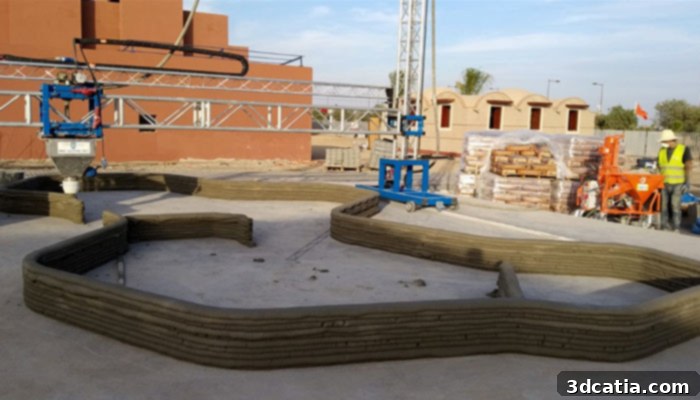
The intricate process of constructing a 3D printed house in Africa | Credits: IT3D
The Broader Impact: Sustainable and Affordable Housing for All
The advent of advanced 3D printing technologies has transformed the dream of developing sustainable and low-cost homes into a tangible reality. This paradigm shift in construction is not limited to Be More 3D’s pioneering efforts; it is a global movement demonstrating diverse approaches to affordable and eco-friendly housing. A prime example is the Italian company WASP, renowned for its innovative “Gaia house.” This remarkable project showcases the potential of utilizing locally sourced, natural materials such as straw and rice husks in 3D printed construction. By integrating such readily available and sustainable resources, WASP’s Gaia house exemplifies how additive manufacturing can significantly reduce environmental impact while simultaneously providing affordable housing solutions. These pioneering projects collectively highlight a critical shift towards construction methods that are both ecologically responsible and economically accessible, addressing the urgent need for housing in a rapidly growing global population.
Be More 3D’s BEM PRO 2, now commercially available through official distributors, further accelerates this vision. While the Valencian company has maintained a degree of discretion regarding the specifics of its immediate future projects, its commitment to expanding the reach of 3D printed construction is evident. The availability of the BEM PRO 2 signifies that this powerful tool for rapid and sustainable building is now accessible to a wider market, empowering other organizations and governments to embark on similar initiatives. Be More 3D has also indicated concrete plans to build more houses on Spanish territory very soon, demonstrating a balanced strategy of both international expansion and strengthening its domestic presence. This dual focus ensures that their innovative solutions contribute to addressing housing needs both at home and abroad. The continuous evolution of such technologies promises a future where robust, energy-efficient, and affordable homes are not a luxury, but a standard, accessible to communities across the globe, fostered by the ongoing advancements in 3D printing in construction.
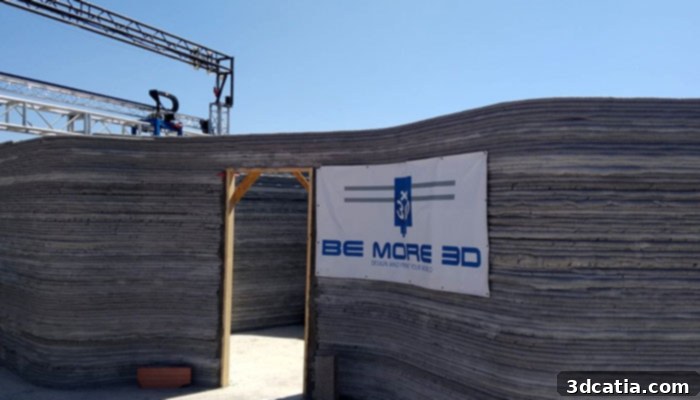
Innovative 3D printing technology at work | Credits: IT3D
The work being done by companies like Be More 3D marks a pivotal moment in the history of construction, offering tangible solutions to some of the world’s most pressing challenges, from housing shortages to the demand for more sustainable building practices. This advancement promises not just new buildings, but entirely new possibilities for community development and humanitarian aid.
What are your thoughts on Be More 3D’s groundbreaking initiative in Morocco and the broader potential of 3D printing in construction? We invite you to share your insights and comments below, or engage with us on our Facebook and Twitter pages. Don’t miss out on the latest advancements and news in additive manufacturing – subscribe to our free weekly Newsletter for all the updates delivered directly to your inbox!