
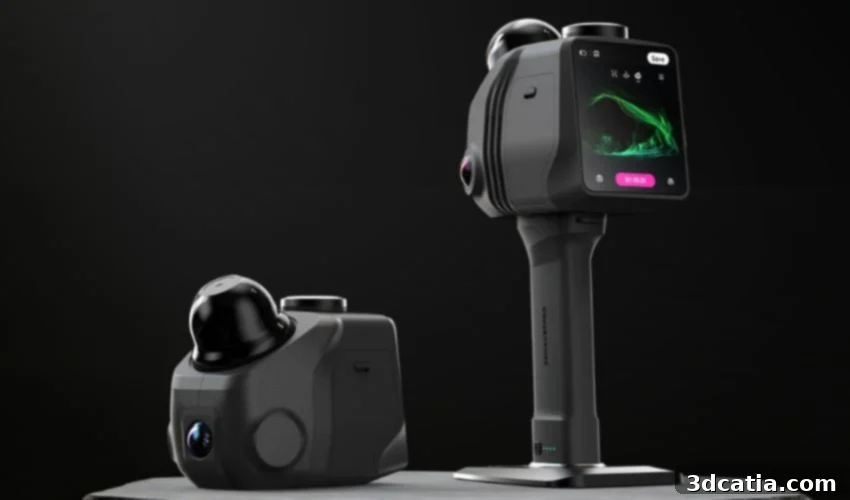
3DMakerpro Raven Series: Revolutionizing 3D Scanning with Affordable LiDAR Technology
The world of 3D capture is undergoing a significant transformation. For years, creators and professionals have faced a challenging dilemma: choose between the convenience of smartphone apps with limited capabilities or invest in expensive, industrial-grade equipment. While smartphone LiDAR applications have democratized spatial scanning, their accuracy and point density often fall short for serious professional applications. Conversely, high-end terrestrial scanners, capable of mapping entire environments, typically come with a hefty price tag, often exceeding $20,000. This leaves a substantial gap for individuals and organizations seeking “survey-grade” performance without breaking the bank.
Addressing this need, 3DMakerpro proudly introduces the Raven series, a groundbreaking line of LiDAR-based spatial 3D scanners designed to bring professional-grade scanning capabilities to a wider audience. The Raven series comprises two distinct models: the Raven and the Raven Max. Both scanners are equipped with a built-in battery, an advanced LiDAR sensor, and sophisticated imaging systems, enabling users to capture accurate and detailed 3D point cloud data quickly and efficiently.
The Raven series delivers professional LiDAR technology with impressive specifications, boasting an accuracy of up to 20mm and a capture rate of 150,000 points per second. What sets these scanners apart is their affordability. The Raven is priced at $1,699, while the Raven Max is available for $2,699. Furthermore, early bird pricing offers even greater savings, with the Raven at $999 and the Raven Max at $1,499 until the end of April. This makes the Raven series an incredibly accessible option for creators, designers, and professionals seeking high-quality 3D scanning solutions.
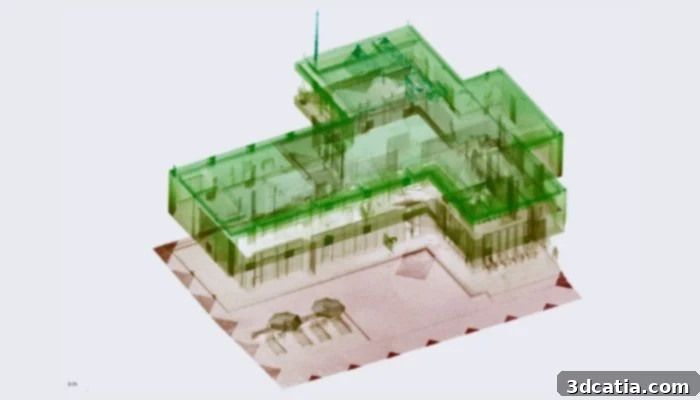
Scanning results from Raven
Key Benefits and Features of the Raven Series
Both the Raven and Raven Max share several core features that contribute to their exceptional performance. They are powered by an 8-core 2.4GHz processor and feature 32GB of internal storage, providing ample processing power and space for storing scan data. The primary difference between the two models lies in their camera systems. The Raven scanner is equipped with a single 12MP camera, while the Raven Max boasts dual 12MP cameras. This dual-camera setup enables the Raven Max to capture data more quickly and comprehensively, making it ideal for larger and more complex scanning projects.
With a scanning range of up to 100 meters and a 360° horizontal field of view, the Raven series is specifically designed for “big picture” scanning. Users can position themselves at the center of a site and capture a vast radius of data points almost instantaneously. This dramatically reduces the time and effort required to gather measurements, especially in large-scale environments.
Recognizing the importance of handling large datasets generated by the LiDAR sensor, the Raven series includes a TF card expansion slot. This allows for completely untethered, mobile scanning, ensuring that users never encounter storage limitations while capturing expansive environments or intricate architectural sites. The ability to expand storage is crucial for maintaining workflow efficiency and capturing all necessary details without interruption.
Beyond its LiDAR capabilities, the Raven series can connect to external cameras, enabling the capture of photorealistic color information and the creation of stunning Gaussian splats for immersive VR/AR experiences. When combined with the dual 12MP Sony sensors (available on the Raven Max), the scanners can produce vibrant 4K color point clouds that bring digital assets to life. The scanners support multiple output formats, including 3D Color Point Clouds (PLY), 3D Gaussian Splatting (PLY), and 3D Colored Polygonal Model (OBJ), providing flexibility for various applications and workflows.
The Raven series prioritizes user comfort and portability. Weighing in at just 1.1kg and featuring a bright 3.9” AMOLED screen, these scanners allow users to process sprawling outdoor scenes or multi-room interiors without experiencing fatigue or compromise. Furthermore, the Raven series incorporates a modular 12,000mAh battery that is easily swappable, ensuring continuous workflow and minimizing downtime. This modular design is a key feature for professionals who require extended scanning sessions without interruption.
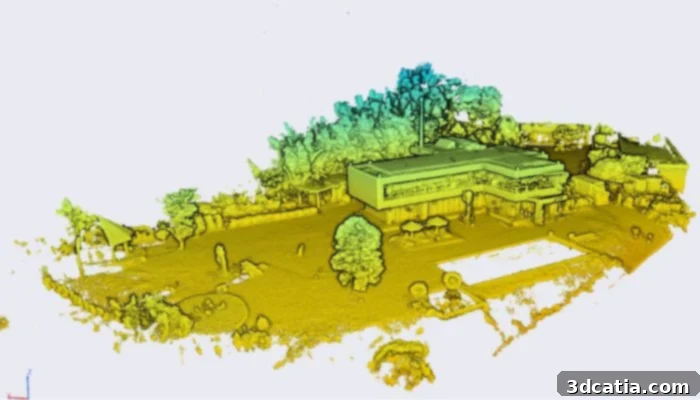
The Raven series is designed for scanning large areas
Optimizing the User Experience
The Raven series is designed with user-friendliness in mind, offering a straightforward and intuitive mobile scanning experience. To begin, users simply attach the battery handle or connect an external Type-C PD power supply. Once powered on, the device requires only a few minutes of setup on a stable surface before it is ready to capture data. This ease of setup ensures that users can quickly begin scanning without complicated procedures or extensive technical knowledge.
Prior to initiating a scan, users can optimize the scanner for their specific environment by toggling between “Indoor” and “Outdoor” modes and adjusting the exposure settings. This level of customization allows for fine-tuning the scanner’s performance to achieve the best possible results in varying lighting conditions and environments. The scanning process itself is designed to be simple and efficient, allowing users to focus on capturing the data they need.
To achieve optimal scanning results, consider these key factors:
- Movement: Maintain a steady pace of 3 km/h or slower for the best data capture. Consistent speed helps ensure accurate and uniform point cloud data.
- Positioning: Hold the scanner horizontally, ensuring that the LiDAR and camera lenses remain unobstructed and at least 1 meter away from any objects. Maintaining proper positioning is crucial for avoiding obstructions and capturing accurate depth information.
- Flexibility: Adjust the camera exposure in real-time as lighting conditions change while moving through a site. Real-time adjustments help maintain data quality and ensure consistent color information throughout the scan.
Software Compatibility and Post-Processing
Upon completing a scan, users have multiple options for transferring their data. They can directly export files to a Type-C USB drive or portable SSD, supporting both exFAT and NTFS formats. Alternatively, they can wirelessly connect to a WiFi hotspot and transfer data to a computer using 3DMakerpro’s RayStudio software. This flexibility ensures that users can choose the data transfer method that best suits their workflow and preferences.
For post-processing, the complimentary RayStudio software provides users with powerful tools to analyze the 3D data and perform essential tasks such as point cloud denoising and filtering. These post-processing capabilities are crucial for ensuring that the final output is a high-quality, clean point cloud that is ready for professional use. It’s important to note that the current version of RayStudio does not support macOS, but support for macOS may be added in future updates.
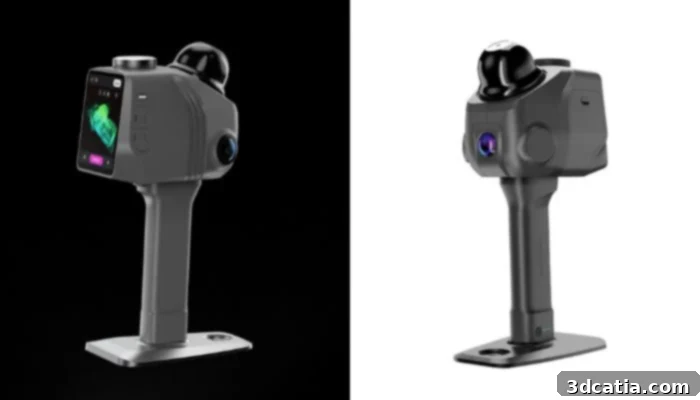
The Raven Max (left) and Raven (right)
Diverse Applications and Expanding Capabilities
The data captured by the Raven series is optimized for a wide range of professional workflows. While capable for 3D printing applications, the system’s primary strengths lie in areas such as architectural design, game animation, and high-precision surveying. The Raven series is also compatible with an extensive ecosystem of auxiliary add-ons, further expanding its utility and versatility.
These add-ons include:
- Surveying & Mapping: RTK Expansion kit for achieving centimeter-level positioning accuracy, essential for professional surveying and mapping applications.
- Mobile Capture: Bicycle, Automotive, Backpack, and Drone kits for enabling large-scale site mapping, providing flexibility for various data capture scenarios.
- Visual Integration: Insta360 X4/X5 Expansion kits for overlaying high-resolution imagery onto 3D data, enhancing the visual richness and realism of the scanned models.
By making survey-grade LiDAR technology accessible to individual creators and small firms, the 3DMakerpro Raven series effectively bridges the gap between consumer-level experiments and industrial-grade professional projects. Whether you are mapping a historic site for preservation purposes or designing a high-fidelity digital twin for the metaverse, the Raven series offers the range and speed needed to transform the physical world into a digital reality, all without the traditional five-figure price tag.
In conclusion, the 3DMakerpro Raven series represents a significant advancement in 3D scanning technology, offering professional-grade LiDAR capabilities at an affordable price point. Its user-friendly design, versatile features, and extensive compatibility make it an ideal solution for a wide range of applications. The Raven series empowers creators, designers, and professionals to capture the world around them with unprecedented accuracy and detail, unlocking new possibilities for innovation and creativity. You can explore the Raven series further HERE.