
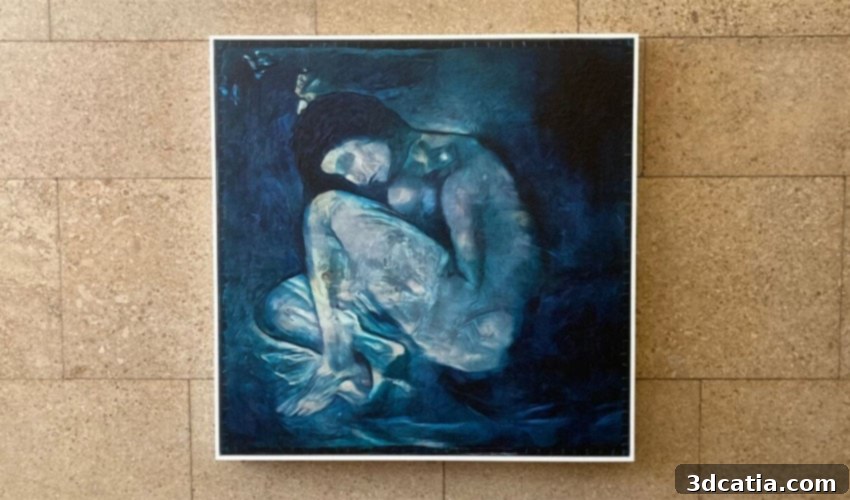
Unveiling Hidden Masterpieces: How 3D Printing and AI Reconstructed Picasso’s Lost Nude
The intersection of art and advanced technology is continually reshaping how we perceive, preserve, and interact with cultural heritage. Just a few weeks ago, the awe-inspiring 3D printed replication of Michelangelo’s Statue of David captivated audiences at the Dubai World Expo, showcasing the incredible potential of additive manufacturing in bringing iconic artworks to a broader public. However, the influence of 3D printing extends far beyond mere replicas. It is making profound news in the art world by actively participating in the discovery and reconstruction of long-lost masterpieces. A particularly compelling example involves the renowned Spanish artist Pablo Picasso, whose work, “The Lonesome Crouching Nude,” remained unseen for an astonishing 118 years before being brought back to life through groundbreaking technological innovation.
This remarkable reconstruction was undertaken by Oxia Palus, a pioneering company founded by University College London (UCL) PhD researchers Anthony Bourached and George Cann. Specializing in cutting-edge technologies like artificial intelligence (AI) and 3D printing, Oxia Palus has positioned itself at the forefront of digital art archaeology. Their latest achievement, the revelation of Picasso’s hidden painting, underscores the transformative power of these tools in uncovering and presenting art history in unprecedented ways. It signifies a new era where technology doesn’t just assist but actively participates in the artistic and historical narrative, bridging centuries with advanced digital and additive processes.
The Discovery and Reconstruction of a Hidden Picasso
The story of “The Lonesome Crouching Nude” is a testament to the dynamic and often resource-constrained life of artists, even those who would later become titans like Pablo Picasso. The painting remained hidden for over a century because Picasso, in a practice common among artists of his time – often due to the high cost of materials – literally painted over his initial work. In 1903, he created a second, more famous work, “The Blind Man’s Meal,” directly on top of “The Lonesome Crouching Nude.” This subsequent painting is well-known and cherished by art enthusiasts globally, yet beneath its surface lay another masterpiece, waiting patiently to be discovered.
Oxia Palus embarked on a meticulous process to unearth and reconstruct the hidden artwork. The journey began with advanced spectroscopic imaging, a non-invasive technique that uses different wavelengths of light to penetrate the layers of paint and reveal underlying imagery. This process allowed researchers to visualize the contours, forms, and compositions of the original painting that Picasso had covered. Once the hidden work became visible through these initial scans, the real ingenuity of modern technology came into play. Oxia Palus then leveraged sophisticated image processing algorithms to enhance these spectral images, clarifying the faint outlines and details of “The Lonesome Crouching Nude.”
With the digital outline established, artificial intelligence took over. The AI algorithms were trained on Picasso’s other works from his significant “Blue Period,” allowing them to understand his brushwork, color palette, and textural nuances from that specific era. The AI then meticulously textured and colorized the digitally reconstructed image, generating a rendition that faithfully mimicked Picasso’s style and mood. The final, crucial step involved transforming this digital reconstruction into a tangible artwork. Although the specific additive manufacturing process used by Oxia Palus for the final canvas was not fully revealed, 3D printing technology was employed to physically realize the painting, meticulously recreating the texture and depth on a canvas, thus bringing “The Lonesome Crouching Nude” back into the physical world after more than a century in obscurity.
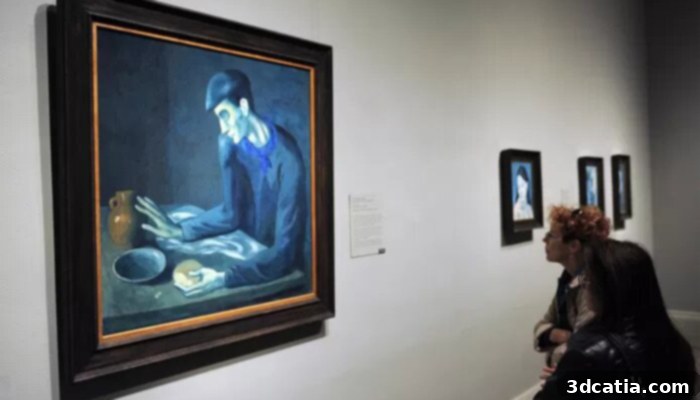
“The Blind Man’s Meal” by Picasso (photo credits: BELGAIMAGE)
The Significance in Picasso’s “Blue Period”
The rediscovery and reconstruction of “The Lonesome Crouching Nude” holds immense art historical significance, particularly in understanding Pablo Picasso’s formative “Blue Period” (1901-1904). This period is characterized by melancholic tones, dominated by shades of blue and blue-green, reflecting themes of poverty, despair, and the human condition. Picasso had moved to Paris and faced significant personal struggles and financial hardship, which deeply influenced his artistic output during these years. The subjects often included beggars, street workers, and lonely figures, depicted with elongated forms and a palpable sense of isolation.
“The Lonesome Crouching Nude” perfectly embodies the thematic and stylistic elements of this critical phase. A solitary figure, stripped of adornment and perhaps hope, speaks volumes about the emotional landscape Picasso was exploring. Uncovering this work provides art historians with a deeper insight into his creative process and the evolution of his early style. It offers a window into the raw emotion and nascent genius that would eventually lead to Cubism and other revolutionary movements. The fact that he chose to paint over it also tells a story – perhaps a moment of creative abandonment, a need for a new canvas, or an evolving artistic vision that momentarily overshadowed this deeply poignant piece. Its return enriches our understanding of one of art history’s most influential periods and artists.
Authenticity vs. Advanced Replication: Expert Perspectives
While the technological achievement of reconstructing “The Lonesome Crouching Nude” is undeniably remarkable, it naturally sparks a nuanced discussion about authenticity and replication in the art world. Pablo Picasso experts acknowledge the impressive quality of the 3D printed rendition, yet they point out subtle differences that distinguish it from an actual, centuries-old original. British art expert Ty Murphy articulately captured this sentiment, explaining, “The AI-produced painting looks like a Picasso Blue Period, but under close scrutiny an expert would probably be able to recognize that it wasn’t an original.” This distinction is crucial; an expert might discern variations in the actual pigment composition, the aging of the canvas, the precise physical texture that comes from an artist’s hand, or the microscopic cracks that develop over time—elements that current technologies can simulate but not truly replicate in their original form.
However, Murphy’s follow-up comment offers a powerful glimpse into the future: “Give it time. As soon as those technologies emerge they’re going to be very convincing.” This suggests that the line between a faithful reproduction and an “original” might become increasingly blurred. The advancements in AI, capable of learning and mimicking an artist’s style with astonishing accuracy, coupled with the ever-improving precision of 3D printing in rendering texture and color, indicate a future where these digital reconstructions could be incredibly difficult to differentiate from their unearthed counterparts. This evolving capability challenges traditional notions of art ownership and authenticity, opening doors for debates on the value of digital creations, the role of human artistic touch, and how museums and collectors will classify and value such technologically resurrected artworks. It’s a compelling frontier for both art history and technological innovation.
Broadening Horizons: 3D Technologies in Art Conservation and Replication
The reconstruction of “The Lonesome Crouching Nude” is not an isolated incident but rather a prominent example within a growing trend of 3D technologies being utilized across the art world. These innovative methods are revolutionizing art conservation, research, and public accessibility. For instance, in 2016, 3D technologies played a pivotal role in creating a haptic replica of Gustav Klimt’s celebrated painting, “The Kiss,” displayed at the Belvedere Museum in Vienna. This project allowed visually impaired individuals to experience the texture, brushstrokes, and raised elements of the artwork for the first time, fostering a new level of inclusivity in art appreciation. Such applications highlight how 3D printing can democratize access to art, transcending traditional visual barriers.
Oxia Palus itself is a significant player in this burgeoning field, with “The Lonesome Crouching Nude” being their third major artistic reconstruction to be publicly revealed. Previously, the dedicated researchers successfully uncovered a woman’s portrait hidden beneath Amedeo Modigliani’s “Portrait of a Girl of 1917,” shedding new light on the artist’s creative process and potentially revealing a previously unknown work. Another groundbreaking project brought to light a mountainous landscape concealed beneath another Picasso masterpiece, “The Crouching Beggar.” Each of these projects adds invaluable context to art history, offering rare glimpses into the genesis and evolution of iconic works. The ability to peer beneath existing layers of paint without damaging the artwork is a game-changer for art historians and conservators.
Beyond uncovering hidden paintings, 3D printing finds diverse applications in heritage preservation. Museums worldwide are employing 3D scanning and printing to create precise replicas of fragile artifacts, allowing for detailed study without risking damage to the originals. These replicas also serve as educational tools, enabling tactile interaction in classrooms and museum exhibits, making history more engaging and accessible. Furthermore, 3D digital models are invaluable for documenting artworks, ensuring that detailed records exist for future generations, even in the face of natural disaster or degradation. The ongoing exhibition of “The Lonesome Crouching Nude” at Morf Gallery in London, as part of the Deeep AI festival, further cements the public and cultural recognition of these technological advancements in the art sphere. You can find more details about this specific project and its technological underpinnings by visiting the UCL news page HERE.
The Future Landscape of Art and Technology
The successful reconstruction of Picasso’s “The Lonesome Crouching Nude” stands as a powerful testament to the transformative potential of combining artificial intelligence and 3D printing in the art world. This fusion of technologies is not merely about restoring old artworks; it’s about pushing the boundaries of what’s possible in art history, conservation, and appreciation. It allows us to uncover lost narratives, bridge gaps in artistic understanding, and present cultural heritage in dynamic and accessible new ways. For museums, art historians, and conservators, these tools represent a new frontier, offering non-invasive methods to explore, analyze, and preserve invaluable artworks, while simultaneously providing unprecedented opportunities for public engagement and education.
As companies like Oxia Palus continue to innovate, the capabilities of AI and 3D printing will only grow more sophisticated. We can anticipate a future where more hidden masterpieces are revealed, where fragile artifacts are meticulously replicated for study and exhibition, and where art becomes more interactive and inclusive for diverse audiences. This technological revolution in art challenges us to rethink our definitions of authenticity and originality, encouraging a broader appreciation for both the historical essence and the innovative methods that bring it to life. The symbiotic relationship between art and technology is undoubtedly shaping a vibrant and accessible future for cultural heritage worldwide.
*Cover Photo Credits: Oxia Palus
What are your thoughts on using 3D printing and AI technologies to recover and reconstruct lost artworks like this Picasso painting? Share your opinions in a comment below or connect with us on our LinkedIn, Facebook, and Twitter pages! Don’t forget to sign up for our free weekly Newsletter here to receive the latest 3D printing news straight to your inbox! You can also find all our videos on our YouTube channel.