
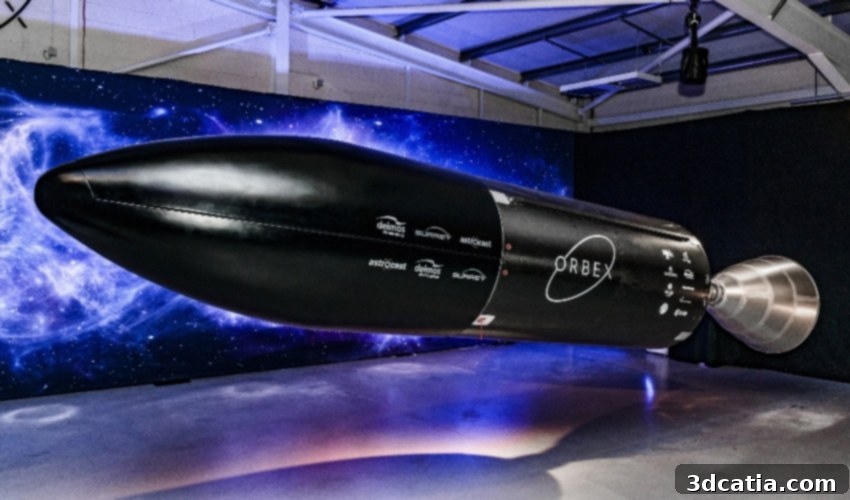
Orbex Revolutionizes Space Launch with Europe’s Largest Industrial 3D Printer for Sustainable Rockets
In a monumental leap forward for the European space sector, Orbex, a pioneering Scottish company dedicated to efficient and sustainable space launch solutions, has announced a significant strategic investment. The company has commissioned AMCM, a leading manufacturer of advanced additive manufacturing systems, to build an industrial 3D printer that will be the largest of its kind across Europe. This cutting-edge machine, weighing over twelve metric tons, represents a paradigm shift in rocket manufacturing, designed specifically for rapid in-house production of rocket components. This strategic move is poised to dramatically accelerate Orbex’s production capabilities, enabling the annual fabrication of thirty-five sophisticated rocket engines and main stage turbopump systems, propelling the company towards its ambitious goal of launching rockets from Scotland as early as next year.
This multi-million-pound deal with AMCM is a clear indicator of Orbex’s commitment to scaling its operations and cementing its position at the forefront of the commercial space industry. To accommodate this colossal new machinery and its expanded production scope, Orbex has simultaneously undertaken a substantial expansion of its factory, adding an additional thousand square meters to its manufacturing footprint. This dual investment underscores a proactive approach to mastering every aspect of the rocket production lifecycle, from design and fabrication to assembly and launch, all while prioritizing innovation and efficiency.
Driving Innovation and Agility Through In-House Additive Manufacturing
Chris Larmour, CEO of Orbex, articulated the profound impact of this new acquisition on the company’s operational philosophy. He stated, “Although our rocket engines and other critical systems are already quite mature after years of testing, a large-scale in-house 3D printing system like this gives us far greater speed and agility as we ramp up production.” This highlights a crucial advantage of additive manufacturing: the ability to rapidly iterate and refine designs. In the fast-paced aerospace industry, the capacity to quickly test, modify, and reproduce components can significantly reduce development cycles and accelerate time-to-market.
Larmour further elaborated on the long-term benefits, explaining, “It means we can continue to iterate and drive up performance even further. Longer term, as we get ready for multiple launches per year, it will give us greater control over our costs and supply chain.” This points to a strategic shift towards greater vertical integration. By bringing a significant portion of component manufacturing in-house, Orbex gains unparalleled control over quality, production schedules, and intellectual property. This reduces reliance on external suppliers, mitigates supply chain risks, and provides a significant competitive edge in terms of both cost efficiency and responsiveness to market demands. The rigorous evaluation process leading to the partnership was also emphasized, with Larmour confirming, “After exhaustive trials, the results we’ve seen from AMCM were very successful and we’re confident that we’ve made the right choice of partner.” This assurance speaks volumes about the reliability and advanced capabilities of AMCM’s technology.
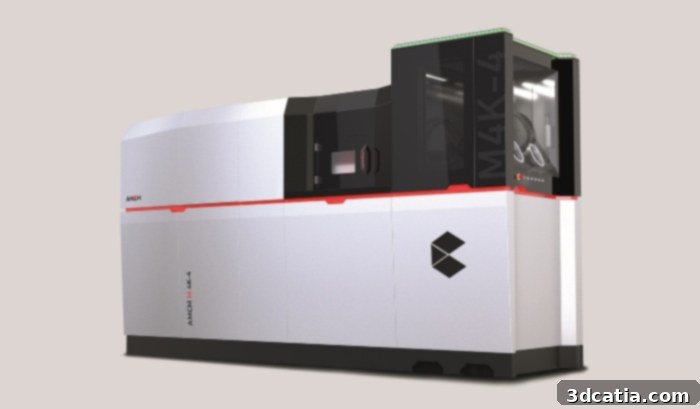
Rendering of a smaller scale industrial 3D printer, similar to the one being built for Orbex. (Photo Credit: AMCM)
AMCM’s Advanced 3D Printing Solution: Engineering Excellence for Spaceflight
AMCM is not merely delivering a large 3D printer; they are providing a comprehensive additive manufacturing solution tailored for the demanding requirements of aerospace. This includes state-of-the-art post-processing machinery, which is critical for refining the surface finish and ensuring the structural integrity of complex printed parts. For rocket components subjected to immense stresses, precise post-processing is paramount to achieving the necessary performance and reliability.
Furthermore, the system incorporates advanced ‘Machine Vision’ technology. These intelligent systems leverage automatic imaging-based inspection to meticulously examine printed parts for any defects or inconsistencies. This real-time, high-precision quality control mechanism is indispensable in aerospace, where even minute imperfections can have catastrophic consequences. By automating this inspection process, Orbex can ensure higher part quality, reduce human error, and accelerate the certification process for critical components.
One of the most transformative capabilities of this new 3D printing system is the ability to print entire parts, such as complete rocket engines, in a single piece. This eliminates the inherent weaknesses traditionally associated with joining and welding multiple sub-components. Welds, while often robust, introduce potential points of failure and can add significant weight and complexity to the manufacturing process. By producing monolithic structures, Orbex can achieve superior structural integrity, enhance part reliability, and simplify assembly, all while potentially reducing overall component mass – a critical factor in space launch economics.
Optimized Materials for Extreme Conditions
The advanced 3D printing system, coupled with Orbex’s custom blend of metals, will result in rocket parts with significantly improved performance characteristics. These specialized materials are engineered to offer an optimal balance of lightness and extreme resistance to the formidable temperatures and pressures encountered during spaceflight. Rocket engines, in particular, operate under incredibly harsh conditions, experiencing temperatures that can melt conventional metals and pressures that could crush ordinary structures. The ability to tailor material properties through custom blends and sophisticated additive manufacturing processes allows Orbex to create components that are not only lighter, thus improving payload capacity and fuel efficiency, but also exceptionally resilient, ensuring mission success.
The Orbex Prime: A Sustainable Microlauncher for Small Satellites
These highly advanced 3D printed rocket parts are destined to become essential components of the Orbex Prime, a nineteen-meter long microlauncher rocket. The Prime is specifically designed to place small satellites into polar orbits around Earth. This focus on the small satellite market is strategic, catering to the rapidly growing demand for dedicated launch services for CubeSats and other micro-satellites used for everything from Earth observation and telecommunications to scientific research. Microlaunchers offer distinct advantages, providing more flexible launch schedules and tailored orbital insertions compared to sharing rides on larger, less frequent heavy-lift rockets.
Orbex has not only set its sights on becoming a leader in launch capability but also on establishing new benchmarks for sustainability in the space industry. Having already made headlines in 2019 by unveiling the largest 3D printed rocket engine in the world, the company is now poised to boast Europe’s largest industrial 3D printer and, crucially, to champion high standards of environmental responsibility.
Pioneering Environmental Stewardship in Space
Orbex’s commitment to sustainability is multi-faceted, addressing some of the most pressing environmental concerns associated with spaceflight. Firstly, the Prime rocket features Orbex’s novel reusability and recovery system, making it a reusable launch vehicle. Reusability is a cornerstone of sustainable space operations, significantly reducing the cost per launch and minimizing the environmental footprint by allowing components to be recovered, refurbished, and flown again instead of being expended after a single use. This aligns with global efforts to make space access more affordable and environmentally conscious.
Secondly, the rocket has been meticulously designed to prevent the creation of orbital debris. Space debris poses a growing threat to active satellites and future space missions, and Orbex’s proactive design approach helps to mitigate this critical issue. By ensuring that no components are left behind in orbit, Orbex contributes to the long-term sustainability and safety of Earth’s orbital environment, a principle that is gaining increasing importance within the international space community.
Perhaps one of the most significant environmental innovations of the Prime rocket is its compatibility with bio-propane. This clean-burning, renewable fuel dramatically reduces CO2 emissions by an impressive 90% compared to traditional kerosene-based rocket fuels. The adoption of bio-propane showcases Orbex’s dedication to pushing the boundaries of green propulsion technology, offering a viable and impactful solution for reducing the carbon footprint of space launches. This commitment positions Orbex as a leader in environmentally responsible space exploration, aligning its business model with global climate action goals. Further details on Orbex’s groundbreaking projects and their vision can be explored directly on their website HERE.
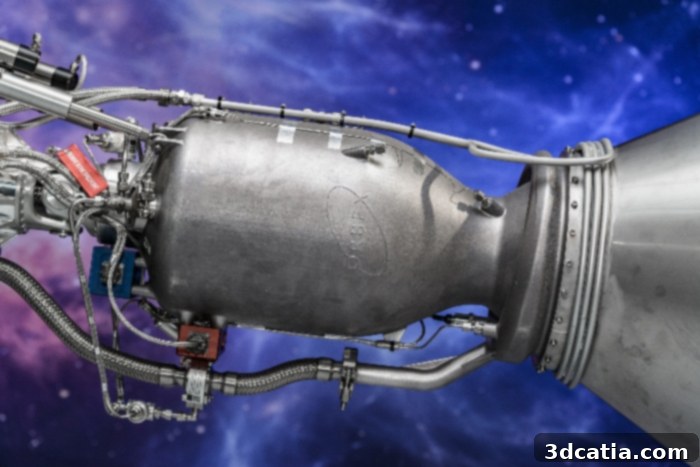
3D printed rocket engine in Stage 2 rocket engineering prototype. (Photo Credit: Orbex)
The Broader Impact of Additive Manufacturing in the Aerospace Sector
The investment by Orbex in such a significant additive manufacturing capability underscores a growing trend across the global aerospace sector. Additive manufacturing, or 3D printing, offers unparalleled advantages for producing complex, high-performance components. Its ability to create intricate geometries that are impossible or cost-prohibitive with traditional manufacturing methods allows engineers to design parts with optimized weight, improved thermal management, and consolidated functionality. This leads to lighter aircraft and spacecraft, which in turn reduces fuel consumption and increases payload capacity – vital considerations in both commercial aviation and space exploration.
Beyond design freedom, 3D printing accelerates prototyping and development cycles. What once took months through traditional casting or machining can now be realized in days or weeks, allowing for rapid iteration and testing. This agility is invaluable in a field where technological advancements are continuous and the race to innovate is fierce. Furthermore, on-demand manufacturing capabilities reduce the need for extensive warehousing of spare parts, streamlining supply chains and potentially cutting down on waste. For critical components like rocket engines, the precision and repeatability offered by advanced industrial 3D printers, especially those with integrated quality control systems like AMCM’s Machine Vision, provide a level of reliability previously unattainable.
If you are interested in exploring these transformative applications and the expanding role of additive manufacturing in the aerospace sector, you won’t want to miss our next virtual event, ADDITIV Aerospace! This event gathers experts and innovators to discuss the latest trends, challenges, and breakthroughs in applying AM technologies to aviation and space. You can register for free and secure your spot to gain invaluable insights HERE.
What are your thoughts on Orbex’s monumental commission of the largest industrial 3D printer in Europe and its potential to redefine sustainable space launch? We encourage you to share your perspectives in a comment below or join the conversation on our Facebook, Twitter, and LinkedIn pages! Stay informed about the very latest in 3D printing news, delivered straight to your inbox, by signing up for our free weekly Newsletter here.
*Cover photo courtesy of Orbex.