
Revolutionizing Ocean Conservation: 3D Printed Roman Concrete Reefs for Sustainable Marine Biodiversity
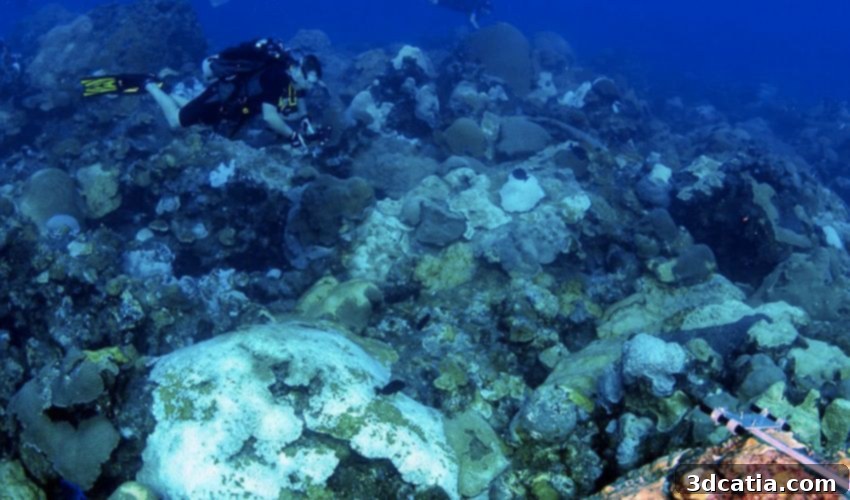
The world’s coral reefs stand as truly exceptional ecosystems, teeming with life and boasting unparalleled biodiversity. These vibrant, living structures are often referred to as the rainforests of the sea, supporting an estimated 25% of all marine species, despite covering less than 0.1% of the ocean floor. However, these critical underwater cities are facing an unprecedented crisis. Escalating threats such as marine pollution, rising ocean temperatures due to climate change, ocean acidification, and destructive fishing practices are pushing coral reefs to the brink. Projections indicate a dire future, with a staggering 90% of Earth’s coral reefs potentially vanishing by 2050 if current trends continue. The urgency of this ecological catastrophe has spurred global innovation, leading to fascinating new approaches in marine conservation. Among these, the development of 3D printed coral reefs has emerged as a promising solution, offering a new frontier in the quest to protect and revitalize our oceans’ fragile ecosystems. Over the past several years, groundbreaking technologies have enabled a range of solutions, from growing natural coral on bespoke 3D printed structures to innovative methods for fish preservation. These efforts leverage a variety of advanced materials and sophisticated 3D printing techniques to create resilient and habitat-rich artificial reefs, aiming to keep reef biodiversity safe and intact. Now, a pioneering multidisciplinary team from the University of Texas at Arlington (UTA) is embarking on its own significant coral preservation initiative in the critical waters of the Gulf of Mexico, employing a remarkably familiar concept rooted deeply in ancient engineering principles.
The history of artificial reef creation is extensive, yet it has often been plagued by challenges related to the chosen materials. Early attempts to establish safe havens for ocean wildlife involved repurposing a diverse array of objects, many of which proved to be environmentally problematic in the long run. Decommissioned ships, for instance, while large and offering immediate structural complexity, often leached toxic chemicals, fuels, and heavy metals into the marine environment as they corroded. Similarly, scrap metal, rubber tires, and even concrete blocks, despite initial intentions, frequently failed to provide truly sustainable or non-polluting habitats. The relentless forces of ocean currents, combined with the corrosive effects of saltwater and the passage of time, inevitably led to the degradation of these materials. They would break apart, releasing debris and microplastics, or slowly leach harmful substances, thereby further contaminating the very environment they were meant to protect. This fundamental flaw in material selection necessitated a radical shift in approach. Recognizing these critical shortcomings, the innovative UTA Team, under the expert leadership of Warda Ashraf, an associate professor in the Department of Civil Engineering, is proposing a revolutionary solution. Their plan involves utilizing a specialized 3D printing material – one remarkably similar to the ultra-durable concrete used by ancient Romans – to repair, restore, and ultimately rebuild endangered coral reefs, offering a long-term, eco-friendly alternative to past methods.
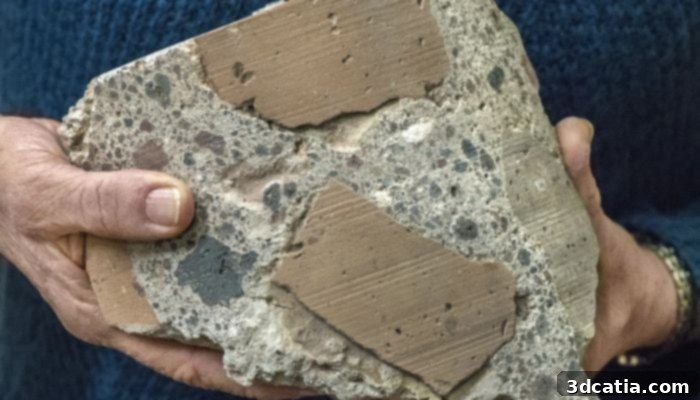
Roman concrete (Photo credits: Roy Kaltschmidt, Berkeley Lab)
Roman concrete, known to the ancients as *opus caementicium*, shares a superficial resemblance to modern construction materials but distinguishes itself through several key characteristics that grant it unparalleled strength and durability, particularly in marine environments. Unlike its contemporary counterpart, which primarily uses Portland cement, Roman concrete was formulated with a unique blend of ingredients. It incorporated a variation of different rocks and large pieces of stone or rubble as aggregates, but its defining feature was the use of volcanic dust or ash, specifically *pozzolana*, as a highly reactive binding agent. When mixed with lime and seawater, these volcanic components would undergo a complex chemical reaction, forming a mineral called calcium-aluminum-silicate-hydrate (C-A-S-H). This reaction, far from degrading the material, actually caused it to become increasingly resistant to cracks and breaks over time. Remarkably, this concrete mixture continues to harden and strengthen for years, even decades, after its initial construction, exhibiting a self-healing capability that modern concrete lacks. This extraordinary property has earned it the moniker “the most durable building material in human history.” Its enduring legacy is powerfully evidenced by ancient structures such as the majestic Pantheon in Rome, whose massive dome, made of Roman concrete, still stands proudly after nearly two thousand years, a testament to its incredible resilience. Furthermore, the Romans extensively utilized this material for their harbor structures and underwater foundations, demonstrating its inherent compatibility with and superior performance in saltwater environments – a quality that makes it exceptionally appealing for modern marine conservation efforts.
It is precisely these exceptional underwater characteristics of Roman concrete that deeply fascinate Professor Ashraf and her dedicated team at UTA. The material’s proven saltwater resistance and remarkable longevity offer a compelling, long-lasting solution for coral reef restoration, significantly reducing the risks of environmental pollution often associated with modern concrete or other artificial reef solutions. The inherent stability and durability of this ancient formula mean that the artificial reef structures will not easily degrade or break apart, ensuring a stable foundation for new marine life to flourish. To rigorously test their hypothesis, the UTA team has already successfully 3D printed several small, intricate pieces using their modified Roman concrete formula. These prototypes were then deployed for comprehensive underwater testing in Baffin Bay, a small, biologically rich inlet located off the vast Gulf of Mexico, south of Corpus Christi, Texas. The preliminary results from these critical trials have been overwhelmingly positive and highly encouraging. According to Professor Ashraf, the tests have been a resounding success: “Barnacles that have attached themselves to the new reef really grab hold of it. The materials also got 40% to 50% stronger in seawater within five months.” This observed increase in strength within a relatively short period underwater is a crucial indicator of the material’s suitability and validates its ancient reputation for marine resilience. This unparalleled performance highlights the potential of 3D printed Roman concrete to provide robust, long-term, and biologically integrated foundations for future coral reef ecosystems.
Beyond its remarkable durability and environmental inertness, this innovative Roman concrete carries an exciting added bonus: a direct contribution to climate change mitigation. Natural coral reefs play a vital role in our global environment by capturing carbon dioxide from the water to build their calcium carbonate skeletons. Professor Ashraf and her team aim to replicate and even enhance this natural process. Their ambitious plan involves strategically modifying the Roman concrete recipe to actively store carbon, thereby offering a novel and groundbreaking pathway to permanently sequester thousands of tons of atmospheric carbon directly under the ocean. This dual-purpose approach not only facilitates critical coastal resilience by providing natural barriers against erosion and storm surges but also significantly supports and enhances marine habitat creation, leading to a flourishing ecosystem. The ability to integrate carbon capture directly into reef restoration efforts positions this project at the forefront of sustainable environmental engineering. With a highly skilled multidisciplinary team of professionals and bolstered by a substantial $2 million grant from the National Science Foundation, the UTA team is exceptionally well-resourced and poised to make a profound and lasting impact on the preservation of marine biodiversity, not just in the Gulf of Mexico, but potentially as a scalable model for similar efforts around the world. Their work represents a powerful synergy of ancient wisdom, cutting-edge 3D printing technology, and modern ecological imperatives. Learn more about the project and its ongoing progress HERE.

The team is led by Warda Ashraf, associate professor at the Department of Civil Engineering (Photo credits: University of Texas at Arlington)
The innovative application of Roman concrete in 3D printed artificial reefs by the University of Texas at Arlington marks a significant step forward in marine conservation. This pioneering project offers a beacon of hope for threatened coral ecosystems worldwide, combining historical engineering brilliance with contemporary additive manufacturing techniques to create resilient, eco-friendly, and carbon-sequestering underwater habitats. As research continues and these methodologies are refined, the potential for scaling these efforts globally becomes increasingly apparent, promising a more sustainable future for our oceans and their invaluable biodiversity. We eagerly await further developments from Professor Ashraf’s team and the broader implications for oceanic health.
What are your thoughts on the revolutionary potential of these 3D printed Roman concrete reefs? Do you believe this ancient material holds the key to safeguarding our marine biodiversity? Share your insights and join the conversation in a comment below or connect with us on our LinkedIn, Facebook, and Twitter pages! Don’t miss out on the latest advancements in 3D printing and environmental innovation – sign up for our free weekly Newsletter here, delivered straight to your inbox! You can also find all our compelling videos and interviews on our YouTube channel, exploring the cutting edge of additive manufacturing.
Cover photo credits: NOAA