
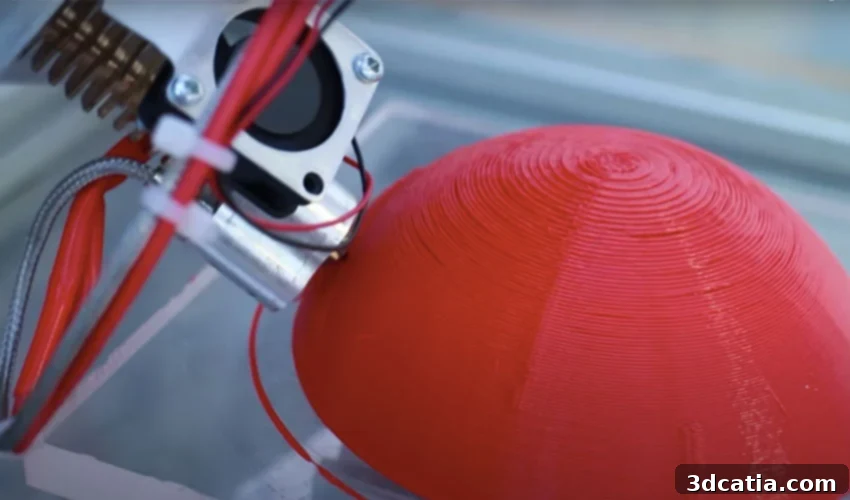
Revolutionizing 3D Printing: Penn State’s Five-Axis Additive Manufacturing Software Enables Support-Free Production
Additive manufacturing, commonly known as 3D printing, has rapidly transformed various industries, offering unprecedented design freedom and the ability to produce complex geometries. However, conventional 3D printing methods often face significant limitations, particularly the necessity of support structures. These temporary scaffolding elements are crucial for preventing parts from collapsing during the build process but contribute to material waste, increased production time, and additional post-processing costs. Addressing these challenges, Xinyi Xiao, a distinguished PhD graduate in industrial engineering from Penn State University, has spearheaded groundbreaking research. Her study, recently published in the prestigious Journal of Additive Manufacturing, introduces an innovative solution: automated process planning software for five-axis additive manufacturing that facilitates the creation of parts entirely without printing support structures.
This pioneering project involved the intricate design and development of sophisticated software capable of optimizing the additive manufacturing workflow on five-axis systems. The overarching goal of Xiao’s research is to deliver a viable and robust solution that significantly reduces the overall costs, time, and resource consumption typically associated with the additive manufacturing production process. By eliminating the need for supports, this technology promises to unlock new efficiencies and expand the capabilities of 3D printing across diverse applications.
For decades, additive manufacturing systems have undergone tremendous advancements, evolving from nascent prototypes to industrial-grade machines capable of producing highly complex components. Despite this rapid hardware development, the supporting software infrastructure often struggles to keep pace, quickly becoming outdated or insufficient for the latest innovations. Traditionally, most 3D printing operates on a three-axis principle, where material is deposited layer-by-layer along the X, Y, and Z planes. This “three-axis additive manufacturing” or planar deposition technique inherently necessitates the construction of support structures to maintain the integrity of overhangs and complex features as the desired model is built.
In stark contrast, five-axis 3D printers represent a significant leap forward in kinematic capability. Unlike their three-axis counterparts, these advanced machines can not only move linearly along the X, Y, and Z axes but also rotate around two additional axes, typically designated as A and B. This enhanced rotational freedom grants five-axis printers the immense potential to build structures from multiple orientations, fundamentally altering the traditional layer-by-layer approach and, crucially, making it possible to produce parts without the need for support structures. The ability to reorient the build platform or the print head during the manufacturing process allows for continuous, optimal deposition angles, thereby circumventing the conditions that would typically require supports.
Despite the inherent time and money savings offered by this advanced technology – primarily due to reduced material waste, faster print times (no support generation), and minimized post-processing – five-axis additive manufacturing has historically suffered from a significant drawback: the lack of comprehensive design planning and automation software comparable to what exists for three-axis machines. The complexity of orchestrating multi-axis movements and dynamic reorientations in real-time presents a considerable challenge. Therefore, creating intelligent, automated planning software for this method is not just beneficial but absolutely vital to fully leverage its capabilities and ensure its widespread adoption and integration within industrial applications.
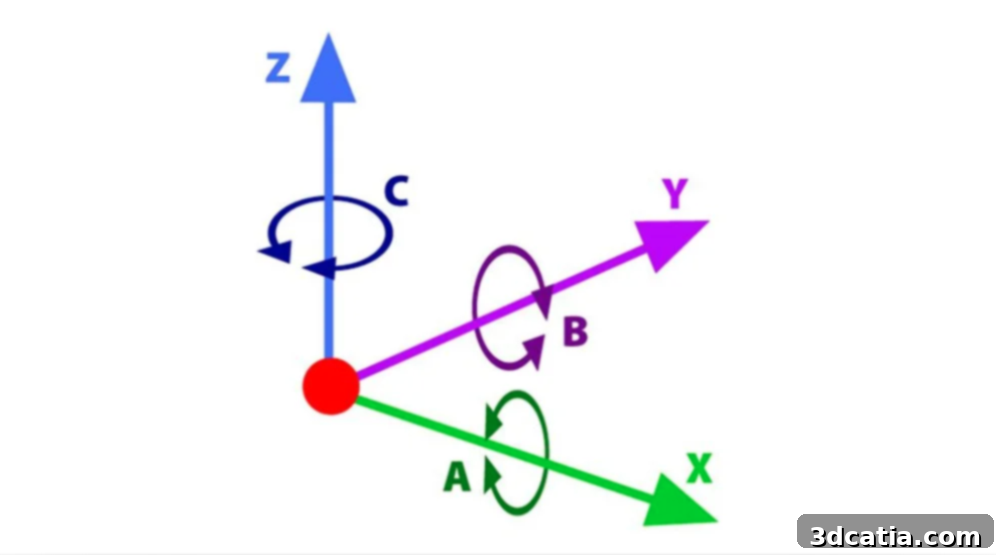
While this example illustrates a 6-axis system, a 5-axis 3D printer shares similar principles, offering linear movement along X, Y, and Z planes, combined with rotational capabilities around the A and B axes. This enhanced dexterity is key to support-free manufacturing.
The Genesis of Support-Free Printing: How the Algorithms Were Developed
The development of this transformative software was a significant undertaking, led by Xinyi Xiao as an integral part of her doctoral curriculum at Penn State. She conducted her research under the expert supervision of Professor Sanjay Joshi, a distinguished specialist in industrial engineering. Professor Joshi provided critical guidance and mentorship throughout the project, acknowledging Xiao’s exceptional leadership and innovative thinking. Reflecting on the collaborative process, Professor Joshi commented, “The core idea behind this software is to make five-axis additive manufacturing a fully automated process, eliminating any need for manual intervention or a complete redesign of the product itself. Xinyi approached me when she required guidance or had specific questions, but ultimately, she took the helm and skillfully led this entire project to its successful conclusion.” The study unequivocally demonstrates the efficacy of the developed software, highlighting its algorithm’s ability to automatically reorient the part during the additive manufacturing build using a five-axis machine, a crucial step towards achieving support-free production.
These dynamic reorientations are central to the software’s functionality, allowing the part to be built using a modified planar deposition approach but, critically, without the reliance on support structures. To achieve this, a sophisticated methodology was devised where the target part is first computationally decomposed into a series of smaller, manageable “sub-volumes.” Each of these sub-volumes is then analyzed to determine its optimal build direction and orientation, ensuring that it can be fabricated with stable, planar layers without needing external supports. This paper meticulously details the innovative algorithms developed to execute this decomposition, intelligently identify the most suitable orientations for each sub-volume, and establish the precise sequence in which these sub-volumes should be manufactured. Together, these algorithms form the major, integrated components of the comprehensive process plan, providing a complete blueprint for five-axis, support-free additive manufacturing.
Beyond the primary objective of support elimination, this advanced algorithm offers a significant added benefit: it empowers designers to proactively evaluate the manufacturability and feasibility of complex parts. By simulating the support-free build process, the software provides invaluable insights early in the design phase, offering unparalleled opportunities to identify and correct potential issues or reshape structures before they even reach the physical 3D printer. This includes detailed information regarding the “support-free manufacturability” of a given part, allowing for design optimization that aligns perfectly with the capabilities of five-axis systems. Such pre-emptive evaluation capabilities dramatically reduce design iterations, mitigate risks, and curb costs associated with prototyping and production when utilizing advanced three-dimensional technologies. Xiao elaborated on the profound impact of her work, stating, “Traditional additive manufacturing, especially for large metal components, can take days and result in substantial material waste due to the extensive use of support structures. While additive manufacturing is incredibly powerful and versatile because of its inherent flexibility, it also carries its own set of disadvantages. Our research is a significant step forward, yet there is still more work to be done to fully realize its potential.” Her statement underscores both the achievement and the ongoing journey towards perfecting additive manufacturing processes.
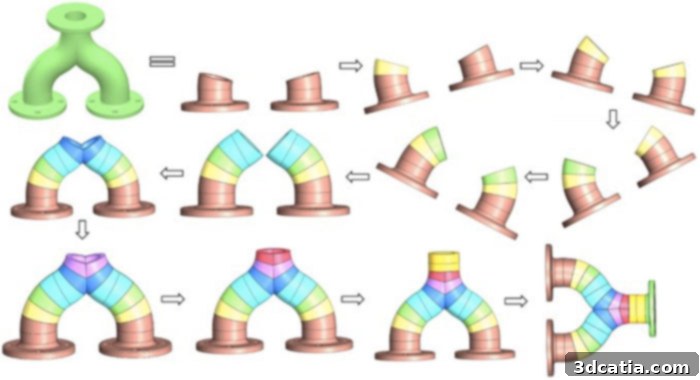
A visual representation of the support-free 3D printing process, a testament to Xinyi Xiao’s innovative research from Penn State.
The successful development and validation of these algorithms mark a pivotal moment for the additive manufacturing industry. The immediate goal now is to continue advancing this research, refining the algorithms, and expanding their applicability to a broader range of materials and geometries. This ongoing effort aims to facilitate the seamless integration of advanced five-axis technology into various demanding industrial sectors, including aerospace, automotive, and medical device manufacturing. Industries that prioritize precision, efficiency, and cost-effectiveness stand to benefit immensely from these developments, paving the way for lighter, stronger, and more sustainably produced components. Further comprehensive information regarding this groundbreaking study can be accessed in the journal where it was originally published, available HERE. This research not only pushes the boundaries of what’s possible in 3D printing but also sets a new standard for intelligent automation in advanced manufacturing processes.
We are eager to hear your thoughts on this transformative study! Please share your insights and comments below, or engage with us on our social media platforms, including Facebook and Twitter pages. For the latest updates and breaking news in the world of 3D printing, remember to sign up for our free weekly Newsletter here, delivered straight to your inbox!
*Cover Photo Credits: 5AXISMAKER