
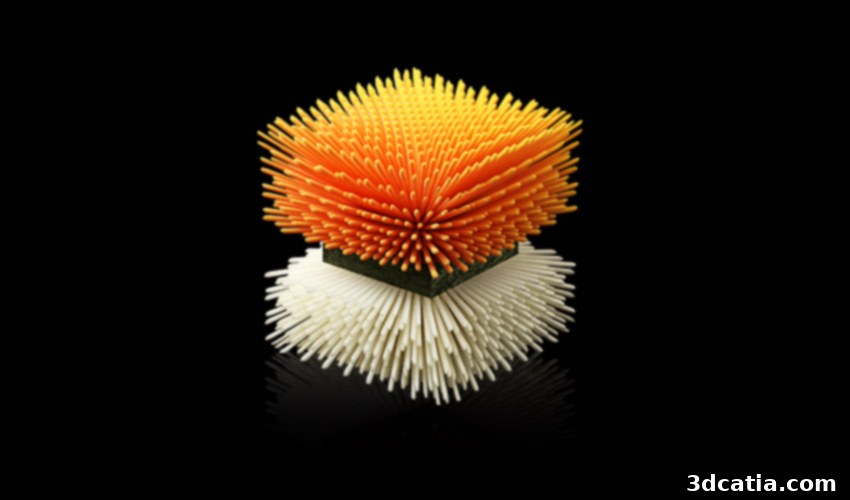
Revolutionizing Gastronomy: The Future of 3D Printed Sushi and Personalized Food with Open Meals
The landscape of culinary innovation is undergoing a profound transformation, propelled by technological advancements that are continually pushing the boundaries of what is conceivable in food preparation and consumption. Just a few weeks ago, at the highly anticipated South by Southwest (SXSW) fair, the visionary Asian company Open Meals captured global attention by unveiling its ambitious project: ‘Sushi Singularity.’ This initiative represents a monumental leap forward in the realm of 3D printed food, specifically targeting the intricate and revered art of sushi. While we’ve previously explored fascinating applications of additive manufacturing within the food sector, such as the precision of 3D printed chocolate or ingenious methods of transforming food waste into innovative 3D snacks, the introduction of 3D printed sushi elevates the conversation, hinting at unprecedented levels of complexity, customization, and culinary artistry. This groundbreaking endeavor is poised to undoubtedly revolutionize the entire 3D printed food industry, establishing new benchmarks for precision, personalization, and the very concept of gastronomic creation.
To gain a deeper understanding of this audacious undertaking and the future it promises, we had the distinct privilege of engaging in an exclusive interview with Hironao Kato, the esteemed Chief Technology Officer (CTO) of Open Meals. During our conversation, Mr. Kato eloquently illuminated the genesis of the ‘Sushi Singularity’ project, revealing the core inspirations that ignited its inception. He also candidly discussed the multifaceted technical challenges his team has confronted and meticulously overcome in their relentless pursuit of perfecting the science and art of 3D printing sushi. His insights offer a rare and captivating glimpse into a future where technology and gastronomy converge, crafting dining experiences that are not only novel and aesthetically remarkable but also deeply personal and tailored to the individual.
3DN: How did the idea of creating Open Meals come about, and what is its relation with 3D printing?

The very first inspiration that ultimately blossomed into the Open Meals project stemmed from a surprisingly analogous concept: the CMYK printing model. Our founder, a visionary art director with a profound appreciation for innovative design and its practical applications, entertained a truly audacious idea. He posed a compelling question: “If the entire spectrum of observable colors can be meticulously decomposed into just four fundamental elements – Cyan, Magenta, Yellow, and Key (black) – why couldn’t an equivalent principle be applied to the vast and complex world of food?” This bold and imaginative analogy became the foundational cornerstone upon which our entire project was built. We meticulously translated this CMYK paradigm into the culinary domain, coining the evocative term SSSB, an acronym that elegantly encapsulates the four fundamental taste profiles that form the bedrock of human flavor perception: Salty, Sour, Sweet, and Bitter. Our initial forays into this concept involved rudimentary experiments utilizing a standard 2D printer, where we explored the feasibility of printing on edible paper with edible inks to create distinct flavor layers. The promising, albeit limited, results garnered from these preliminary tests provided compelling evidence that we were indeed on the cusp of a truly revolutionary discovery. It was at this pivotal juncture, witnessing the latent potential of digital deposition methods for food, that we decisively recognized the inherent limitations of 2D printing for achieving our ultimate vision. Consequently, we made the strategic pivot towards embracing the immense capabilities and transformative power of 3D printing. Additive manufacturing offered the unparalleled precision, intricate structural complexity, and advanced multi-material handling required to bring our vision of deconstructed and precisely reconstructed food elements to vivid life in three dimensions, truly unlocking the full potential of the SSSB model and enabling us to build food, layer by intricate layer, with unprecedented control and artistic freedom.
3DN: Can you tell us more about the project “Sushi Singularity”?
The Open Meals project, with ‘Sushi Singularity’ serving as its vanguard initiative, represents an extraordinary challenge to fundamentally redefine our collective relationship with food by comprehensively digitizing it in every conceivable dimension. Our ultimate, overarching objective is to transform the ambitious concept of ‘Food Singularity’ from a theoretical construct into a tangible, accessible reality. This grand vision entails elevating food beyond its conventional physical, often ephemeral, form and transforming it into a dynamic, adaptable digital data stream. This digital blueprint of food can then be meticulously designed, seamlessly shared across vast distances, and precisely reproduced with unparalleled accuracy and infinite customization. We envision a near future where food is as fluid, adaptable, and effortlessly shareable as any digital file, rendering it accessible to anyone, anywhere on the planet, irrespective of geographical or logistical barriers.
Once food transcends its traditional physical constraints and becomes intrinsically connected to the internet – a true ‘food internet’ or ‘Internet of Food,’ if you will – we foresee the dawn of two profound and fundamentally transformative revolutions. These revolutions will dramatically reshape both global culinary practices and deeply ingrained individual nutritional habits:
- **Global Connectivity and Unprecedented Culinary Creativity:** This first revolution paints a vivid picture of a world where individuals are seamlessly interconnected with a boundless repository of food and recipes originating from every conceivable corner of the globe. Envision an expansive, open-source digital library of food data, where users can not only instantly access an incredible diversity of traditional, exotic, and experimental recipes but also actively participate in their creation, iterative editing, and effortless sharing. This sophisticated digital infrastructure will ignite an unparalleled explosion of culinary innovation, empowering anyone, regardless of their geographical location, culinary background, or traditional cooking proficiencies, to freely experiment with an infinite palette of flavors, textures, and aesthetic designs. New and entirely novel food creations will emerge at an unprecedented pace, effortlessly transcending cultural boundaries and democratizing the art of cooking. This will foster a truly global, interconnected, and dynamically evolving food culture, enabling users to download a nuanced sushi recipe from Tokyo and precisely print it in New York, or to ingeniously modify a traditional Italian dish with locally sourced, intricately 3D printed components.
- **Hyper-Personalized Nutrition and Integrated Health Management:** Perhaps the most impactful and paradigm-shifting revolution will manifest when highly detailed data pertaining to our individual physical bodies – encompassing a wide array of biological markers, precise genetic predispositions, specific dietary restrictions, known allergies, identified nutritional deficiencies, and real-time health data – becomes seamlessly and intelligently integrated with comprehensive food data. This synergistic fusion of personal health metrics with meticulously customizable food blueprints will usher in an entirely new epoch of hyper-personalized food. Meals will no longer adhere to a generic, one-size-fits-all model but will instead be meticulously tailored to each individual’s utterly unique biological makeup, specific health requirements, and evolving wellness goals. Imagine food explicitly designed to precisely combat particular health conditions, optimally enhance athletic performance, accelerate post-operative recovery, or simply cater to nuanced personal taste preferences while simultaneously guaranteeing peak nutritional value. This could span from meticulously allergen-free meals for individuals with severe sensitivities, to densely nutrient-packed preparations for elite athletes, or precisely formulated dietary interventions for the proactive management of chronic diseases. In this future, food will transcend its role as mere sustenance, transforming into a dynamic, powerful instrument for preventative health and truly personalized well-being, moving beyond basic nourishment to become a potent tool for optimizing individual health outcomes.
To vividly demonstrate the monumental potential inherent in our work and to provide a truly tangible, immersive experience of this culinary future, Open Meals is meticulously planning the grand inauguration of a flagship restaurant situated in the vibrant, bustling heart of Tokyo. This exceptionally unique culinary destination, aptly christened ‘Sushi Singularity Tokyo,’ will transcend the conventional definition of an eatery. It is designed to be an immersive exhibition, a dynamic living laboratory, and a public interface where guests can directly experience the awe-inspiring wonders of 3D printed, hyper-personalized sushi. This establishment will serve as a powerful testament to our overarching vision, offering an unparalleled glimpse into the very future of gastronomy and showcasing how cutting-edge technology can unlock unprecedented levels of customization, sensory delight, and sustainable practices in food.
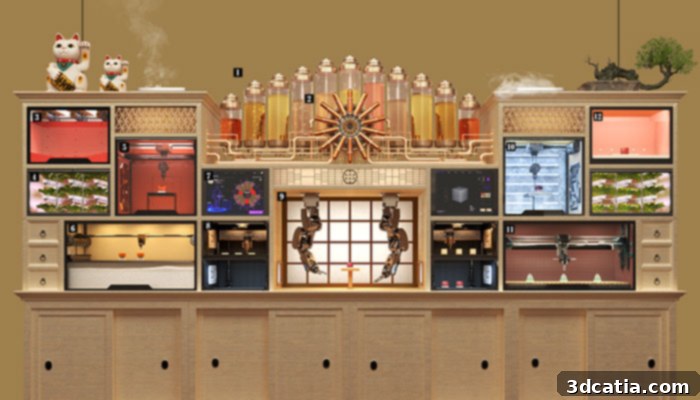
Open Meals anticipates opening its revolutionary restaurant by 2020, offering a glimpse into the future of food.
3DN: Could you explain what technique you are using to 3D print sushi?
The intricate process of 3D printing food, particularly something as nuanced, delicate, and structurally complex as sushi, is fundamentally far from a generic, one-size-fits-all manufacturing solution. At Open Meals, we have committed substantial resources and expertise to the extensive study, rigorous research, and continuous development of a diverse array of specialized methods precisely tailored for the additive manufacturing of various food items. It is critically important to understand that no single, universal 3D printing method can effectively or efficiently handle the vast and inherent diversity of food materials; each ingredient possesses profoundly unique rheological properties, distinctive textural characteristics, and specific behaviors under varying conditions of temperature, pressure, and moisture. Consequently, our approach is inherently bespoke, involving a dynamic process where we adapt, modify, and synergistically combine different 3D printing techniques to meet the specific demands of each culinary creation.
For instance, one of our foundational prototypes, which served as a crucial stepping stone and laid much of the groundwork for our current innovations, was conceptually derived from the well-established FDM (Fused Deposition Modeling) procedures. However, it is essential to clarify that the core FDM technology was not simply adopted wholesale; instead, it underwent profound modifications and extensive re-engineering to precisely accommodate the specific and often challenging requirements of food-grade materials. This involved significant and intricate changes to the extrusion system, the development of sophisticated temperature control mechanisms, innovative nozzle designs optimized for various food consistencies, and even advanced deposition strategies to ensure that ingredients – whether they are viscous pastes, elastic gels, or finely ground powders – could be accurately, consistently, and hygienically deposited layer by meticulous layer without compromising their intrinsic integrity, desired edibility, or sensory appeal. Our ongoing research and development endeavors are fundamentally and continuously driven by the precise characteristics of the specific food materials we aim to 3D print. This material-centric R&D paradigm empowers us to innovate targeted solutions for complex challenges such as maintaining optimal texture, guaranteeing stringent food safety standards, and achieving meticulously desired flavor profiles in the final printed product.
While we are currently diligently working to patent several of our proprietary 3D printing systems and highly specialized techniques – a critical and necessary step to safeguard our innovations and sustain our competitive leadership in this emerging field – we are, at this stage, constrained from divulging the intricate technical details of these cutting-edge processes. What we can share, however, is that our overarching methodology frequently draws conceptual parallels with the engineering principle of “reverse engineering.” In the context of food, this translates into taking existing culinary forms and meticulously deconstructing them down to their elemental and often microscopic components. We then thoroughly analyze and comprehend their molecular structures and physicochemical properties, and subsequently employ additive manufacturing to precisely reconstruct these elements in entirely novel and often complex ways. This allows us to exert unparalleled control not just over the external shape and macroscopic form, but also over the internal structure, the micro-texture, and the precise distribution of flavor compounds within the final product. This level of precision enables us to create truly unique, consistent, and reproducible dining experiences that traditional, manual culinary methods simply cannot replicate, opening up a new frontier for culinary science and artistry.
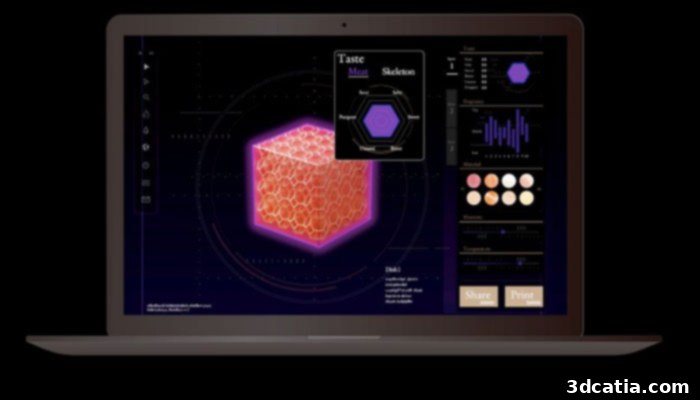
Sophisticated software is utilized to meticulously model and design each sushi piece before 3D printing.
3DN: How important do you think is the relation between design and food?
This question is not merely important; it is absolutely critical and lies at the very core of Open Meals’ philosophy and operational ethos, particularly given our unwavering and meticulous focus on the intricate textures and holistic sensory experiences of food throughout all our experiments. For us, food transcends its fundamental role as mere sustenance; it is profoundly viewed as an exquisite art form, a versatile medium for boundless creative expression, and an expansive canvas for relentless innovation. Our overarching goal extends far beyond simply replicating existing, conventional dishes; instead, we aspire to create entirely novel forms of food, pioneering new sensations and delivering unprecedented culinary experiences that deeply engage and captivate all the human senses – sight, smell, taste, touch, and even sound.
This is precisely where 3D printing emerges as an utterly indispensable and transformative tool. Additive manufacturing uniquely empowers us to not only conceive but also to precisely actualize designs and intricate internal structures for food that are simply impossible to achieve through even the most skilled traditional human handcraft. The unparalleled precision and geometric freedom afforded by 3D printing technology allow us to manipulate food at an intricate micro-architectural level, crafting sophisticated patterns, multi-layered textures, and bespoke forms. These capabilities can dramatically alter the mouthfeel, precisely control the release of flavors, and profoundly enhance the overall dining experience. This technological prowess opens up an entirely new frontier in gastronomy, enabling us to move decisively beyond the inherent limitations of conventional cooking techniques and manual dexterity, ushering in an era of engineered culinary delight.
To vividly illustrate this transformative potential, we are actively engaged in the ambitious planning of integrating advanced architectural principles directly into our sushi dishes. A prime and compelling example of this is the meticulous incorporation of a specialized structure known as the “negative stiffness honeycomb.” This remarkable design, frequently encountered in cutting-edge engineering and advanced material science, possesses uniquely counter-intuitive mechanical properties that allow it to compress and expand in highly unconventional ways, thereby creating a distinct and often surprising “spring-back” or resilient effect. By embedding such an ingenious structure within one of our sushi creations, we can introduce an entirely unexpected and utterly delightful textural element – perhaps a delicate, initial crunch that transitions into a soft, yielding interior, or a burst of concentrated flavor precisely released by its unique deformation characteristics upon mastication. This endeavor is not merely about achieving visual aesthetics; it is fundamentally about meticulously engineering the entire sensory journey, thereby providing a truly unique and profoundly memorable interaction with the food. The synergistic interplay between cutting-edge design principles and advanced culinary science, meticulously facilitated by 3D printing, enables us to craft sushi that is not only visually stunning and artistically compelling but also offers an unparalleled textural adventure, elevating the dining experience to an entirely new, multi-dimensional plane.
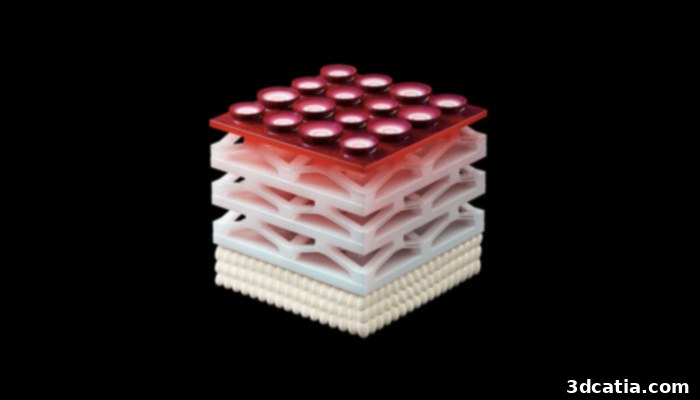
This intricate sushi piece demonstrates the integration of the ‘negative stiffness honeycomb’ architecture, showcasing unique textural possibilities.
3DN: What role do you think additive manufacturing has for the development of 3D printed food?
Additive manufacturing, more commonly known as 3D printing, is far from being merely a niche tool for creating novel or whimsical food items; it fundamentally represents a monumental opportunity to significantly expand the general utility, widespread adoption, and universal accessibility of 3D printing technology itself. It has the potential to propel additive manufacturing beyond its specialized industrial applications and seamlessly integrate it into the fabric of everyday life for consumers worldwide. For the profound development of 3D printed food, its role is nothing short of transformative and utterly foundational. It possesses the inherent capacity to fundamentally redefine and revolutionize the entire food supply chain, encompassing every stage from initial preparation and precise processing to final consumption and nutritional impact.
One of the most immediate, tangible, and impactful applications of 3D food printing lies in its remarkable ability to effectively replace numerous conventional, labor-intensive, and often time-consuming processes traditionally involved in cooking and food preparation. Imagine a future kitchen – whether domestic or commercial – where mundane yet critical tasks such as precision cutting, delicate slicing, meticulous mincing, controlled boiling, and even integrated grilling can be largely automated and executed with unparalleled accuracy and consistency by a sophisticated 3D food printer. This automation not only drastically streamlines food preparation, significantly reducing the time and manual effort traditionally required, but also profoundly minimizes food waste through optimized material utilization. For instance, printers can dispense exact amounts of ingredients, virtually eliminating the scraps and trimmings that would normally be discarded during manual preparation. This inherent efficiency extends powerfully to personalized nutrition, where precise portions and exact nutrient compositions can be printed on demand, thereby reducing instances of overconsumption and rigorously ensuring strict dietary adherence for specific health or lifestyle goals.
Beyond the compelling advantages of automation and waste reduction, printing food opens a completely new and expansive gateway for 3D printing technology as a holistic discipline. It introduces additive manufacturing to a vast, universally relevant, and deeply ingrained industry – food – thereby accelerating its technological development, driving down production costs, and fostering unprecedented widespread adoption across various sectors. Consider the profound implications of this paradigm shift:
- **Personalized Nutrition at Home:** Envision advanced home food printers capable of creating meticulously customized meals precisely tailored to individual dietary needs, nuanced taste preferences, and specific health objectives, all based on real-time biometric data or direct user input.
- **Revolutionized Industrial Food Production:** Large-scale 3D food printing has the potential to utterly revolutionize industrial food manufacturing processes, enabling mass customization of products, the creation of previously impossible complex product geometries, and highly efficient utilization of raw materials within advanced factory settings.
- **Sustainable Food Solutions:** By enabling the precise utilization of alternative protein sources, the re-purposing of food waste streams, and hyper-accurate ingredient deposition, 3D printing can contribute significantly to the development of a more sustainable, resource-efficient, and environmentally conscious global food system.
- **Support for Space Exploration and Remote Environments:** In extreme environments where fresh ingredients are scarce or inaccessible, such as long-duration space missions or remote disaster relief zones, 3D printing can provide on-demand, nutritious, and varied meals from a limited set of printable cartridges, ensuring sustenance and psychological well-being.
- **Enhanced Culinary Artistry and Education:** Professional chefs and aspiring culinary students could leverage 3D printers as innovative tools to explore new aesthetic forms, daringly experiment with unprecedented textures, and teach advanced culinary concepts and scientific principles in an entirely novel and engaging manner.
The overarching ‘Food Singularity’ vision, powered intrinsically by the boundless capabilities of additive manufacturing, unequivocally promises a future where food is intelligent, inherently adaptable, exquisitely personalized, and universally accessible. It fundamentally transforms 3D printing from a relatively niche manufacturing process into an absolutely essential, pervasive technology critical for optimizing human well-being, fostering profound culinary innovation, and fundamentally altering how we interact with, prepare, and ultimately savor our meals on a global scale.
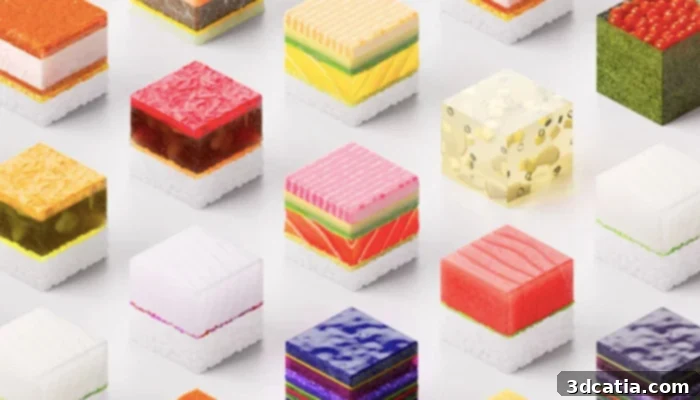
The ‘Sushi Singularity’ project by Open Meals is far more than just an innovative application of 3D printing; it represents a bold, visionary declaration of intent for the very future of food and dining. As Hironao Kato and his dedicated team meticulously push the boundaries of what is technologically and culinarily possible, they compellingly invite us all to fundamentally reconsider our relationship with what we eat – guiding us towards a future world where food is not only hyper-personalized and digitally shareable but also architecturally engineered for unprecedented sensory experiences. This groundbreaking venture not only promises truly revolutionary dining experiences but also heralds a new era for additive manufacturing itself, solidifying its pivotal place as an indispensable technology that will deeply integrate into and enhance our everyday lives.
What are your profound thoughts on 3D printed sushi and the immense potential for a complete ‘Food Singularity’? Do you envision a near future where your daily meals are precisely tailored to your unique biological data and nuanced personal preferences? We invite you to share your insightful perspectives and join this crucial conversation by leaving a thoughtful comment below, or by engaging with us directly on our vibrant Facebook and Twitter pages! And critically, don’t forget to sign up for our free weekly Newsletter to ensure you receive all the very latest news, groundbreaking innovations, and exclusive insights in the world of 3D printing delivered directly to your inbox!