
Moi Composites: Revolutionizing High-Performance Manufacturing with Continuous Fiber Technology
The landscape of manufacturing is continually evolving, with advanced techniques pushing the boundaries of what’s possible. Among these, composites manufacturing stands out as a powerful form of additive manufacturing, offering unparalleled structural efficiency and performance for finished parts. Unlike traditional layer-by-layer 3D printing, which often focuses on building objects on a flat plane, this innovative method extends manufacturing capabilities into the Z-direction, significantly enhancing the strength, rigidity, and overall mechanical properties of the resulting object. This multi-directional approach allows for the creation of intricate, high-performance structures that are lighter yet stronger than those produced by conventional methods.
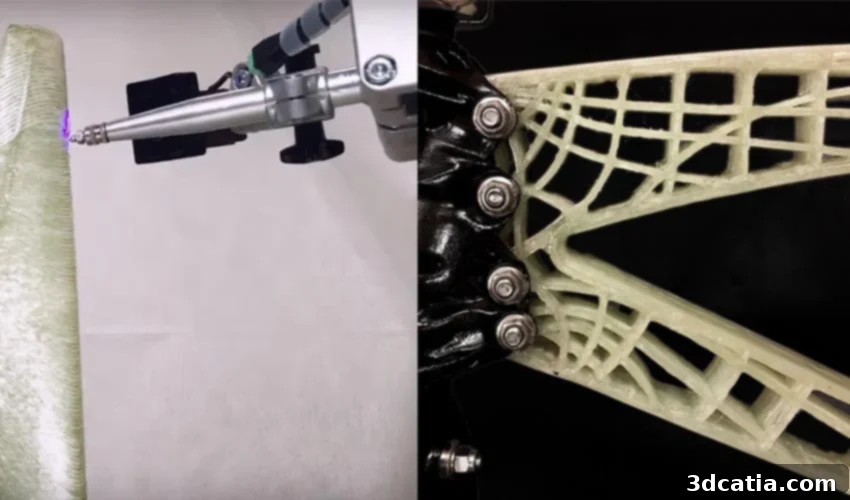
At the forefront of this revolution is moi composites, an ambitious startup that has developed its proprietary Continuous Fiber Manufacturing (CFM) process. This groundbreaking technology enables the precise placement of composite fibers exactly where they are needed, strategically aligning them with the load paths within a design. The result is the creation of incredibly robust, three-dimensional structures with optimized material use and superior performance. To delve deeper into this transformative technology and explore its vast potential applications, we recently sat down with Michele Tonizzo, the accomplished CTO of moi composites. Our conversation uncovered the genesis of moi, the intricacies of their CFM process, and the exciting future they envision for additive manufacturing.
Could you introduce yourself and explain your connection to 3D printing and advanced manufacturing?
My name is Michele Tonizzo, and I proudly serve as the CTO of moi composites. Our company emerged as a dynamic spin-off from the prestigious Politecnico di Milano University in Italy, where our core mission is to develop cutting-edge Additive Manufacturing processes specifically tailored for composite materials. My journey into the realm of 3D printing began during my time working in architectural offices. It was there that I first utilized 3D printing to create scaled models of complex designs, which offered an invaluable tool for visualization and iteration. This initial exposure sparked a profound interest.
One day, quite by chance, I discovered +LAB – the pioneering 3D printing laboratory within the “Giulio Natta” department at the university. This serendipitous encounter proved to be a pivotal moment. I spent two transformative years working at +LAB as a researcher, immersing myself in the forefront of additive manufacturing innovation. It was during this period that I had the privilege of meeting my fellow co-founders, Gabriele Natale and Professor Marinella Levi, who shared a common vision for pushing the boundaries of composite manufacturing. Our collective experience and shared passion laid the foundation for what would eventually become moi composites.
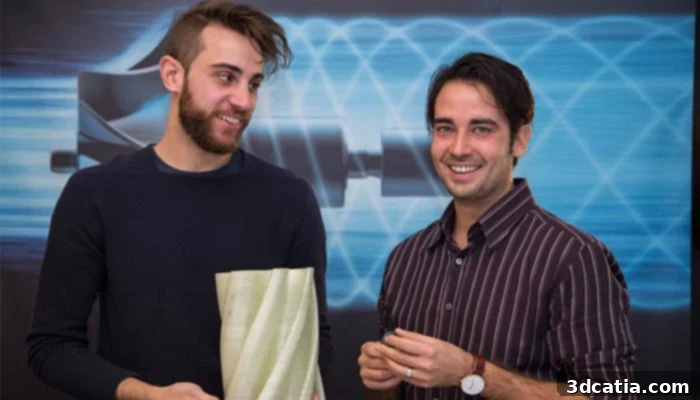
Michele Tonizzo (left) and Gabriele Natale (right) at the James Dyson Award, showcasing their dedication to innovation.
What inspired the creation of moi composites, and how did the idea for your unique CFM technology come about?
The innovative Continuous Fiber Manufacturing (CFM) process that forms the technological backbone of moi composites originated from a truly visionary idea. It began with Gabriele Natale’s thesis project in Design and Engineering. Gabriele harbored a strong desire to design and construct a boat, but he felt constrained by the inherent limitations and tight design restrictions imposed by traditional fiberglass manufacturing processes. He envisioned a method that would allow for greater geometric freedom and optimized performance, moving beyond the conventional methods that often dictate form rather than allowing form to follow function.
Following his graduation, Gabriele and I began working closely together at +LAB. Our collaborative efforts were focused on the intensive development of the CFM technology, alongside exploring other processes tailored for various types of composite materials. Our overarching ambition was clear: to offer novel solutions for the additive manufacturing of composite materials that could significantly enhance the performance capabilities of fibers, all while liberating design from historical constraints. We firmly believed that by precisely controlling fiber orientation, we could unlock unprecedented strength-to-weight ratios and geometric complexity.
After three years of rigorous research, development, and refinement, we realized that our technology had matured sufficiently. It was time to transition from the laboratory setting to the commercial market. With this conviction, we officially founded moi composites, driven by the belief that our CFM process could fundamentally transform how high-performance composite structures are designed and manufactured across numerous industries. Our journey from an academic research project to a market-ready solution was fueled by a shared passion for innovation and a commitment to pushing the boundaries of what composite additive manufacturing can achieve.
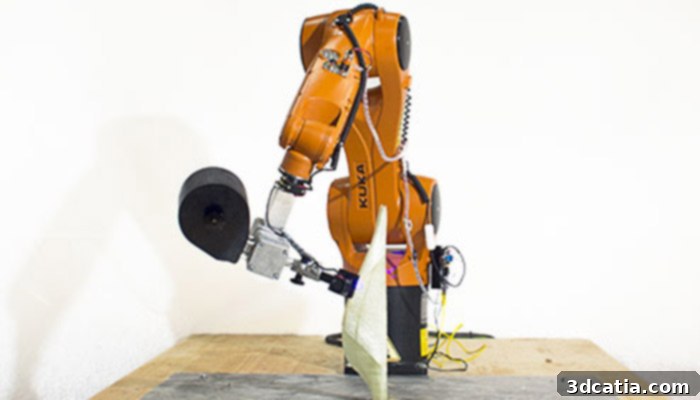
Photo Credits: moi composites, demonstrating their advanced manufacturing capabilities.
Could you elaborate on your CFM technology and its core benefits, especially in the context of robotic additive manufacturing?
Moi composites’ Continuous Fiber Manufacturing – or CFM – process is a revolutionary approach that seamlessly blends the exceptional mechanical performances inherent in composite materials with the profound advantages offered by advanced robotic additive manufacturing systems. The cornerstone of our technology lies in the utilization of a multiple-axis machine, typically a robotic arm, which dramatically magnifies the inherent capabilities of additive manufacturing. This multi-axis capability is absolutely crucial because composite materials are inherently anisotropic. This means their mechanical properties, such as strength and stiffness, are directional; they vary depending on the direction of the applied force relative to the fiber orientation. Therefore, the performance of objects made from these materials is critically dependent on how the fibers are aligned within the structure.
With a conventional 3D printer, material is often deposited layer by layer in a planar fashion, limiting control over fiber orientation in all three dimensions. However, by employing a sophisticated multiple-axis robotic system, our CFM process allows us to precisely orient the continuous fibers along the lines of maximum stress within a given design. This bio-inspired approach, mirroring how natural structures like bone grow to optimize material use, ensures that material is only placed where it contributes most effectively to the structural integrity and performance. Consequently, we can create truly three-dimensional objects from composite materials directly from a CAD file, entirely eliminating the need for expensive and time-consuming tools like molds and jigs.
The benefits are multi-faceted and significant. Firstly, this targeted deposition leads to a far better utilization of material. We can deposit more material where stress is highest, less where it’s moderate, and even no material where it’s not needed, resulting in substantial weight savings without compromising strength. Secondly, the ability to control fiber orientation at a micro-structural level unlocks unparalleled mechanical performance, yielding parts that are significantly stronger and stiffer for their weight compared to traditionally manufactured composite parts. Finally, the toolless production aspect dramatically reduces manufacturing lead times and costs, especially for complex, customized, or low-volume parts, making high-performance composites accessible for a wider range of applications.
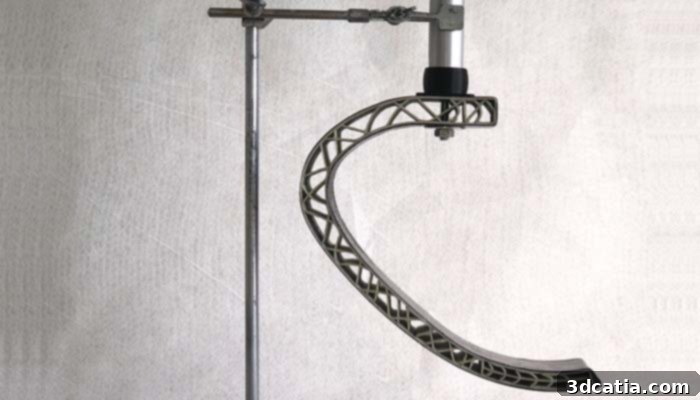
3D printed (using robotic arm) lower limb prosthesis | Photo Credits: moi composites, showcasing advanced customization.
You’ve produced remarkable demonstration pieces like a BMX frame, a lower limb prosthesis, and a riser using a robotic arm. Can you tell us more about these projects and what they illustrate about CFM’s capabilities?
Indeed, these demonstration objects – the BMX frame, the lower limb prosthesis, and the riser – are not just prototypes; they are powerful testaments to the key potentiality of our CFM technology. Each project meticulously showcases our ability to deposit continuous fibers precisely aligned with the principal stress lines within the structure. This fundamental capability allows us to achieve incredibly high performances by fully exploiting the anisotropy of the fibers, thereby creating parts that are exceptionally strong and stiff where needed, while simultaneously cutting weight by avoiding the placement of material in areas that do not bear significant loads.
The BMX frame was a particularly exciting endeavor, our inaugural project realized in collaboration with Autodesk after our successful meeting at JEC 2017, where we were honored with the Innovation Award for our Atropos project. This BMX frame was subsequently showcased at Formnext 2017, drawing significant attention. What made the BMX frame truly revolutionary was its ability to demonstrate how a multiple-axis machine can liberate itself from the constraints of depositing material solely layer by layer. For instance, the back forks of the frame are elegantly curved in the Z-direction, a geometry that would be incredibly challenging, if not impossible, to achieve with traditional layer-based 3D printing or even conventional composite manufacturing without complex molds. This Z-direction curvature allowed for optimal accommodation of the back wheel and superior structural integration.
The lower limb prosthesis, alongside the riser, represents two impactful thesis projects. These were developed in close collaboration with +LAB and Politecnico di Milano, with the outstanding work of Sara Schiavo and Alberto Riganti, respectively. The prosthesis stands as a prime example of an application where extreme customization is not merely a benefit but an absolute fundamental requirement. Our technology allowed us not only to tailor the external shape precisely to the individual’s anatomy but also to optimize the internal fiber architecture, enabling fine-tuning of the mechanical behavior to match the specific needs and activity levels of the wearer. This level of personalized mechanical response is revolutionary for medical devices.
Similarly, the riser project was meticulously tailor-made to the athlete’s specific preferences, ergonomics, and performance requirements. Through CFM, we achieved a final weight that was comparable to, or even less than, that of professional Olympic risers currently available on the market. Furthermore, a significant achievement was the simplification and considerable reduction in production costs for a single part. By eliminating the need for expensive and time-consuming tooling, such as molds, we demonstrated a vastly more efficient and cost-effective manufacturing pathway for high-performance, customized sporting equipment. These projects collectively underscore CFM’s potential for lightweighting, bespoke design, and efficient production in high-stakes applications.
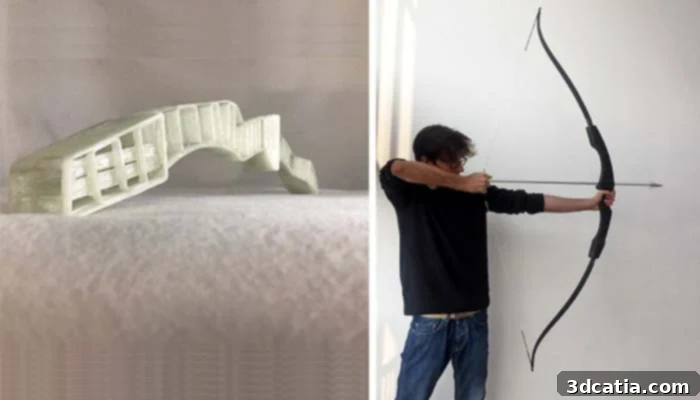
The riser project | Photo Credits: moi composites, showcasing advanced customization for athletes.
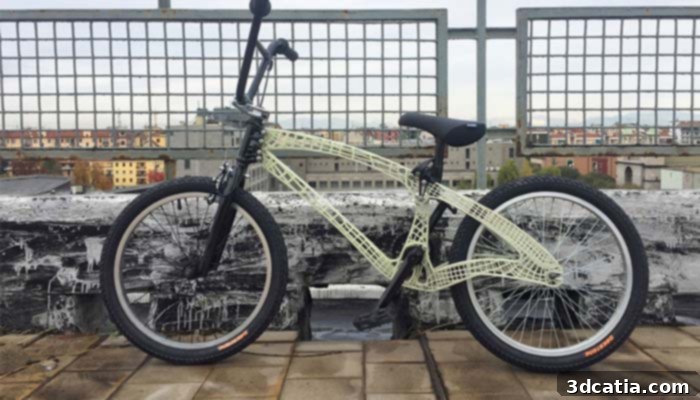
BMX Fiber Frame from a collaboration with Autodesk. The weight of the frame was reduced by 40% compared to the steel frame | Photo credits: moi composites, highlighting lightweight design.
For which applications and sectors do you foresee your technology having the most significant impact and use?
Continuous fiber composites are renowned globally for possessing some of the highest mechanical performances available, making them indispensable materials across a wide array of sectors. These traditionally include highly demanding industries such as Aerospace, Automotive, Architecture, Biomedical, Marine, and Oil and Gas, among others. Our CFM technology excels by ingeniously merging the unparalleled manufacturing capabilities of 3D printing – specifically its ability to produce unique, complex parts without the economic penalties associated with traditional manufacturing break-even points – with the superior mechanical characteristics of advanced composite materials.
Through this powerful synergy, we have discovered that CFM technology is exceptionally well-suited to provide transformative, cross-market solutions to industries where high-performance objects, especially those that are tailor-made, highly customized, or required in small series, are an absolute necessity. These are environments where standard, mass-produced components simply cannot meet the exacting demands for performance, weight, or specific functionality. The inherent flexibility and precision of our robotic additive manufacturing system allows for bespoke designs that are optimized for specific applications and user requirements, whether it’s for enhanced aerodynamics, improved ergonomics, or extreme load-bearing capacity.
In just our first year as moi composites, we have already successfully engaged and collaborated with several diverse industries. Our projects have spanned the demanding fields of Aerospace, where lightweight yet incredibly strong components are critical; Marine, for durable and corrosion-resistant structures; Oil and Gas, for components that can withstand harsh operating conditions; and Biomedical, for highly customized prosthetics and orthotics that directly improve quality of life. This initial success is merely the beginning, and we are incredibly optimistic about new projects and partnerships on the horizon, further expanding the reach and impact of our continuous fiber additive manufacturing technology.
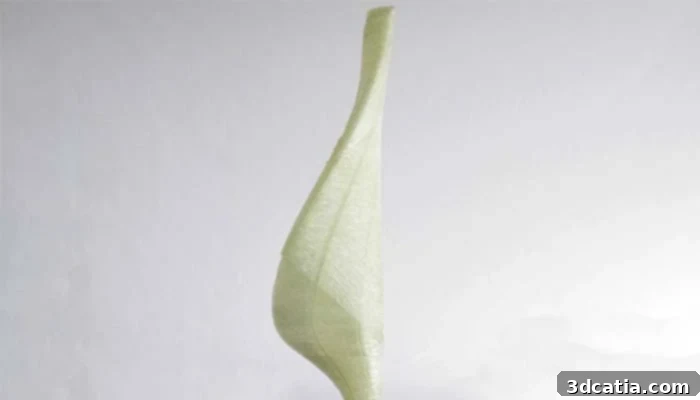
Propeller blade | Photo credits: moi composites, showcasing advanced design and manufacturing.
What is your vision for the future of the additive manufacturing industry as a whole?
I firmly believe that additive manufacturing is already making incredible strides in addressing a persistent challenge that traditional manufacturing methods have long struggled with: the efficient and cost-effective production of single, unique parts or very small series. For a considerable period, additive manufacturing was unfortunately perceived predominantly as a prototyping technology, largely due to the perceived lack of high-performance materials capable of producing truly employable, end-use parts. This limitation was, in fact, one of the primary motivations behind our development of CFM technology – to elevate additive manufacturing beyond prototyping into the realm of functional, high-strength components.
However, the industry is undergoing a significant transformation, and things are rapidly changing. Over the last few years, I have witnessed the emergence and development of numerous new, incredibly promising materials and advanced AM technologies. These innovations are critical enablers, allowing additive manufacturing to confidently carve out its indispensable place alongside conventional manufacturing techniques. This evolution is not just about producing parts; it’s about fundamentally expanding the possibilities of manufacturing. By offering unprecedented design freedom, the ability to create highly complex geometries, and the optimization of material properties, additive manufacturing is opening entirely new ways of designing and engineering products across a multitude of industries. It’s moving from a niche technology to a core manufacturing capability, enabling previously impossible designs and applications.
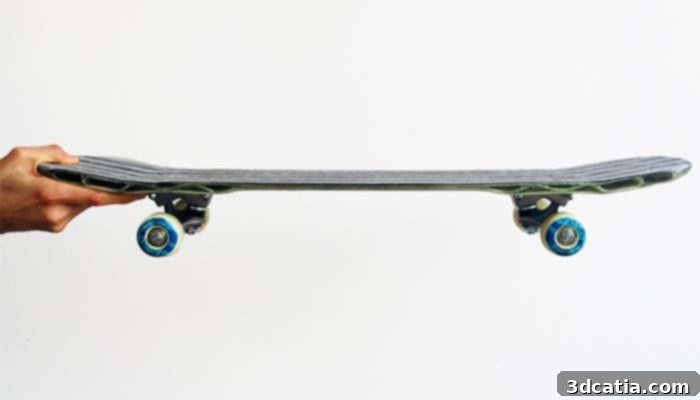
Skateboard | Photo Credits: moi composites, demonstrating design freedom.
Do you have any final words or advice for our readers, particularly those interested in additive manufacturing and innovative technologies?
Absolutely. I am a firm believer in the motto that “new is always better,” not in the sense of discarding everything old, but rather embracing the potential for progress, unprecedented discoveries, and revolutionary advancements that new ideas and technologies bring. Therefore, my strong suggestion to all your readers, especially those venturing into or currently engaged with new technologies like Additive Manufacturing, is to never cease experimenting. Never stop exploring, questioning, and pushing the boundaries of what is currently understood or possible. You genuinely never know where such open-minded experimentation and persistent innovation might lead you. The future of manufacturing, and indeed many other fields, is being shaped by those who dare to explore the unknown.
What are your thoughts on moi composites’ groundbreaking CFM technology? Share your insights and opinions in a comment below, or engage with us on our Facebook and Twitter pages! For all the latest news and updates in the dynamic world of 3D printing, don’t forget to sign up for our free weekly Newsletter, delivered directly to your inbox!