
Revolutionizing Construction: GUtech & COBOD 3D Print Three Buildings in Oman with Record Speed and Efficiency
The construction industry is undergoing a remarkable transformation, largely driven by the advent of additive manufacturing, more commonly known as 3D printing. This innovative technology is continually pushing the boundaries of what’s possible, from erecting structures of impressive height to enabling rapid, large-scale projects and fostering sustainable building practices. In a recent groundbreaking achievement that underscores the immense potential of this technology, a collaborative effort between the German University of Technology in Oman (GUtech) and leading 3D construction printing company COBOD has resulted in the astonishingly swift construction of three distinct buildings in Sezad, Oman, in a mere eight days. This project not only sets new benchmarks for construction speed but also demonstrates unparalleled cost-effectiveness and a commitment to utilizing local resources, solidifying 3D printing’s pivotal role in the future of infrastructure development.
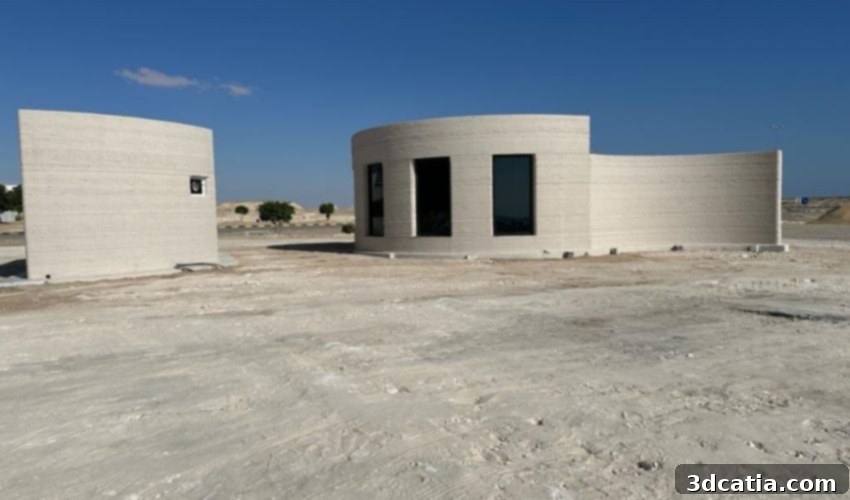
This landmark project, located within the bustling economic zone of Duqm in Sezad, saw the creation of a coffee shop, a public toilet facility, and a dedicated fishing house. These structures are more than just buildings; they are tangible proof of how quickly and affordably essential infrastructure can be deployed using advanced manufacturing techniques. The unprecedented speed of execution – completing three separate buildings on-site within eight days – highlights a synergy between cutting-edge technology and skilled implementation. COBOD, a well-recognized pioneer in the additive construction sector, brought its advanced 3D printing systems to the fore, while GUtech, with its strong academic and research foundation, provided the on-site expertise and vision to realize this ambitious endeavor.
Pioneering Partners in Additive Construction: GUtech and COBOD
COBOD International has firmly established itself as a global leader in the field of 3D construction printing, renowned for its contributions to some of the world’s most ambitious additive manufacturing projects. Their portfolio boasts an impressive array of structures, from massive wind turbine bases to record-breaking high-rise buildings, consistently demonstrating the versatility and robustness of their technology. Their state-of-the-art 3D printers are at the forefront of enabling faster, more efficient, and more sustainable construction methods worldwide, making them a natural partner for such a pioneering project.
GUtech, the German University of Technology in Oman, plays a crucial role as an academic and research institution committed to fostering intellectual exchange and technological advancement within the Sultanate. Affiliated with Germany’s prestigious RWTH Aachen University, GUtech upholds high standards of engineering education and innovation. Since its establishment in 2007, the university has actively pursued projects that bridge the gap between academic research and practical application, drawing students and faculty from diverse international backgrounds. For those familiar with the additive manufacturing landscape, GUtech might ring a bell; in December of the previous year, they were instrumental in producing what was then considered the largest 3D-printed building, a substantial 190 m² structure constructed with concrete material costs amounting to an incredibly modest $2,000. This prior success showcased GUtech’s capability and commitment to leveraging 3D printing for cost-effective, large-scale construction.
The recent collaboration between GUtech and COBOD in Sezad builds upon this legacy, further pushing the boundaries of what is achievable. This project not only emphasizes rapid deployment but also innovative material usage. COBOD proudly states that the completion of three buildings on-site in such a short timeframe was achieved through a “combination of minimal labor and very low cost for concrete materials.” This dual advantage of speed and affordability positions 3D construction printing as a viable solution for addressing global infrastructure needs efficiently and sustainably. It underscores a fundamental shift in how we approach construction, promising not just faster builds, but smarter, more economical, and environmentally conscious ones.
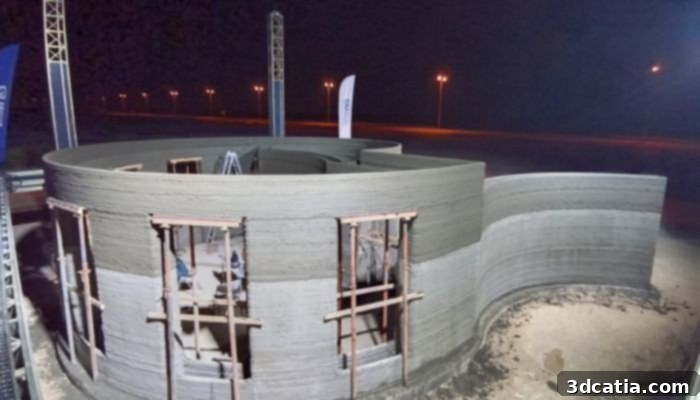
The cafe, a pioneering structure, was printed in an impressive 22 hours (Photo credits: COBOD)
The World’s First 3D Printed Cafe and Rapid Infrastructure Development
The quick turnaround for the three buildings in Sezad is groundbreaking in itself, but the project also includes a particularly unique structure: the world’s first 3D-printed cafe. This innovative establishment was brought to life in an astonishing 22 hours of printing time, showcasing the unprecedented speed possible with additive manufacturing. Complementing the cafe, a public toilet facility was printed in just 13 hours, and a fisherman’s house was completed in 19 hours. While these figures represent the actual printing durations, the total on-site time for printer setup, calibration, and sequential printing across all three structures amounted to eight days, a testament to the streamlined workflow achievable with modern 3D construction techniques.
Beyond speed, additive manufacturing in construction offers significant economic advantages. The total cost for the concrete materials used across all three buildings, which together span an impressive 173 square meters, was an incredibly modest 3,600 US dollars. This cost efficiency, combined with minimal labor requirements, positions 3D printing as a highly attractive solution for developing robust infrastructure at a fraction of traditional construction costs. Such figures highlight why 3D printing is rapidly gaining traction as a sustainable and financially viable method for construction projects globally, especially in regions seeking rapid and cost-effective development.
Engineering Excellence: Detailed Look at Each Structure
Working diligently with COBOD’s advanced 3D printers, the GUtech team adhered to an efficient eight-hour daily work schedule to construct these three structures. The coffee shop, a vibrant addition to the economic zone, boasts a base area of 81 square meters and reaches a height of 3.7 meters. Its construction required approximately 19.6 cubic meters of concrete, a significant portion of which was produced using readily available local resources. This emphasis on local sourcing not only reduces transportation costs and environmental impact but also strengthens local economies, aligning with sustainable development goals.
The public toilet facility, designed for accessibility and utility, covers a surface area of 20 square meters with a height of 3.5 meters. This essential piece of infrastructure was completed in just 13 hours of printing, consuming a mere 10.6 cubic meters of concrete. The efficiency demonstrated in its construction is a testament to the speed and precision of 3D printing technology, enabling the rapid deployment of much-needed public amenities.
Completing this record-breaking trio is the Fisherman’s House, a single-story building spanning 72 square meters with a height of 3 meters. This structure was printed over two days, totaling 19 hours of active printing, and utilized 17.3 cubic meters of concrete. All three buildings exemplify modern architectural flexibility and structural integrity. They feature robust, load-bearing walls that were directly 3D printed, eliminating the need for temporary supports during construction, a common requirement in traditional building. Furthermore, elements like roof panels and parapets were also fabricated using the 3D printer, showcasing the holistic capabilities of additive manufacturing in constructing a complete building envelope.
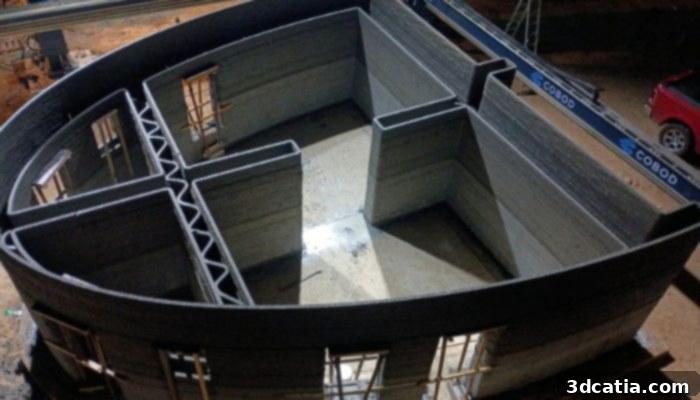
The fisherman’s house, an integral part of the project, features an area of 72 m² (Photo credits: COBOD)
Strategic Location and Future Vision: Duqm’s Development
The strategic placement of these innovative 3D-printed buildings within the economic zone of Duqm, Oman, is no coincidence. Duqm is rapidly emerging as a significant development hub, strategically planned to encompass diverse economic sectors. This includes expansive economic zones, burgeoning tourism and development areas, a multi-purpose port, a state-of-the-art dry dock for ship repair, a modern fishing port, and a regional airport, alongside numerous other industrial, logistical, and tourist facilities. This ambitious vision for Duqm makes it an ideal canvas for showcasing forward-thinking construction methods like 3D printing.
The general contractor, Teejan, provided essential support alongside COBOD’s 3D printing technology, ensuring the seamless execution of the project. Zaid Marmash, the lead architect and COBOD’s representative for the Middle East, expressed immense pride in the outcome, highlighting how these structures perfectly align with Duqm’s aspirational future. He noted, “I am proud to have co-designed the buildings 3D printed by GUtech and approved in Duqm. With the use of curves and unconventional shapes, the buildings match the futuristic and aspirational nature of Duqm. 3D concrete printing, as well as Duqm, are both very promising, and GUtech is providing the proof that the promises are being realized.” His statement encapsulates the synergistic relationship between innovative technology and progressive urban planning, demonstrating how 3D printing can facilitate the realization of bold development visions.
The Broader Impact of 3D Printing in Construction
This project in Oman serves as a powerful demonstration of the multifaceted benefits that 3D printing brings to the construction industry. Beyond the remarkable speed and cost-efficiency, additive manufacturing offers unparalleled design freedom, allowing for complex geometries and organic shapes that would be cost-prohibitive or technically challenging with conventional methods. The ability to use locally sourced materials not only reduces the carbon footprint associated with material transport but also fosters local industries and promotes regional self-sufficiency. Furthermore, 3D printing significantly reduces construction waste, a major environmental concern in traditional building, contributing to greener construction practices.
The minimal labor requirements for on-site operations enhance safety and reduce overall project timelines. This efficiency makes 3D printing an attractive solution for emergency housing, disaster relief, or rapid infrastructure development in remote or challenging environments. As technology continues to advance, we can anticipate even greater integration of automation, smarter material formulations, and more expansive applications, from multi-story residential complexes to intricate architectural marvels. The collaboration between GUtech and COBOD is not merely a single project; it is a blueprint for the future of construction, indicating a shift towards a more sustainable, efficient, and innovative building paradigm globally.
The success in Duqm underscores a critical message: the future of construction is here, and it is being built one layer at a time. The swift, cost-effective, and sustainable delivery of these three essential buildings represents a significant leap forward, offering inspiration and practical lessons for developers, governments, and architects worldwide looking to embrace cutting-edge solutions for modern challenges.
What are your thoughts on this groundbreaking construction project by COBOD and GUtech? Do you believe this sets a new standard for global construction? Share your insights in a comment below or connect with us on ourLinkedIn,Facebook, and Twitter pages! Don’t miss out on the latest advancements; sign up for our free weeklyNewsletter here to get the freshest 3D printing news delivered straight to your inbox! You can also explore our extensive video library on ourYouTube channel for more fascinating insights.