
Optimizing 3D Printing: How Nippon Gases Elevates Additive Manufacturing with Specialized Industrial Gas Solutions
In the rapidly evolving landscape of additive manufacturing, a complex ecosystem of systems works in harmony to ensure machines operate flawlessly and produce high-quality parts. Among these critical elements is the precise supply of industrial gases, indispensable for processes demanding stable temperatures and inert environments – a requirement particularly prominent in advanced metal 3D printing technologies. Nippon Gases stands out as a leading provider of such specialized solutions, serving not only the burgeoning 3D printing industry but also a vast array of other sectors. To gain a deeper understanding of how these essential gases are meticulously utilized to maintain an optimal manufacturing environment in additive manufacturing, we had the privilege of sitting down with a key member of their expert team.
Meet the Expert: Pablo Acha on Nippon Gases’ Role in Additive Manufacturing
3DN: Could you introduce yourself and your role at Nippon Gases?

Pablo Acha
My name is Pablo Acha, and I am a dedicated member of the team specializing in metal fabrication processes at Nippon Gases. Our core activities span a wide range, including traditional welding and cutting techniques such as oxyfuel, plasma, and laser cutting, alongside the cutting-edge field of additive manufacturing. Our extensive experience and profound expertise enable us to provide unparalleled support to our customers throughout every critical stage of various additive manufacturing processes. This comprehensive assistance begins with the precise making and careful storage of filler materials, extends to the crucial inertization of the working atmosphere to prevent contamination, encompasses the protection of the manufacturing process itself, and concludes with the essential post-processing of the manufactured part. We ensure that every step, from material preparation to final product, is optimized for quality and efficiency, leveraging our deep understanding of industrial gas applications to enhance metal 3D printing results.
3DN: What is the overarching mission of Nippon Gases, particularly in the context of industrial applications?
Nippon Gases’ core business revolves around the manufacturing and reliable supply of high-quality industrial, food, and medical gases, in addition to providing the necessary installations for the safe and efficient consumption of these gases. Furthermore, within the Iberian Peninsula, we operate a specialized Cutting&Welding division that furnishes a comprehensive suite of welding and cutting equipment, alongside an extensive array of consumables. This robust product portfolio crucially includes diverse metal materials in various wire coil formats, which are specifically utilized in different metal 3D printing processes, such as Directed Energy Deposition (DED) techniques. Our fundamental mission is deeply rooted in our commitment to creating significant social value through the development and implementation of innovative gas solutions. By doing so, we aim to substantially increase industrial productivity across various sectors, while simultaneously contributing to the shaping of a safer, more sustainable future for industries worldwide. This commitment extends directly into additive manufacturing, where our gases play a vital role in enabling advanced, resource-efficient production of high-performance components.
3DN: Could you detail the range of products and services Nippon Gases offers specifically for the additive manufacturing market?
For the highly demanding additive manufacturing market, the cornerstone of Nippon Gases’ offering is an exceptionally high-quality gas supply, crucial for achieving superior results in metal 3D printing. Building upon this foundation of premium gases, we have meticulously developed a comprehensive range of specific products and services, collectively branded as 3DPro®. These solutions are engineered to assist our customers in achieving and maintaining the absolute highest quality standards throughout their intricate 3D printing processes. This includes not only the inert gases themselves but also the delivery systems and expertise necessary for optimal implementation. A truly unique and innovative service in the market is MiruGas®. This sophisticated tool provides unparalleled process monitoring and analysis capabilities, empowering our customers to exert full control over their manufacturing processes. MiruGas® helps identify potential issues, optimize gas consumption, and fine-tune parameters, leading to enhanced productivity, reduced waste, and consistently high-quality output. By integrating these advanced gas management systems, we provide a holistic approach that elevates the entire additive manufacturing workflow, ensuring reliability and precision in every printed part.
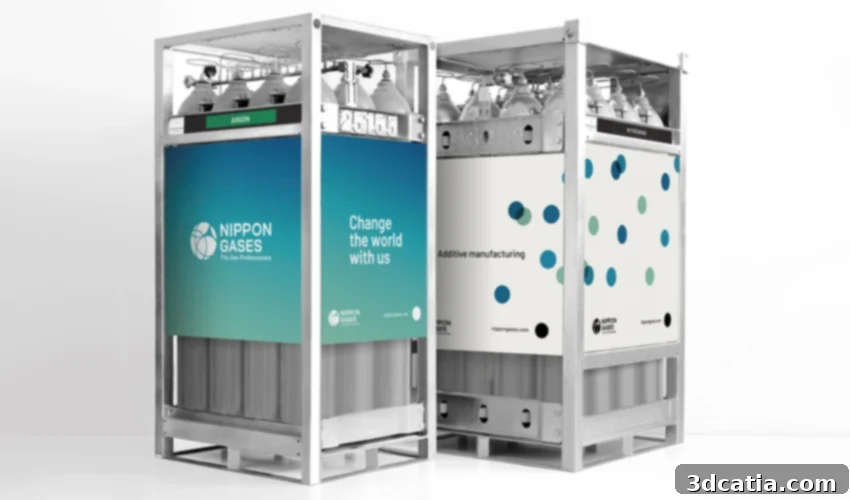
Nippon Gases offers solutions for various additive manufacturing processes
3DN: Which 3D printing technologies benefit from Nippon Gases’ solutions, and what types of gases do you supply?
Our advanced technology solutions are meticulously designed to be suitable for a broad spectrum of additive manufacturing processes. This includes technologies that consume gas during the critical material deposition stage, where an inert or specific atmosphere is paramount, as well as manufacturing processes that necessitate precise gas consumption during the post-processing phase of the part to enhance its properties or ensure its integrity. For cutting-edge technologies that require gas consumption during deposition, such as powder bed fusion (PBF) and directed energy deposition (DED), we supply ultra-high purity gases. These gases, typically argon or nitrogen, are critical for guaranteeing the best possible printing conditions by preventing oxidation, minimizing defects, and ensuring the structural integrity and mechanical properties of the printed metal parts. The purity of these gases directly impacts the quality and performance of the final product, making our commitment to high purity an essential factor for successful metal 3D printing, especially for demanding applications in aerospace, medical, and automotive sectors.
Furthermore, certain DED technologies, including Laser Metal Deposition (LMD) and Wire Arc Additive Manufacturing (WAAM), frequently leverage specific gas mixtures. These custom-tailored mixtures are strategically employed to achieve diverse objectives, such as improving the mechanical properties of the manufactured part – for example, enhancing hardness, ductility, or fatigue resistance – or to significantly optimize the overall manufacturing process itself, leading to faster build times, reduced material stress, and improved surface finish. Beyond the deposition phase, for technologies like binder jetting, material jetting, and material extrusion (such as FDM, particularly for advanced engineering polymers or composites), which utilize gases primarily in the post-processing of the part, Nippon Gases offers a comprehensive range of gases and precise gas mixtures. These are instrumental in various post-processing steps, including inert atmosphere heat treatments to relieve residual stresses, specialized annealing to refine microstructure, surface finishing treatments to achieve desired aesthetics, or sintering processes. By providing the right atmospheric control, our solutions help to improve the final part’s properties, ensuring superior performance and extending its service life, thus demonstrating our comprehensive support across the entire additive manufacturing value chain, from raw material to finished component.
3DN: How critical is environmental control, specifically regarding atmospheric conditions, during the additive manufacturing process?
Environmental control during metal 3D printing is not merely important; it is absolutely critical for the success and integrity of the manufactured components. The two most significant adversaries of high-quality metal 3D printing are moisture and oxygen. Even minute traces of these contaminants within the build chamber or during material handling can lead to catastrophic consequences. Oxygen, for instance, readily reacts with heated metal powders or molten material, causing oxidation, which compromises the mechanical properties, introduces porosity, and can lead to delamination in the final part. This also affects the recyclability of unused powder. Moisture, similarly, can break down into oxygen and hydrogen at high temperatures, leading to hydrogen embrittlement, blistering, or further oxidation, especially problematic for reactive metals like titanium. Consequently, every single gas product and technological solution that Nippon Gases has meticulously developed and continues to innovate upon is unequivocally aimed at meticulously reducing both oxygen and humidity levels to an absolute minimum within the additive manufacturing environment. This stringent control ensures that the metallic powders remain pristine, the melting process occurs without detrimental reactions, and the resulting part exhibits the desired microstructure, strength, and durability. Our dedication to maintaining an ultra-pure atmosphere is a cornerstone of producing reliable and high-performance 3D printed metal parts that meet the rigorous standards of various industries.

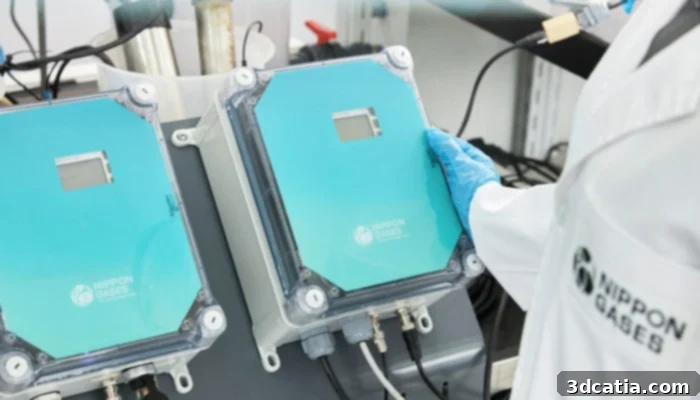
Nippon Gases provides high purity gases to ensure the best 3D printing conditions
3DN: Do you have any final thoughts or words of advice for our readers interested in advanced manufacturing?
Nippon Gases is profoundly committed to the continuous advancement and optimization of additive manufacturing processes across all the various stages in which our specialized gases and technologies are involved. To achieve this ambitious goal, we place immense value on strategic partnerships and collaborations. By working closely with leading research institutions, technology developers, and industry experts, we collectively strive to develop and refine these innovative solutions in the most effective and efficient manner possible, pushing the boundaries of what is achievable in 3D printing. We encourage all our readers, whether they are seasoned professionals or newcomers to the field of additive manufacturing, to explore the vast potential that optimized gas solutions can unlock. Understanding the critical role of atmospheric control is paramount for success in this cutting-edge industry. For those seeking more detailed information about our comprehensive range of products, services, and how Nippon Gases is shaping the future of industrial gas applications in 3D printing, we invite you to visit our official website HERE. We believe that by fostering a deeper understanding of atmospheric control and gas management, the additive manufacturing community can achieve unprecedented levels of precision, quality, and productivity, leading to truly groundbreaking innovations.
What are your thoughts on the crucial role of industrial gases and Nippon Gases’ innovative solutions for additive manufacturing? We welcome your insights! Feel free to share your comments below or engage with us on our LinkedIn, Facebook, and Twitter pages! To stay abreast of the very latest developments and breaking news in the exciting world of 3D printing, don’t forget to sign up for our free weekly Newsletter here, delivering all the essential updates straight to your inbox! Additionally, you can discover a wealth of informative and engaging content, including interviews and technology showcases, on our dedicated YouTube channel.
*All Photo Credits: Nippon Gases