
Nikon Leads JAXA Space Strategy Fund: Pioneering Lightweight, High-Performance Space Parts with Advanced Additive Manufacturing
Nikon Corporation, a global leader renowned for its precision optics and advanced manufacturing solutions, recently announced a significant partnership with the Japan Aerospace Exploration Agency (JAXA). Nikon has been selected as a key organization to implement the prestigious Space Strategy Fund (SSF), a strategic initiative designed to propel Japan’s capabilities in space exploration and technology. This collaboration underscores Nikon’s expanding footprint in the realm of advanced manufacturing, particularly in its cutting-edge selective laser melting (SLM) solutions.
Under the SSF open call for FY2024, Nikon will focus its expertise on the critical technology development theme: “Innovative technology for lightweight, high-performance, and lower cost space transportation systems.” This ambitious mission tasks Nikon with developing and demonstrating advanced additive manufacturing techniques to produce precision parts for space applications. These parts are not only expected to be low-cost and feature short lead times but will also leverage Nikon’s state-of-the-art Nikon SLM Solutions NXG XII 600 system, backed by extensive organic research and development, and new dedicated facilities established in Japan.
The Space Strategy Fund is designed as a collaborative ecosystem, where each participating organization contributes its unique technological expertise. This collective effort integrates groundbreaking research from leading Japanese universities and innovative companies, fostering a synergy that aims to accelerate technological advancements. A cornerstone of this initiative is the utilization of Japan’s first large-scale metal 3D additive manufacturing system platform. Nikon, through its acquired SLM Solutions capabilities, asserts that this platform is poised to “capture the global market,” signifying a bold strategic move to establish Japan as a dominant force in advanced space manufacturing.
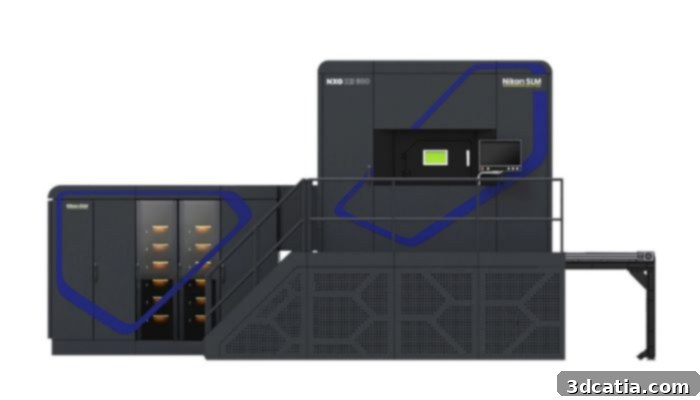
Nikon’s SLM Solutions NXG XII 600, a powerhouse in metal 3D printing, will be instrumental in the SSF project.
The overarching goal of this technology development theme is to establish a foundational technology that drives significant innovations in molding processes and enhances the performance and functionality of manufactured components. Beyond this, a key objective is to broaden the application of metal additive manufacturing for producing both large-scale structures and intricate parts critical for next-generation space transportation systems. The project scope also ambitiously includes the integration of carbon fiber-reinforced plastics (CFRP) to further expand the range of innovative applications, ensuring a multi-faceted approach to advanced material engineering for space.
Traditional manufacturing methods often face limitations when producing complex, high-performance parts required for aerospace, particularly in terms of design freedom, weight reduction, and cost-efficiency for small batch production. Additive manufacturing, or 3D printing, directly addresses these challenges. For space applications, where every gram of weight translates to significant launch costs, the ability to create lightweight yet robust components is paramount. This project specifically aims to develop a robust metal additive manufacturing base technology capable of producing large and highly precise space parts, such as critical components for rocket engines.
Nikon’s strategic entry into the additive manufacturing sector was significantly bolstered by its acquisition of metal 3D printing giant SLM Solutions in 2023. This acquisition brought with it unparalleled expertise in selective laser melting (SLM) technology, a sophisticated powder-bed fusion process. SLM is distinguished by its capability to fabricate parts with incredibly complex geometries and advanced material properties that are difficult, if not impossible, to achieve with conventional methods. The process begins with a thin layer of metallic powder spread evenly over a build plate within an inert atmosphere. A highly focused laser beam then precisely melts the powder according to the digital design data, layer by layer. After each layer is scanned and solidified, the build plate is lowered, and a fresh layer of powder is applied. This meticulous process is repeated until the final, fully dense metal part is realized. The inherent precision and accuracy of SLM make it ideally suited to meet the incredibly demanding standards of aerospace applications, where component integrity is non-negotiable.
The advantages of additive manufacturing extend far beyond geometric complexity. As the project’s title suggests, AM is also exceptionally capable of achieving low-cost and lightweight parts – two attributes that are absolutely critical for aerospace. In space applications, reducing weight directly translates to lower fuel consumption during launch, increased payload capacity, and ultimately, significant cost savings throughout a mission’s lifecycle. This is precisely why leading space agencies and defense organizations worldwide, including NASA and the United States Department of Defense, are increasingly adopting metal 3D printing for critical rocket components. Now, JAXA is making similar strategic efforts, and the industry eagerly awaits to see how Nikon’s pioneering work will impact the future of spacecraft production and space transportation efficiency. For more detailed information on Nikon’s integral role in the JAXA Space Strategy Fund, please click here.
Nikon’s involvement in JAXA’s SSF represents a significant leap forward in the application of advanced manufacturing for space exploration. By combining Nikon’s renowned precision engineering with SLM Solutions’ leading-edge metal 3D printing technology, this project promises to deliver innovations that could fundamentally reshape how spacecraft components are designed, produced, and deployed. The ability to rapidly iterate designs, consolidate multiple parts into single, optimized structures, and achieve unprecedented performance characteristics will undoubtedly contribute to more ambitious and cost-effective space missions in the future. This initiative not only strengthens Japan’s position in the global space industry but also showcases the transformative potential of additive manufacturing when applied to the most demanding engineering challenges.
What are your thoughts on Nikon’s groundbreaking project to build large, high-performance parts for rockets and space transportation systems? Share your insights and join the conversation in a comment below or connect with us on our LinkedIn, Facebook, and Twitter pages! If you are interested in more exciting developments in 3D printing for aerospace & defense, be sure to explore our dedicated page HERE. Don’t miss out on the latest advancements – sign up for our free weekly Newsletter here and get the freshest 3D printing news delivered straight to your inbox! You can also find all our compelling videos on our YouTube channel.
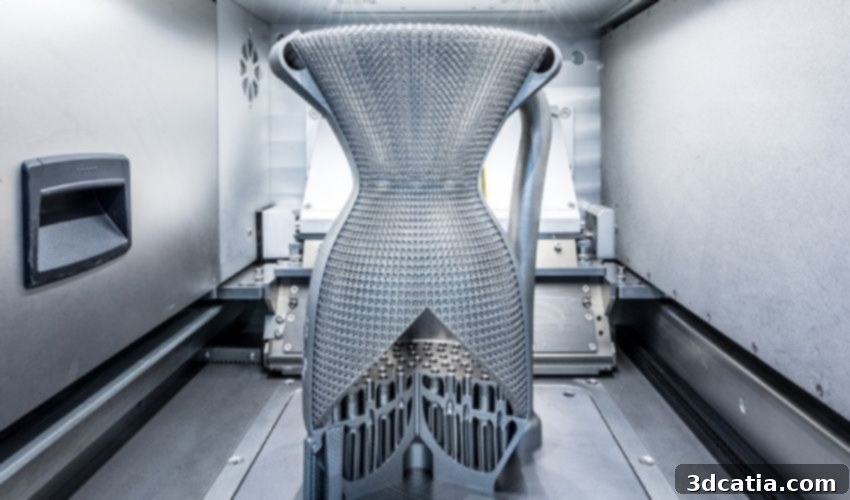
*Cover Image: A critical component for aerospace, meticulously 3D printed by Nikon. All image credits: Nikon.