

Revolutionizing Space Travel: NASA’s 3D Printing Breakthrough for Advanced Rocket Engines
NASA is at the forefront of a new era of space exploration, meticulously preparing for its ambitious Artemis mission, which aims to return humans to the Moon and eventually venture further to Mars. A cornerstone of this monumental endeavor is the strategic adoption of cutting-edge manufacturing technologies, specifically metal additive manufacturing. The American space agency has placed significant reliance on Blown Powder Directed Energy Deposition (DED), a sophisticated 3D printing technique closely related to general DED technology. This innovative approach is enabling NASA to design and fabricate the powerful rockets of tomorrow through its RAMPT (Rapid Analysis and Manufacturing Propulsion Technology) project. The RAMPT initiative is singularly focused on additively manufacturing large-scale components for space rocket engines, aiming to drastically improve their performance, reduce production timelines, and cut costs. To thoroughly validate the capabilities and advantages of this metal 3D printing technology, NASA’s engineering teams have successfully designed and produced a groundbreaking rocket engine nozzle, measuring an impressive one meter in diameter and 0.9 meters in height, complete with intricately integrated cooling channels.
NASA’s journey into additive manufacturing spans several years, with a consistent emphasis on exploring the vast potential of metal 3D printing. The primary motivation behind this focus has been the desire to accelerate the design and production of critical components for its satellites and rockets, all while preserving and even enhancing their structural integrity and design complexity. Traditional manufacturing methods often grapple with the intricate geometries and high-performance material requirements inherent in aerospace components, leading to lengthy production cycles and prohibitive costs. Recognizing these challenges, NASA officially launched the RAMPT Project in April 2019. The project’s core objective is to pioneer new design and manufacturing methodologies that will not only improve the performance of crucial combustion chambers and nozzles but also achieve substantial reductions in manufacturing expenses. These two components are among the heaviest and most challenging parts of a rocket engine system, historically accounting for a significant portion of the overall production cost and time. Ultimately, RAMPT envisions a future where advanced manufacturing processes, particularly 3D printing, are fully integrated on a national scale, enabling comprehensive material characterization and rigorous testing of the resulting components to ensure mission success. It is within this transformative framework that NASA has successfully created its pioneering 3D printed metal nozzle, demonstrating the tangible benefits of additive manufacturing.
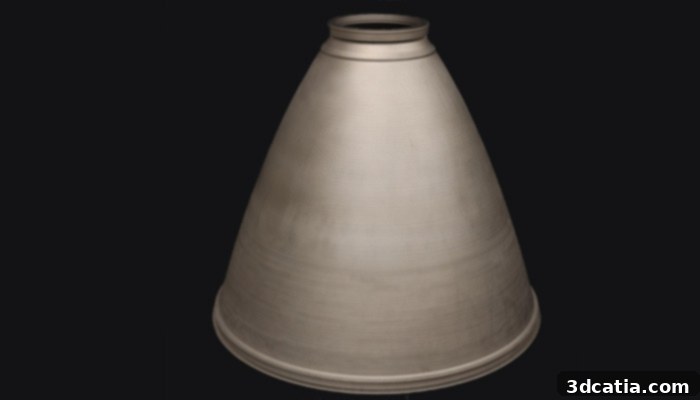
The 3D printed nozzle. (Image credits: NASA)
The RAMPT project’s success is deeply rooted in its application of Blown Powder Directed Energy Deposition (DED) technology. This sophisticated additive manufacturing technique operates by precisely injecting fine metal powder into a localized molten pool, which is continuously maintained by a powerful laser heat source. A specialized print head, robustly mounted on a multi-axis robotic arm, meticulously follows a pre-programmed digital pattern. As it moves, an optical laser works to instantly melt and then solidify the blown powder, building the part layer by layer with exceptional precision. This process is essentially a refined version of general DED, a technology well-regarded for its versatility in both repairing existing metal parts and manufacturing new, large-scale components, such as the demanding geometry of rocket engine nozzles. Paul Gradl, a co-principal investigator for the RAMPT project, eloquently articulates the profound impact of this technology: “It’s a challenging process to manufacture the nozzles traditionally, and it can take a very long time. Blown Powder Directed Energy Deposition additive manufacturing allows us to create very large-scale components with complex internal features that were not previously possible. We’re able to significantly reduce the time and the cost associated with the fabrication of channel-cooled nozzles and other critical rocket components.” This statement underscores the paradigm shift that DED offers, enabling the creation of intricate designs that were once considered unfeasible, thereby opening new avenues for propulsion system innovation.
The RAMPT team proudly unveiled the first large-scale nozzle produced using this method – an impressive component measuring 1 meter in diameter and 0.9 meters in height. What makes this achievement truly remarkable is the compressed manufacturing timeline: it took merely 30 days to produce this complex part. In stark contrast, producing a similar part using conventional welding and fabrication methods would typically require a full year of intensive labor and specialized tooling. This dramatic reduction in production time highlights a key advantage of additive manufacturing for fast-paced aerospace development. Furthermore, the nozzle design incorporates highly sophisticated internal cooling channels. These channels are absolutely critical for rocket engine performance, as they allow cryogenic propellant gases to circulate, effectively regulating and maintaining an optimal operating temperature during extreme combustion events. Without these channels, the intense heat generated could quickly degrade the engine material, leading to catastrophic failure. Achieving such intricate internal geometries with traditional manufacturing techniques is extraordinarily difficult, often requiring multiple separate parts that are then assembled, introducing potential points of failure and increasing complexity. Additive manufacturing, however, fundamentally transforms this challenge, enabling the seamless integration of these complex cooling channels through optimized design methods and layer-by-layer fabrication, resulting in a single, robust, and high-performance component.
Drew Hope, Director of NASA’s Game Changing Development Program, which provides crucial funding for the RAMPT project, emphasized the broader implications of this technological advancement. He commented: “This technology advancement is significant, as it allows us to produce the most difficult and expensive rocket engine parts for a lower price tag than in the past. Further, it will allow companies within and outside of the aerospace industry to do the same and apply this manufacturing technology to the medical, transportation, and infrastructure industries.” Hope’s statement underscores that the benefits extend far beyond space exploration. For instance, in the medical field, DED could enable the creation of customized, patient-specific implants or prosthetic components with superior biomechanical properties. In transportation, it might facilitate the production of lightweight, high-strength parts for automotive or maritime applications, improving fuel efficiency and performance. Within infrastructure, DED could be invaluable for repairing critical components of bridges, pipelines, or power plants, extending their lifespan and reducing replacement costs. The 3D printed nozzle is now poised for a rigorous series of tests designed to simulate the extreme conditions of a rocket launch. These tests will include subjecting the nozzle to combustion temperatures reaching an astonishing 6,000 degrees Fahrenheit and the immense pressures observed during actual rocket engine operation. The successful completion of these trials will be a critical validation of DED technology for high-performance aerospace applications, paving the way for its widespread adoption in future space missions. We eagerly await the results, which promise to redefine the landscape of rocket engine manufacturing. In the meantime, you can find more in-depth information and updates directly from NASA HERE.
NASA’s proactive integration of advanced additive manufacturing technologies into its core production processes marks a pivotal moment for both space exploration and industrial innovation. This strategic shift not only promises to accelerate ambitious missions like Artemis but also sets a precedent for how complex, high-performance components can be manufactured across various sectors. The success of projects like RAMPT demonstrates the tangible benefits of 3D printing in terms of cost reduction, time efficiency, and the ability to realize designs previously deemed impossible. What are your thoughts on NASA’s pioneering efforts in leveraging additive manufacturing for its future endeavors? We encourage you to share your insights and comments down below, or connect with us on our Facebook and Twitter pages! Don’t forget to sign up for our free weekly Newsletter, ensuring you receive all the latest news and breakthroughs in the dynamic world of 3D printing directly to your inbox!