
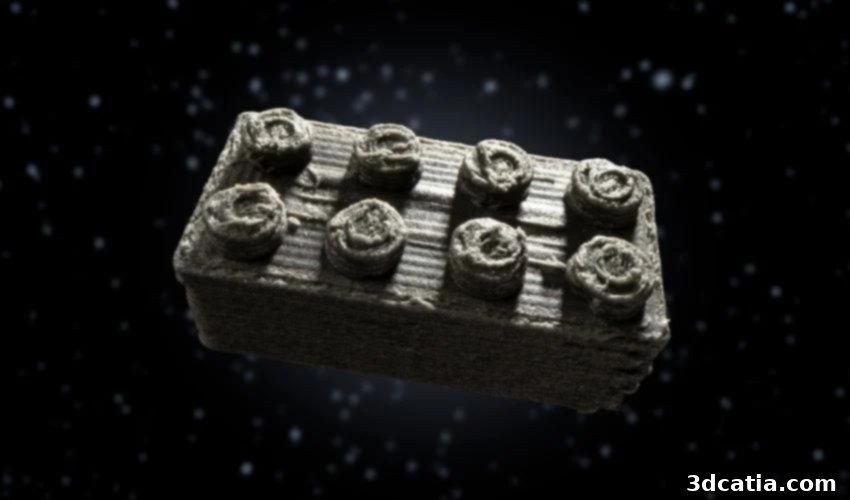
3D-Printed LEGO Bricks from Moon Dust: Igniting Space Exploration and Shaping Future Lunar Habitats
As humanity casts its gaze back towards the Moon, fundamental questions emerge: What would sustainable life on our closest celestial neighbor entail? How can the Moon’s indigenous resources be harnessed to construct essential infrastructure? And most critically, how will astronauts—and potentially future lunar inhabitants—live, work, and thrive in such an extraterrestrial environment? These profound inquiries are at the forefront of ongoing research and development efforts by leading space agencies, including the European Space Agency (ESA) and NASA.
Central to these endeavors is the ambitious Artemis program, which aims to return humans to the lunar surface, establishing a long-term presence. Astronauts involved in Artemis missions are tasked not only with exploring the Moon but also with investigating practical solutions for living and building there. In a remarkable blend of scientific innovation and playful engagement, a new initiative offers unique insights: scientists have successfully created 3D-printed LEGO bricks using simulated moon dust. These innovative bricks are envisioned for constructing everything from habitats and launch pads to essential protective structures. This project skillfully merges serious scientific objectives with a brilliant strategy to captivate children’s interest in space exploration, inspiring the next generation of engineers, scientists, and astronauts.
Harnessing Lunar Resources: The Regolith Challenge and a Playful Solution
The Moon’s surface is predominantly covered by regolith, a fine, powdery material often referred to as “moon dust.” This abundant resource, a byproduct of billions of years of meteorite impacts pulverizing the lunar rock, is crucial for any long-term lunar habitation plans. The concept of In-Situ Resource Utilization (ISRU), which involves using local materials rather than transporting everything from Earth, is fundamental to sustainable space exploration. Transporting building materials from Earth is prohibitively expensive and inefficient, making the utilization of lunar regolith an absolute necessity for establishing permanent bases. However, while plentiful on the Moon, true lunar regolith is exceedingly rare on Earth.
During the Apollo missions, only a minuscule amount of regolith was brought back for scientific study, far too little to experiment with large-scale construction. To overcome this critical limitation and thoroughly test the feasibility of constructing robust building blocks from lunar resources, scientists embarked on an innovative quest for an alternative material. Their solution involved a 4.5 billion-year-old meteorite, carefully processed and reduced to a fine dust. This ancient extraterrestrial material was then meticulously combined with polylactide (a biodegradable thermoplastic polymer commonly used in 3D printing) and a specialized regolith simulant. This carefully engineered mixture became the foundational material for the groundbreaking lunar LEGO bricks, offering a realistic proxy for the Moon’s own building blocks.
The creation of these bricks represents a significant step forward in understanding the practicalities of lunar construction. By mimicking the physical and chemical properties of actual moon dust, researchers can conduct extensive tests on material strength, durability, and printability under Earth-based conditions. This approach allows for iterative design and experimentation, refining techniques and material compositions before applying them in the harsh lunar environment. The project not only validates the potential of using regolith for construction but also demonstrates a practical method for simulating such complex processes here on Earth.
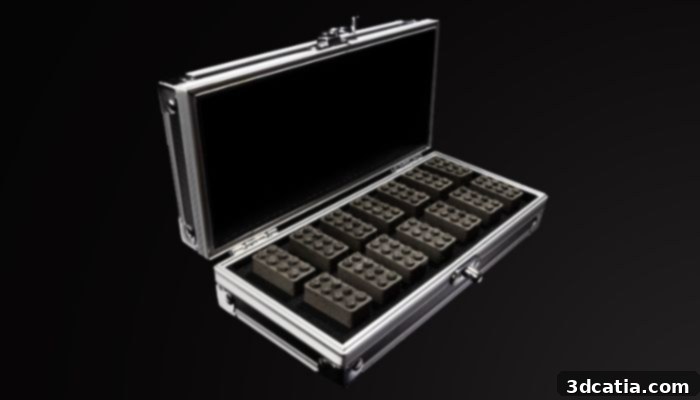
The ESA LEGO bricks were printed from a material similar to Rigolith, enabling critical research into lunar construction techniques.
3D Printing: A Cornerstone for Sustainable Lunar Habitation
Once the unique construction mixture was perfected, it was transformed into small-scale building blocks using advanced 3D printing technologies. While the precise printing process employed for these specific LEGO bricks remains under wraps, both NASA and ESA have extensively explored various additive manufacturing techniques for creating elements crucial for lunar infrastructure. These include stereolithography, which uses lasers to cure liquid resin, and large-format extrusion printing, which deposits layers of material to build structures. The versatility of 3D printing makes it an ideal candidate for off-world construction, allowing for on-demand manufacturing of complex geometries directly from local resources, thereby significantly reducing the need to launch materials from Earth.
For Aidan Cowley, an ESA science officer deeply involved in this pioneering research, the specific “how” of the printing process is secondary. His primary focus, and indeed the overarching challenge for the burgeoning lunar construction industry, lies in the “with what”—the materials and resources that are readily available on the Moon. The ability to utilize lunar regolith not only cuts down on astronomical launch costs but also opens the door to truly sustainable and self-sufficient lunar bases. Imagine a future where lunar outposts can expand and repair themselves using locally sourced materials, greatly lessening their reliance on Earth.
Our teams are working towards the future of space travel and take inspiration from not just what’s above us, but also what we can find on Earth. No-one has ever built a structure on the moon, so we have to work out not only how we build them but what we build them out of as we can’t take any materials with us. My team and I team love creative construction and had the idea to explore whether space dust could be formed into a brick similar to a LEGO brick so we could test different building techniques. The result is amazing and whilst the bricks may look a little rougher than usual, importantly the clutch power still works, enabling us to play and test our designs.
Cowley’s insights underscore the critical importance of material science in space exploration. The “clutch power” of these regolith-based LEGO bricks—their ability to interlock securely—is a seemingly simple detail but profoundly significant. It means these experimental bricks function precisely as their terrestrial counterparts do, allowing engineers and even children to design, build, and iteratively test structural concepts. This hands-on approach facilitates rapid prototyping and conceptualization of lunar structures, from basic shelters to more complex architectural designs, using a familiar and intuitive system.
Inspiring Future Generations: LEGO, Science, and Education
LEGO Bricks Made of Moonstone for Educational and Scientific Purposes
Beyond its compelling scientific objectives, this project carries a profound educational purpose. The fundamental ethos of LEGO has always been to foster discovery and creativity through engaging, hands-on play, ultimately shaping the builders, thinkers, and innovators of tomorrow—or, in this exciting context, the astronauts and lunar architects of the future. By transforming moon dust into a recognizable and beloved toy, LEGO aims to ignite a passionate enthusiasm for space travel and actively encourage children to delve into the fascinating world of space exploration.
To bring this vision to life and inspire a global audience, 15 of these unique ESA LEGO bricks are being showcased in select LEGO stores around the world. From June 24 to September 20, children and families in the USA, Canada, the UK, Germany, France, Denmark, Spain, and Australia will have the extraordinary opportunity to see these “space bricks” firsthand. At these designated LEGO Centers, visitors can discover the incredible story behind their creation and learn how such innovative materials could be utilized to construct essential infrastructure on the Moon. This interactive display serves as a tangible link between childhood imagination and cutting-edge scientific endeavors, making the dream of lunar habitation feel more accessible and real.
Daniel Meehan, Creative Lead at the LEGO Group, emphasizes the power of creative play as an inexhaustible source of inspiration for future applications. He notes, “We recently found out that space remains an area of huge curiosity with 87% of Gen Alpha kids interested in discovering new planets, stars, and galaxies. With the ESA team using the LEGO System-in-Play to advance space travel, it shows kids the sky really is the limit when it comes to LEGO brick building and we hope it encourages children to have a go at building their own space shelters!” This initiative taps directly into the innate curiosity of young minds, leveraging a universal symbol of creativity—the LEGO brick—to demystify complex scientific challenges and make space exploration relatable and exciting. By providing a tangible connection to lunar science, the project aims to cultivate a generation deeply engaged with STEM fields, ready to take on the challenges of future space colonization and exploration.
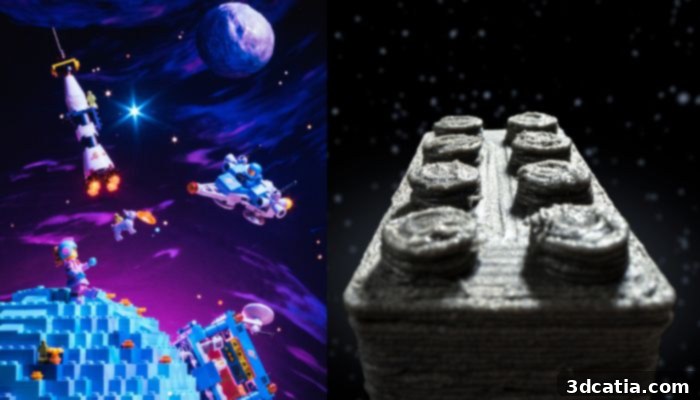
LEGO aims to spark interest in space exploration with its innovative range of products and initiatives.
The Vision for Lunar Habitats and Beyond
The potential applications of these regolith-based LEGO bricks extend far beyond mere educational tools. They represent a tangible step towards designing durable and protective structures essential for human survival on the Moon. Lunar habitats must withstand extreme temperature fluctuations, harmful solar and cosmic radiation, and micrometeoroid impacts. Materials derived from regolith, when properly processed and structured, offer natural shielding properties. The ability to build layers upon layers, mimicking the protective function of the Moon’s natural surface, is crucial for safeguarding astronauts and their equipment. These LEGO-like bricks allow for modular and adaptable construction, enabling future lunar settlers to expand their bases as needs evolve, from basic shelters to interconnected living and working modules.
Ultimately, this research paves the way for the establishment of permanent lunar bases, critical for sustained human presence beyond Earth. Beyond habitats, these 3D-printed regolith structures could form launch and landing pads, roads, power infrastructure bases, and even agricultural enclosures. The ability to construct these elements on-site, using the Moon’s own resources, is not just a cost-saving measure but a fundamental requirement for creating a truly self-sufficient off-world civilization. Such an endeavor would serve as a vital stepping stone, not only for deeper lunar exploration but also for preparing humanity for the monumental challenge of crewed missions to Mars and beyond.
This innovative collaboration between space agencies and a global toy company powerfully demonstrates how combining scientific rigor with creative engagement can accelerate progress in space exploration. The 3D-printed LEGO bricks from moon dust are more than just a novelty; they are a symbol of ingenuity, a practical testbed for future lunar construction, and a potent tool for inspiring the next generation to dream big about the cosmos.
What do you think of these LEGO bricks made of moon dust? Let us know in a comment below or on our LinkedIn, Facebook, and Twitter pages! Don’t forget to sign up for our free weekly newsletter here for the latest 3D printing news straight to your inbox! You can also find all our videos on our YouTube channel.
For more information, click here for LEGO’s official press release. Within, you can find all Locations for the ESA Space Bricks displays in the United States.
*All Photo Credits: LEGO Group