
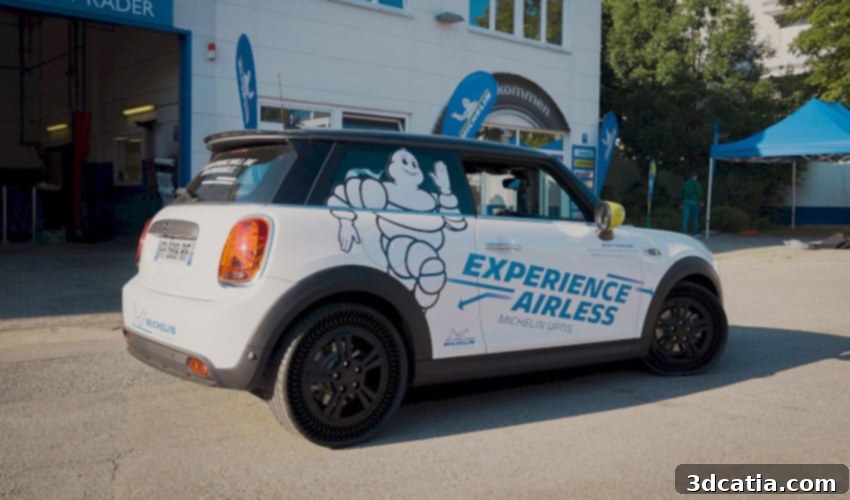
Michelin Uptis: Paving the Future with Revolutionary Airless, 3D Printed Tires
In a significant leap towards sustainable and maintenance-free mobility, the renowned French tire manufacturer Michelin has been actively developing and testing its groundbreaking airless tire concept, dubbed Uptis. First introduced to the public in June 2019, the Unique Puncture-proof Tire System (Uptis) represents a radical departure from conventional pneumatic tires, aiming to eliminate the perennial problems of punctures and blowouts. This innovative design, which initially proposed the use of a 3D printed rubber tread for both repair and customization, is a cornerstone of Michelin’s forward-thinking Vision Concept, designed to reimagine the future of road travel.
The Uptis tire made a sensational debut at the Munich Motor Show, capturing global attention. Mounted on an electric MINI, a vehicle symbolic of modern urban mobility, the airless tires demonstrated Michelin’s bold ambitions to bring this futuristic technology to market by 2024. While the full extent of 3D printing’s role in the final commercial product remains an evolving aspect of the project, the underlying principle of a robust, puncture-proof structure is firmly in place. Michelin has since advanced the program significantly, moving from controlled environments to real-world scenarios, commencing extensive road tests on public roads. Initial feedback from automotive YouTubers, who were among the first to experience the Uptis tires, reported a driving sensation remarkably similar to traditional tires, a crucial validation of its functional integrity and potential for widespread adoption.
The development of the Uptis tire is deeply rooted in Michelin’s broader Vision Concept, a strategic initiative aimed at shaping the tires of tomorrow. This holistic approach focuses intently on reducing the environmental impact associated with tire production and disposal, offering a substantially greener alternative for the automotive industry. Through comprehensive internal studies, Michelin identified a staggering statistic: over 20% of all tires are prematurely discarded due to punctures or irreparable damage. This contributes significantly to a global waste problem, as tires are notoriously difficult to process and recycle, often ending up in landfills where they pose long-term environmental challenges.
By engineering an airless tire, Michelin directly addresses this pressing issue. The inherent design of Uptis intrinsically prevents flats and common forms of damage that lead to premature tire replacement, thereby promising to significantly extend the lifespan of these critical automotive components. This extended durability not only translates to reduced waste but also to a more sustainable consumption model. A particularly intriguing aspect of the original Uptis concept, and one that remains a subject of ongoing discussion, revolved around the potential for users to 3D print the tire tread. This capability, if fully realized, would empower drivers to adapt their tires according to specific driving conditions, prevailing weather, or even the general wear and health of the tire itself. Imagine a future where you could optimize your tire’s grip for winter conditions, then switch to a more fuel-efficient tread for summer, all through on-demand 3D printing. While this highly customizable aspect has not been explicitly confirmed in recent updates, its potential implications for performance, personalization, and environmental responsibility are immense, showcasing the transformative power of additive manufacturing in the automotive sector.
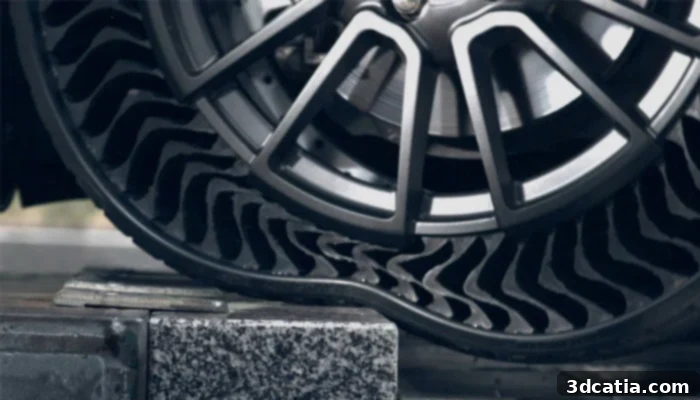
The Uptis tire has been designed to be puncture-proof (photo credits: Michelin)
Despite the excitement surrounding the 3D printed tread concept, specific details regarding the required additive manufacturing technology remain largely under wraps. Questions persist about the type of 3D printing process that would be robust enough to create durable tire treads and the time it would take to manufacture them. The practical implementation of such a system raises several pertinent questions for consumers and the automotive service industry alike. For instance, would drivers need to visit a specialized, licensed garage equipped with industrial-grade 3D printers to replace or customize their tire treads? Or, more ambitiously, could a future scenario allow individuals to print treads themselves, perhaps with smaller, consumer-grade additive manufacturing units? Furthermore, the potential cost of these custom-made, technologically advanced tires is a critical factor that will influence their market adoption. Balancing innovation with affordability will be key to Michelin’s success.
What is known about the material composition of the Uptis tire’s proposed tread offers a glimpse into its advanced engineering. Michelin has indicated a preference for a highly flexible structure, meticulously reinforced with fiberglass and specialized rubber compounds, all mounted securely onto a robust aluminum wheel. This combination of materials is engineered to provide the necessary resilience, grip, and durability characteristic of high-performance tires, while also accommodating the airless architecture. A significant claim made by Michelin is that the Uptis tire is designed to last up to three times longer than conventional pneumatic tires. This extended lifespan represents a monumental improvement, translating directly into considerable cost savings for consumers due to fewer replacements, and a dramatic reduction in waste materials, aligning perfectly with Michelin’s sustainability objectives. The ability to avoid common tire failures like punctures, combined with enhanced longevity, positions Uptis as a genuinely disruptive technology poised to redefine expectations for tire performance and environmental responsibility.
The rigorous road tests conducted by prominent automotive YouTubers Mr. JWW and Gercollector provided invaluable real-world validation for the Uptis tire system. Following these public demonstrations, Cyrille Roget, Michelin’s Director of Technical and Scientific Communications, articulated the profound satisfaction derived from the feedback: “Our greatest satisfaction came at the end of the demonstration when our passengers said they felt no difference compared with conventional tires.” This affirmation is perhaps the most critical endorsement for any radically new automotive component. For a novel, airless tire to perform indistinguishably from its traditional counterparts in terms of ride comfort and handling is a testament to Michelin’s engineering prowess and a crucial factor for mass consumer acceptance. Such seamless integration into the driving experience is paramount for widespread market adoption. Building on these promising results, Michelin has set its sights on a commercial launch for passenger vehicles by 2024, fortified by a strategic partnership with automotive giant General Motors. This collaboration with a major original equipment manufacturer (OEM) signals a serious commitment to bringing Uptis to the mainstream, leveraging GM’s extensive vehicle platforms and distribution networks to accelerate market penetration and acceptance.
Michelin’s innovative trajectory extends far beyond the immediate commercialization of Uptis. The company, globally recognized for its iconic Michelin Man mascot, has articulated an even more ambitious vision for the future: to produce tires made with 100% sustainable materials by the year 2050. This formidable challenge represents a profound commitment to environmental stewardship and sets a new benchmark for the entire industry. Achieving such a goal would necessitate a revolutionary shift in material science, supply chain management, and manufacturing processes, moving towards bio-sourced, recycled, and entirely renewable resources. This long-term objective underscores Michelin’s dedication to creating a truly circular economy for tires, where every stage of a tire’s lifecycle, from raw material sourcing to end-of-life management, minimizes environmental impact. Such initiatives are not just about product development; they are about fostering a sustainable future for mobility itself. The success of projects like Uptis, particularly where additive manufacturing plays a role, will be instrumental in paving the way for these grander sustainable goals. We will continue to monitor and report on the latest developments concerning this transformative project, especially as it relates to the exciting advancements in additive manufacturing and sustainable materials. For more in-depth information directly from the source, you can find additional details HERE.
What are your thoughts on Michelin’s revolutionary Uptis 3D-printed, airless tire? Do you envision a future where punctures are a relic of the past? Share your insights and opinions in a comment below or join the conversation on our Facebook and Twitter pages. And don’t forget to sign up for our free weekly newsletter to stay informed with all the latest news in 3D printing delivered straight to your inbox!