
Cultivating the Future: MeaTech’s Breakthrough in 3D Bioprinted Meat Using Stem Cells
The global demand for meat continues to rise, placing immense pressure on our planet’s resources and raising significant ethical and environmental concerns. In response, the food industry has witnessed a surge in innovation, particularly in the realm of alternative protein sources. For years, companies like Beyond Meat and Impossible Foods have successfully introduced plant-based alternatives that closely mimic the taste and appearance of ground meat products. These innovations have been pivotal in offering consumers more sustainable choices. However, a significant hurdle remained: replicating the complex fibrous texture of whole-cut meats, such as steaks, rather than just mince. This is precisely where cutting-edge technologies like 3D printing, specifically additive manufacturing (AM), are revolutionizing the landscape of sustainable food production.
Additive manufacturing, through its extrusion process, offers a unique advantage in creating intricate structures. By precisely depositing layers of material, it can organize nanofibers in a manner remarkably similar to natural animal tissue. This capability is crucial for accurately recreating the chewiness, succulence, and mouthfeel that consumers expect from traditional meat. The precision of 3D bioprinting holds the key to unlocking the next generation of meat alternatives, moving beyond simple ground textures to sophisticated whole cuts that are indistinguishable from their animal-derived counterparts.
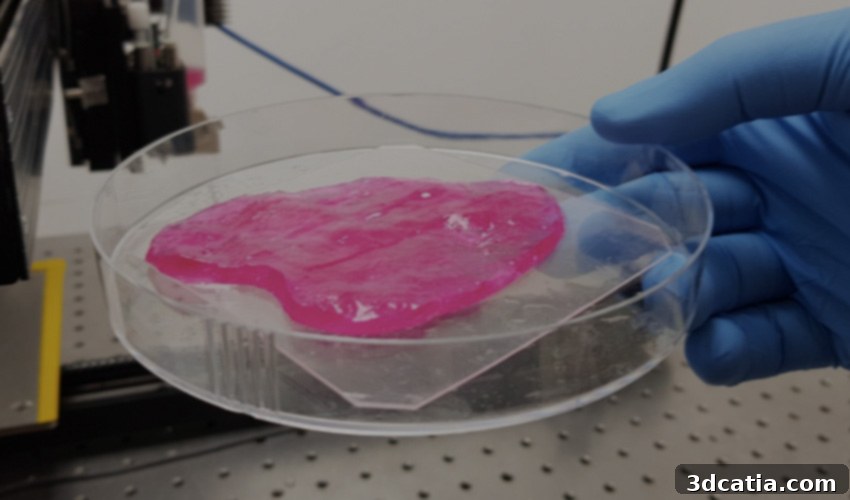
Among the pioneering companies making strides in this exciting domain is MeaTech, an innovative Israeli startup. MeaTech recently captured global attention with a groundbreaking announcement: their team of dedicated scientists successfully reproduced thin, uniform, slaughter-free meat tissue using advanced 3D bioprinting techniques. This achievement marks a significant milestone in the quest for sustainable and ethical meat production. While a relative newcomer to this burgeoning market, MeaTech has quickly established itself as a frontrunner due to its ambitious vision to scale up the production of sophisticated, cultured meat products.
What sets MeaTech apart from some other industry players, such as NovaMeat or Redefine Meat, which primarily focus on 3D printing plant-based steaks, is its innovative approach to sourcing its raw materials. Instead of plant proteins, MeaTech harnesses the power of stem cells. By utilizing animal stem cells, the company is able to cultivate genuine meat tissue, specifically beef, without the need for animal slaughter. This ethical dimension is a core tenet of their mission. Their initial success in producing these thinly-sliced meat analogues led them to aptly name their experiment “Project Carpaccio,” highlighting the delicate and precise nature of their cultivated creation.
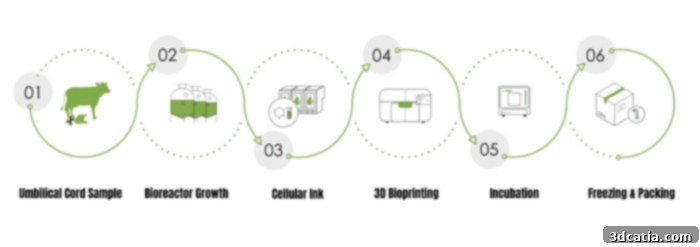
The MeaTech process: From stem cell to 3D printed tissue | Image via MeaTech
The Innovative MeaTech Process: From Stem Cells to Sustainable Slices
The scientific methodology behind MeaTech’s breakthrough is as fascinating as it is complex. The company announced that its scientists successfully printed multiple cell types, which were then skillfully blended to form a single, coherent fat and muscle tissue. This tissue was meticulously grown and cultivated within their advanced laboratory environment. The integrity and authenticity of the project’s results were rigorously analyzed by an independent professional examiner and further corroborated by the company’s internal audit committee, underscoring the scientific validity and reproducibility of their findings.
The entire MeaTech process can be distilled into four critical steps, each representing a triumph of cellular agriculture and bio-engineering:
- Initial Stem Cell Sampling: The journey begins with taking a small, harmless sample of stem cells from an animal. This process is minimally invasive and ensures that no animals are harmed in the ongoing production of cultivated meat. These initial cells serve as the foundational building blocks for all subsequent meat production.
- Cell Reproduction and Expansion: Once collected, these precious stem cells are then carefully reproduced and expanded in a controlled laboratory setting. Utilizing specialized bioreactors and nutrient-rich mediums, the cells are encouraged to proliferate rapidly, generating a substantial volume of cellular material necessary for significant production.
- Cell Differentiation and Specialization: The expanded stem cells are then precisely guided through a process of differentiation. This crucial step involves directing the cells to specialize into different types of meat components – primarily muscle cells, which provide the bulk and protein, and fat cells, which contribute to the flavor, juiciness, and overall mouthfeel of the meat. This controlled specialization is vital for achieving the desired taste and texture profile.
- 3D Bioprinting and Tissue Formation: Finally, these differentiated muscle and fat cells are formulated into bio-inks. These custom-engineered bio-inks are then precisely extruded layer by layer using 3D bioprinters. This additive manufacturing technique allows for the accurate construction of the desired meat shape and texture, replicating the complex fibrous architecture of natural meat tissue. The ability to precisely arrange these cells mimics the intricate structure found in animal muscles, giving the final product its characteristic bite and appearance.
Three Pivotal Achievements: Paving the Way for Scalable Cultivated Meat
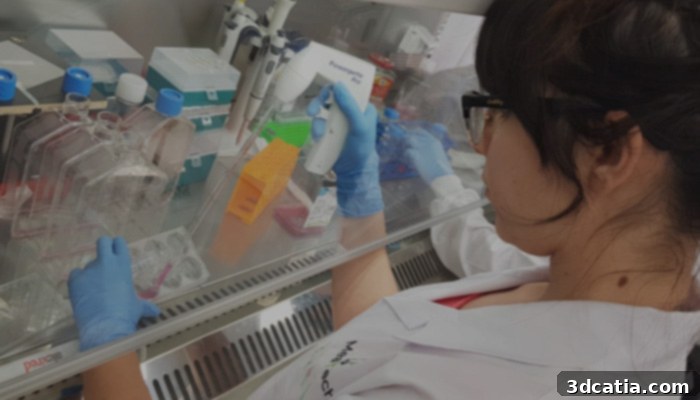
MeaTech’s cultivated meat sample | Image via MeaTech
MeaTech’s recent announcement underscores not just one, but three significant scientific and technological milestones achieved by the company. These accomplishments collectively demonstrate a major leap forward in the field of cellular agriculture and food technology:
- Successful Sorting and Differentiation of Stem Cells: A critical challenge in cultivated meat production is the ability to reliably direct stem cells to differentiate into the specific cell types that constitute meat. MeaTech has proven its capability to successfully sort stem cells into distinct fat and muscle cells. This precise control is fundamental, as it allows for the independent synthesis and maturation of muscle fibers (for texture and protein) and fat tissue (for flavor, juiciness, and aroma). This ability to create both components separately, and then combine them, is crucial for recreating the complex sensory experience of traditional meat.
- Formulation and Production of Specialized Bio-Inks: The success of 3D bioprinting hinges on the development of suitable bio-inks. These aren’t just any inks; they are carefully engineered formulations that contain living cells, along with biocompatible materials that provide structural support and promote cell viability and growth during and after the printing process. MeaTech’s achievement in formulating and producing bio-inks specifically designed to print both fat and muscle cells, enabling them to ultimately form cohesive tissues, is a testament to their deep understanding of biomaterials and cell biology. These bio-inks must maintain cell integrity, allow for precise extrusion, and support the subsequent development of the printed construct.
- Formation of Printed Tissue with Coalesced Fat and Muscle Cells: The ultimate goal is not just to print individual cells, but to create a unified tissue where muscle and fat cells integrate and coalesce naturally. MeaTech’s success in forming printed tissue that contains these coalesced fat and muscle cells signifies that the printed structure isn’t merely a collection of cells, but a functional, maturing biological entity. This coalescence is vital for developing the desired texture, marbling, and overall organoleptic properties that define high-quality meat. It indicates that the cells are communicating and organizing themselves, mimicking in-vivo tissue development.
The Broader Impact: Sustainability, Ethics, and the Future of Food
The implications of MeaTech’s advancements, and indeed the broader cultivated meat industry, extend far beyond just replicating a delicious steak. This technology addresses some of the most pressing challenges facing humanity today. Environmentally, traditional livestock farming is a significant contributor to greenhouse gas emissions, deforestation, and water pollution. Cultivated meat production promises a drastically reduced environmental footprint, requiring less land, water, and energy, thereby offering a more sustainable path to feeding a growing global population.
Ethically, the concept of “slaughter-free” meat resonates deeply with consumers concerned about animal welfare. By producing meat from cells rather than entire animals, the industry can eliminate the ethical dilemmas associated with intensive farming practices. Furthermore, cultivated meat could offer potential health benefits, as the production process allows for greater control over the nutritional profile, potentially enabling the reduction of unhealthy fats or the elimination of antibiotics and growth hormones commonly used in conventional agriculture.
While the scientific progress is undeniable, the journey ahead for MeaTech and the cultivated meat industry involves significant challenges. The primary hurdle remains scalability – transitioning from laboratory-scale prototypes to industrial-scale production that can compete with conventional meat on price and availability. Regulatory approval processes will also play a crucial role, varying significantly across different regions. Consumer acceptance is another key factor; educating the public about the safety, benefits, and nature of cultivated meat will be essential for widespread adoption. However, MeaTech’s clear vision to scale up their technology indicates a strong commitment to overcoming these obstacles.
Conclusion: A Taste of Tomorrow
MeaTech’s breakthrough in 3D bioprinting slaughter-free meat tissue using stem cells represents a monumental step forward for food technology and sustainable living. By mastering the art of cell differentiation, bio-ink formulation, and tissue coalescence, they are not just creating alternative proteins; they are engineering the very future of how we consume meat. The ability to precisely replicate the complex textures of whole cuts, combined with the ethical and environmental advantages of cultivated meat, positions this technology as a genuine game-changer.
As we look to a future where food security and sustainability are paramount, innovations like MeaTech’s offer a tantalizing glimpse into a more responsible and resource-efficient food system. The potential for 3D printed cultivated meat to transform our plates, reduce our environmental impact, and redefine our relationship with food is immense. We eagerly anticipate how this technology will evolve and if it can indeed be scaled up to meet the ambitious goals MeaTech has set for itself. For more detailed information, you can visit their official website HERE.
The conversation around sustainable protein is more vibrant than ever. Would you be willing to try 3D printed meat crafted from stem cells? Share your thoughts and engage with us! Let us know your perspective in the comments section below or connect with us on our social media platforms like Facebook and Twitter. Don’t miss out on the latest advancements and news in the exciting world of 3D printing by signing up for our free weekly Newsletter, delivered directly to your inbox!