
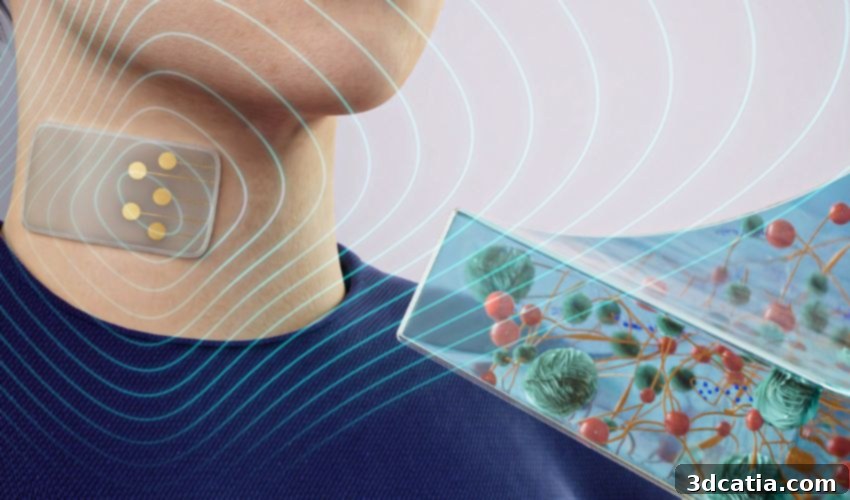
Revolutionary 3D Printed Electronic Skin: Advancing Human-Machine Interaction with Bio-Inspired Sensing
The human body’s largest organ, the skin, serves as an intricate interface with the external world. Boasting over 1,000 nerve endings per square inch, it provides an unparalleled sensory connection, enabling us to perceive touch, temperature, and pressure. This remarkable complexity makes replicating human skin an incredibly difficult challenge, even with advanced technologies like 3D printing. However, a significant breakthrough from researchers at Texas A&M University suggests that this challenge may soon be overcome. They have successfully developed a novel 3D printed electronic skin, or e-skin, engineered to mimic the human skin’s natural ability to flex, stretch, and sense. This innovative development holds immense promise, potentially marking the first step towards a new era of seamless and intuitive human-machine interaction.
While the concept of lifelike artificial skin might sound like something out of science fiction – reminiscent of androids indistinguishable from humans or transformative bionic surgeries – this 3D printed electronic skin is very much a reality. Its creation is a testament to the powerful combination of bioengineered hydrogels and cutting-edge 3D printing techniques. Beyond its impressive technical achievement, this e-skin is poised to revolutionize numerous applications, offering profound benefits, particularly for individuals with disabilities by enhancing prosthetic capabilities and enabling more responsive assistive devices.
The Vision: Replicating Touch for Advanced Human-Machine Interfaces
Dr. Akhilesh Gaharwar, a distinguished professor and director of research for Texas A&M’s Department of Biomedical Engineering, articulates the profound impact of this innovation. He states, “The ability to replicate the sense of touch and integrate it into various technologies opens up new possibilities for human-machine interaction and advanced sensory experiences.” This sentiment underscores the fundamental goal of their research: to bridge the gap between human perception and technological functionality. He further explains, “The inspiration behind developing E-skin is rooted in the desire to create more advanced and versatile interfaces between technology, the human body and the environment.”
The potential applications of this e-skin are vast and diverse, spanning multiple industries and improving daily life in myriad ways. Dr. Gaharwar highlights several key areas: “The most exciting aspect of this research is its potential applications in robotics, prosthetics, wearable technology, sports and fitness, security systems and entertainment devices.” In robotics, this could mean robots with a more delicate touch, capable of handling fragile objects or interacting with humans in a safer, more nuanced manner. For prosthetics, it promises a future where artificial limbs not only move but also feel, providing users with crucial sensory feedback that significantly enhances dexterity and integration with their own bodies. Wearable technology could evolve beyond simple data collection to offer truly interactive and responsive experiences, while sports and fitness devices could provide real-time biomechanical feedback. Even in security and entertainment, the e-skin could pave the way for more immersive and personalized experiences.
Transforming Healthcare: Wearable Monitoring and Rehabilitation
One of the most immediate and impactful applications outlined by the researchers involves wearable health devices. This 3D printed e-skin could be integrated into devices capable of continually monitoring vital signs with unprecedented accuracy, surpassing the capabilities of current smartwatches and fitness trackers. Imagine a patch on your skin that not only tracks your heart rate and temperature but also provides sophisticated feedback to users. This could be particularly revolutionary for rehabilitation, helping individuals improve motor skills and coordination by offering real-time, tactile feedback during therapeutic exercises.

This breakthrough is expected to impact many industries, including wearable electronics, such as the smartwatches seen here. Thanks to this 3D printed electronic skin, vital signs will be even more accurate and feedback more intuitive.
The precision and flexibility of this e-skin would allow for continuous, non-invasive health monitoring, potentially detecting subtle changes in physiological parameters that might otherwise go unnoticed. This constant stream of accurate data could empower both patients and healthcare providers, facilitating personalized medicine and proactive health management. For athletes, it could offer advanced performance tracking and injury prevention insights. For the elderly or those with chronic conditions, it could provide a crucial layer of safety and continuous oversight, sending alerts in case of anomalies and improving overall quality of life.
Making the 3D Printed Electronic Skin: Overcoming Engineering Challenges
What sets this e-skin apart from previous attempts? A key differentiator lies in its significantly improved flexibility and reduced stiffness. Earlier projects often struggled to achieve the delicate balance between electronic functionality and mechanical properties that truly mimic human skin. The Texas A&M researchers tackled this by leveraging the power of 3D printing in conjunction with innovative bioengineered hydrogels. These specialized hydrogels are capable of exhibiting tunable electronic and thermal biosensing capabilities, meaning their electrical and thermal properties can be precisely controlled and adjusted.
This careful engineering allowed the team to create an e-skin that is remarkably as flexible as human skin. Crucially, it integrates sophisticated bioelectrical sensing capabilities directly within its structure, enabling it to detect electrical signals similar to how human nerves respond to stimuli. Furthermore, the fabrication techniques employed are suitable for creating devices that are either wearable or implantable, opening up vast possibilities for medical and prosthetic applications. The ability to customize the e-skin’s properties allows it to adapt to various bodily contours and functions, a critical step towards seamless integration with biological systems.
To specifically overcome the pervasive issue of stiffness, the researchers capitalized on a unique property of their hydrogels: their ability to decrease viscosity under shear stress during the 3D printing process. This shear-thinning behavior makes the material exceptionally pliable and easier to handle and manipulate during fabrication. By controlling this property, the team could precisely construct intricate 2D and 3D electronic structures, which are essential for replicating the complex, multi-layered nature of human skin. While the specific 3D printing technology used was not detailed in the press release, given the properties of hydrogels and similar past projects, it is highly probable that an extrusion-based 3D printing method was employed. Extrusion printing is particularly well-suited for depositing viscous, soft materials with high precision, allowing for the creation of complex geometries with embedded functionalities.
Advanced Material Innovations: Nanoparticles for Superior Functionality
Beyond the novel use of hydrogels and advanced 3D printing techniques, the researchers also incorporated a material with carefully engineered imperfections in its atomic structure. This seemingly counter-intuitive design choice was crucial for achieving high electrical conductivity, a vital characteristic for any functional electronic skin. These atomic imperfections create pathways for efficient electron flow, allowing the e-skin to transmit electrical signals effectively. In addition to this, nanoparticles were integrated into the material composition, serving a critical role in enhancing the e-skin’s adhesion properties, particularly its ability to stick to wet biological tissues.
These specialized nanoparticles interact synergistically with the hydrogel matrix, imparting both electrical and thermal conductivity to the 3D printed electronic skin. Their presence is fundamental to the e-skin’s overall functionality, enabling it to not only sense electrical signals but also detect temperature changes, mirroring the thermal receptors in human skin. Dr. Shounak Roy, a former Fulbright Nehru doctoral fellow in Gaharwar’s Lab and one of the paper’s lead authors alongside Dr. Kaivalya Deo, emphasizes the novelty of their approach:
We are the first to report using [nanoparticles] as the key component. The material’s ability for adhesion to wet tissues is particularly crucial for potential healthcare applications where the E-skin needs to conform and adhere to dynamic, moist biological surfaces.”
This unique combination of materials and fabrication methods represents a significant leap forward in the field of soft electronics and biomimicry. The strong adhesion to wet tissues is paramount for long-term, stable performance in real-world scenarios, especially for implantable devices or continuous wearable monitoring where bodily fluids and movement are constant factors. This innovation ensures that the e-skin remains securely in place, maintaining its sensing capabilities without degradation, thus paving the way for truly integrated human-machine systems.
To delve deeper into the specifics of this groundbreaking research, you can find more information in Texas A&M’s official press release HERE. What are your thoughts on this revolutionary 3D printed electronic skin? Which applications do you believe hold the most promise for its implementation? Share your insights in a comment below or join the conversation on our LinkedIn, Facebook, and Twitter pages! Don’t miss out on the latest advancements in additive manufacturing – remember to sign up for our free weekly newsletter here, delivering the newest 3D printing news straight to your inbox! You can also explore all our informative videos on our YouTube channel.
*Cover Photo Credits: INMYWORK Studio