

3D-Printed Robot Hand Conquers Super Mario Bros. with Groundbreaking Soft Robotics and Fluidic Controls
Engineers at the University of Maryland have achieved a significant milestone in robotics and additive manufacturing, developing a sophisticated 3D-printed robot hand capable of playing one of Nintendo’s most iconic video games, Super Mario Bros. This remarkable feat, which might initially sound like something from a science fiction novel, is now a tangible reality, demonstrating highly successful results. Through precise programming of its delicate finger movements, this innovative robot hand successfully navigated and completed the challenging first level of Super Mario Bros. While the research team acknowledges that a more traditional demonstration, such as playing a piano score, could have been used to evaluate the hand’s capabilities and performance, they opted for a uniquely challenging and engaging task. They found the inherent precision and real-time responsiveness required by the video game to be a far more compelling and rigorous test for their goals, pushing the boundaries of soft robotics in an unprecedented way.
The convergence of 3D printing and robotics continues to drive groundbreaking innovation across various fields. Numerous initiatives today leverage the synergistic advantages of these two transformative technologies. For instance, a notable project from Cornell University previously utilized additive manufacturing to create a robotic muscle with the astonishing ability to sweat and self-regulate its temperature. Such research underscores the immense and undeniable potential that arises when 3D printing and robotics are combined. The authors of the University of Maryland project certainly concur with this sentiment. As co-author Joshua Hubbard explained, their integrated approach overcomes significant limitations found in conventional soft robotics: “Previously, each finger of a soft robotic hand would typically need its own control line, which can limit portability and usefulness. But by 3D printing the soft robotic hand with our integrated fluidic transistors, it can play Nintendo based on just one pressure input.” This singular input control represents a major leap forward, simplifying complex robotic movements and enhancing the practicality of soft robotic designs.
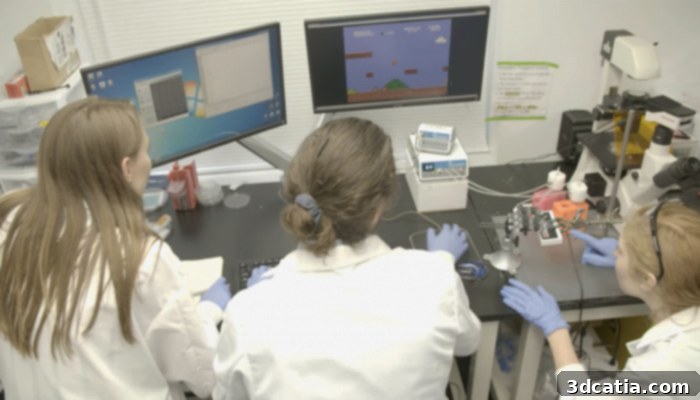
Researchers studying a game from Nintendo to help program the 3D-printed robotic hand (photo credits: University of Maryland)
The 3D-Printed Robot Hand: An Engineering Marvel
To fabricate the intricate components that form this advanced robot hand, the researchers employed Stratasys’ advanced PolyJet technology. PolyJet is a sophisticated form of material jetting that allows for the simultaneous printing of multiple materials with varying mechanical and aesthetic properties, making it ideal for creating complex, multi-material soft robots. Soft robots, like this pioneering hand, are inherently characterized by their exceptional malleability and adaptability, as they are constructed from highly flexible materials such as specialized rubbers or silicones. This inherent flexibility provides a level of compliance and safety often lacking in rigid robotic systems, making them suitable for interacting with delicate objects or operating in close proximity to humans.
A key innovation in this 3D-printed hand lies in its integration of “fluidic circuits” within the three fingers. These precisely engineered channels act as controlled pipes, enabling the fingers to move solely through the manipulation of air pressure, entirely eliminating the need for additional electrical components or wires. This fluidic control system dramatically simplifies the design and operation of the robot. Ryan Sochol, a co-author of the study, elaborated on this innovative approach: “These special types of robots are powered using fluids like water or air. Soft robots can stretch or be inflated or deflated relatively easily. As a result, they have inherent adaptability to reform around complex and sometimes delicate objects. What’s special here is that we made a new type of fluidic circuit that can sense the pressure types of air to decide how it’s going to behave.” This ability to “sense” and respond to pressure variations within the fluidic circuit is what grants the robot hand its remarkable dexterity and responsive control, mimicking the complex mechanics of biological systems.
Unlike traditional electronic microchips that rely on semiconductor transistors to switch movement signals on and off, this 3D-printed soft robot leverages sophisticated pressure sensors strategically embedded within each of its fingers. This ingenious design allows the precise movements of the fingers to be meticulously controlled by the subtle variations in air pressure flowing through the hand’s integrated fluidic circuits. The choice to test the robot’s capabilities by playing Super Mario Bros. was a deliberate one, designed to push the boundaries of robotic precision and real-time control. Sochol further elucidated the rationale behind this challenging evaluation: “With a piano, we’d be able to set the tempo arbitrarily and any errors like missing a note wouldn’t have meaningful penalties. In contrast, the video game’s timing and level make-up have long been established and are invariable, with just a single mistake able to result in an immediate game over, so playing a game like Super Mario Bros. in real time provided a means for evaluating soft robot performance that was uniquely challenging and uncompromising.” This highlights the game’s unforgiving nature as an ideal benchmark for assessing a robot’s ability to execute complex, sequential actions with split-second timing and zero tolerance for error, mirroring demands in critical real-world applications.
Unlocking Future Potential: Applications of Soft Robotics
The extraordinary success achieved in this research has illuminated a vast array of potential application areas for these advanced soft robots, particularly within the medical sector. The inherent ability of soft robots to mold, expand, and delicately conform around complex and often irregular structures makes them exceptionally well-suited for interaction with the human body. This flexibility significantly minimizes the risk of tissue damage, a common concern with rigid robotic instruments. Imagine surgical tools that can gently navigate intricate anatomical pathways, adapting their shape to reach difficult areas without causing harm, or internal devices that can safely deliver drugs with unparalleled precision. This opens up groundbreaking avenues for applications such as minimally invasive surgical instruments, targeted drug delivery systems that can release medication exactly where and when it’s needed, and highly customized prosthetics that offer more natural movement and a superior fit for individual patients. The integration of 3D printing allows for rapid prototyping and personalization, ensuring that these medical devices can be tailored to the unique needs of each patient, enhancing both efficacy and comfort.
Beyond healthcare, the implications of this breakthrough in fluidic soft robotics extend to numerous other fields. In manufacturing, these dexterous hands could be employed for delicate assembly tasks or handling fragile components where traditional grippers might cause damage. Their compliance makes them ideal for human-robot collaboration in industrial settings, where safety and adaptability are paramount. Furthermore, the ability to operate without electricity could make them invaluable in hazardous environments, such as underwater exploration, chemical handling, or even space missions, where electrical interference or power limitations are significant concerns. The simplicity of control via a single pressure input also reduces the complexity of programming and increases the robustness of the system, paving the way for more autonomous and reliable robotic agents. This research from the University of Maryland marks a pivotal moment, showcasing not only the exciting future of human-robot interaction but also the transformative power of additive manufacturing in bringing such advanced technologies to life. For those eager to delve deeper into the technical aspects, the comprehensive research article is available HERE.
What are your thoughts on this incredible 3D-printed robot hand that can master Nintendo’s Super Mario Bros.? Do you envision other revolutionary applications for soft robotics and fluidic controls? Share your insights in a comment below or join the conversation on our Facebook and Twitter pages. And don’t miss out on the latest advancements in additive manufacturing – subscribe to our free weekly newsletter to get all the cutting-edge 3D printing news delivered straight to your inbox!