
Unlocking Nature’s Hidden Dimensions: Nicholas Sherlock’s 3D Printed Stereoscopic Macro Lens System
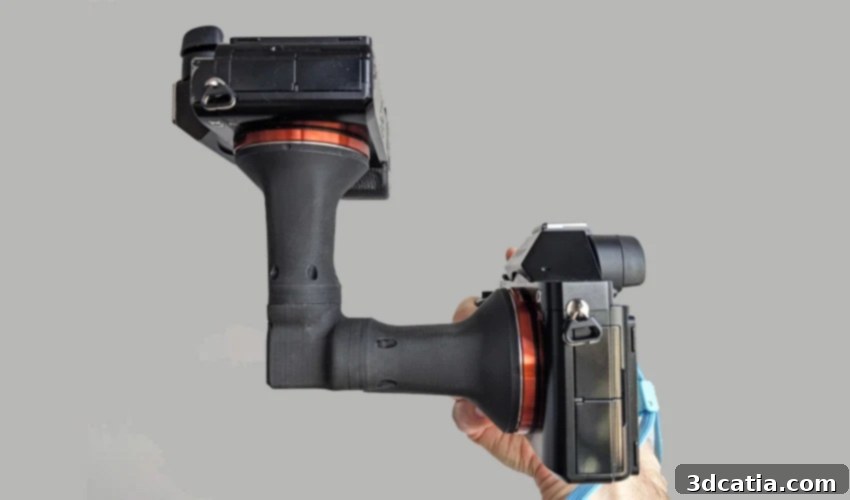
In the rapidly evolving landscape of photography, innovation often arises from passionate individuals who dare to challenge conventional limitations. Some projects leveraging the power of 3D printing are so profoundly unique and original that they demand global attention. This particular endeavor takes us into the fascinating world of amateur photographer and software developer Nicholas Sherlock, a New Zealander whose ingenuity has birthed an extraordinary 3D-printed lens system. This custom-engineered solution is designed to deliver optimal magnification, allowing photographers to immortalize living organisms in their natural habitats with breathtaking clarity and astonishing depth. The true marvel of this system lies not just in the incredible results it produces, but also in the ingenious design of the camera setup itself – or rather, cameras, as Sherlock’s 3D-printed equipment ingeniously combines two lenses to achieve truly astounding stereoscopic images.
Nicholas Sherlock, a talented software developer based in New Zealand, quickly discovered a profound passion for photography. Like many creatives, he encountered limitations with commercially available equipment, prompting him to leverage his technical skills. His website proudly declares his DIY philosophy: “When I couldn’t find the photography equipment I wanted, I designed it myself and 3D-printed it!” This ethos underpins much of his work, which extends beyond this particular macro lens system. Indeed, Sherlock has meticulously designed and 3D-printed various photography accessories, including custom tripods, specialized lens adapters, and, most notably, the groundbreaking “3D macro lens.” This innovative system offers double the standard magnification and an impressive 18 x 12 mm field of view, pushing the boundaries of what’s achievable in amateur and semi-professional macro photography.
The Genesis of an Idea: Bridging Software and Photography Through 3D Printing
Sherlock’s journey highlights a growing trend: the convergence of digital fabrication and artistic pursuits. His background in software development provided him with the analytical and problem-solving skills necessary to tackle complex optical and mechanical challenges. Instead of waiting for manufacturers to produce niche equipment, he took matters into his own hands, transforming digital designs into physical reality with a 3D printer. This approach not only democratizes access to specialized tools but also fosters a culture of innovation where creators can iterate and perfect their designs with unprecedented speed and flexibility. The “3D macro lens” is a testament to this philosophy, showcasing how personal drive combined with accessible technology can lead to groundbreaking achievements in photography.
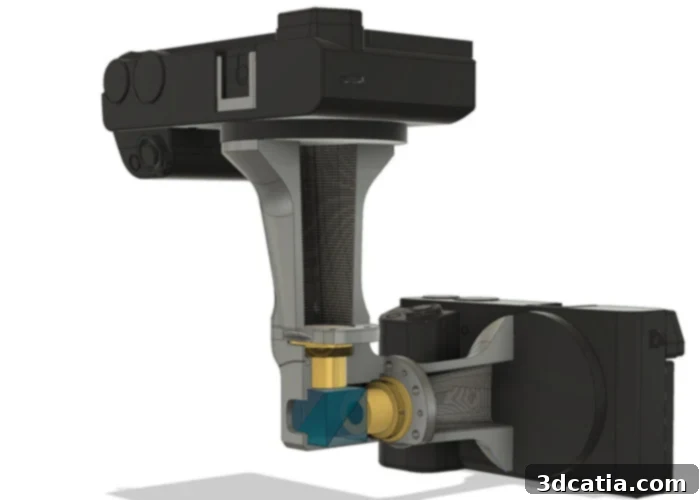
STL files for Nicholas Sherlock’s innovative 3D Printed Stereoscopic Macro Lens are freely available on the Printables website, empowering makers worldwide.
Technical Ingenuity: How the Stereoscopic Lens System Works
What truly sets Sherlock’s creation apart is its sophisticated technical design, enabling true stereoscopic 3D capture. This innovative lens system is not merely a single lens but an integrated unit meticulously engineered for compatibility with two Sony E/FE mirrorless cameras. At its core, the system incorporates two powerful 4x microscope lenses, which collectively provide a remarkable 2x optical magnification. This dual-camera, dual-lens approach is absolutely crucial for achieving the stereoscopic effect, which gives the photographs a perception of depth. Unlike traditional macro photography, which often struggles to convey the true dimensionality of tiny subjects, Sherlock’s setup ingeniously mimics human binocular vision, capturing two slightly different perspectives of the same subject simultaneously. This results in images that are not only sharp and detailed but also possess an immersive three-dimensional quality.
The Beam-Splitting Prism: The Heart of the Stereoscopic Capture
The true genius of this system lies in its use of a specialized component: a beam-splitting prism. As the photographer explains, the light from the subject passes through this prism, which effectively divides the optical path. One camera is mounted either at the top or bottom of the equipment, capturing one distinct perspective of the subject. Simultaneously, the other camera is aimed normally at the subject, capturing a slightly offset view. This simultaneous capture of two distinct images, each with a subtle shift in perspective, is what allows for the creation of stunning 3D photographs. When these images are later combined and viewed correctly (as detailed below), the human brain interprets the disparities as depth, transforming what would otherwise be flat macro shots into vivid, immersive three-dimensional scenes. This innovative arrangement provides an unparalleled level of detail and realism, especially for capturing the intricate features of small living organisms in their natural environments without disturbing them.
Embracing Open Source: Sharing Innovation with the Global Community
In a move that profoundly underscores the collaborative and community-driven spirit of the 3D printing world, Nicholas Sherlock has made this remarkable photographic equipment available as open-source on the popular Printables website. By releasing his meticulously designed 3D files (STL files), he not only invites fellow enthusiasts to replicate his ingenious design but also actively encourages them to modify, improve, and share their own adaptations. This open-source approach serves multiple vital purposes: it significantly accelerates innovation within the niche field of specialized photography tools, and it democratizes access, circumventing the often prohibitively high costs associated with commercially produced macro photography setups. Furthermore, demonstrating his commitment to accessibility, Nicholas has thoughtfully announced that he will soon be offering pre-printed versions of his product for sale. This thoughtful provision ensures that his groundbreaking invention reaches anyone keen to explore the captivating world of stereoscopic macro photography, regardless of whether they own a 3D printer or have experience with additive manufacturing technology.
3D Printing Best Practices: Materials and Parameters for Optimal Performance
For those looking to 3D print their own stereoscopic macro lens, Nicholas provides invaluable and detailed printing tips on the dedicated Printables site. He specifies that he primarily used black ABS+ from eSUN for his prototypes, a material highly regarded for its excellent strength, good heat resistance, and moderate flexibility, which is beneficial for components that need a degree of resilience. However, he also highly recommends ASA (Acrylonitrile Styrene Acrylate), another robust engineering-grade thermoplastic that offers superior UV resistance, making it an ideal choice for outdoor photography equipment that will be exposed to sunlight. The selection of a strong, durable material like ABS+ or ASA is paramount to ensure the structural integrity of the complex lens housing and its ability to withstand environmental factors, protecting the delicate optical components. Beyond material selection, Sherlock communicates several critical print parameters crucial for achieving the precision required for photographic equipment. These include optimal layer height for fine detail reproduction, infill density for maximizing strength without excessive material use, and specific recommendations for print supports to ensure complex geometries are printed accurately. These detailed instructions are essential for ensuring that the printed parts fit together perfectly, maintain precise optical alignment, and ultimately contribute to high-quality photographic results. His ultimate goal is truly to empower a large community of photography and 3D printing enthusiasts to successfully recreate and benefit from his pioneering invention.
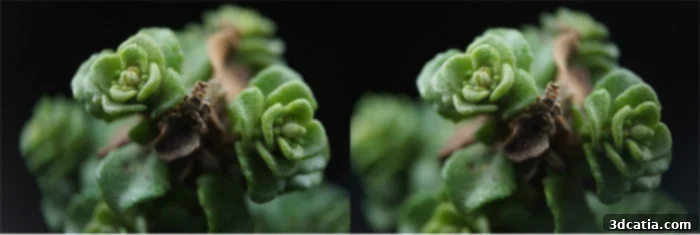
Experience the breathtaking 3D effect firsthand by performing the cross-eye viewing technique as described in the article.
Mastering the Art of 3D Viewing: The Cross-Eye Technique for Stereoscopic Photos
Experiencing the full immersive potential of photos taken with this 3D-printed photographic equipment requires a specific viewing technique known as the cross-eye method. Nicholas Sherlock meticulously explains this process, guiding viewers through the steps to perceive true depth: “If you hold your finger up in front of your face and look at it, your eyes converge (cross) in order to both point at it. If you now move your finger towards you and away from you, in the background you will see the two side-by-side photos cross over each other more and less, respectively. Move your finger until both images in the background fully fuse together to form a third image in the middle of your field of view. The trick is now that you need to keep your eyes at the same convergence (still crossed to point at your finger) but you need to refocus to look at the monitor. This takes some practice, but once you get good at it, you can cross your eyes at will without using a finger. The fused third central image will now appear to be 3D.” This technique, while initially requiring a bit of patience and practice, unlocks a whole new dimension of photographic appreciation. The human brain, remarkably adaptable, merges the two distinct images – each taken from a slightly different angle – into a single, cohesive 3D perception. This process allows intricate details of insects, plants, and other tiny subjects to literally pop out with startling realism and depth, revealing textures and forms previously hidden in two-dimensional images. We highly encourage you to try this fascinating exercise with the example image provided above to truly grasp the innovation and impact of Sherlock’s work!
The Broader Impact: Inspiring the Next Generation of Creator-Photographers
Nicholas Sherlock’s stereoscopic macro lens system is far more than just a clever gadget; it’s a powerful demonstration of how accessible technologies like 3D printing can empower individuals to transcend the limitations of commercial markets and create specialized tools meticulously tailored to their unique needs and artistic visions. This project serves as a profound inspiration for photographers, engineers, and makers alike, showcasing the immense potential that unfolds when different disciplines converge. It highlights that professional-grade results and truly innovative solutions are no longer solely the domain of large corporations with vast R&D budgets but are increasingly within the reach of dedicated hobbyists and independent innovators. This open-source initiative fosters a collaborative environment where knowledge and sophisticated designs are freely shared, significantly accelerating the pace of discovery and development in niche fields such as extreme macro photography and scientific imaging.
To delve deeper into Nicholas’s innovative work and explore his other DIY photography projects, you can visit his comprehensive website HERE. We are genuinely curious to hear your thoughts on this remarkable 3D-printed photographic equipment. Do you envision trying to print one yourself, or are you excited about the possibility of purchasing a pre-printed version? Share your insights and experiences in a comment below or engage with us on our vibrant social media platforms: LinkedIn, Facebook, and Twitter pages! Don’t miss out on the latest advancements in additive manufacturing – remember to sign up for our free weekly Newsletter here, delivering the freshest 3D printing news straight to your inbox! You can also find all our compelling videos and more insights on our dedicated YouTube channel.
*All Photo Credits: Nicholas Sherlock