

Revolutionizing Infrastructure: Exploring the World’s Most Innovative 3D-Printed Bridges
The construction industry is experiencing a profound transformation with the widespread adoption of additive manufacturing. This innovative technology, commonly known as 3D printing, is no longer confined to prototyping or small-scale fabrication; it’s actively shaping the future of large-scale infrastructure projects. From building houses and schools to intricate architectural components and vital connecting structures, 3D technology offers a multitude of compelling benefits. In the realm of urban architecture, 3D-printed bridge projects have seen a remarkable proliferation in recent years. Countries worldwide are increasingly leveraging additive manufacturing to construct these essential links, driven by factors such as reduced costs, faster construction times, enhanced design freedom, and improved sustainability. These advantages are particularly significant in a sector constantly seeking more efficient and environmentally friendly solutions.
The appeal of 3D printing in bridge construction lies in its ability to optimize material use, create complex geometries previously unachievable with traditional methods, and accelerate project timelines. This leads to not only economic savings but also a lower environmental footprint, a crucial consideration for modern development. To provide a comprehensive overview of this exciting trend, we have curated a list of some of the most pioneering 3D-printed bridge initiatives from recent years, highlighting projects that are either fully completed or currently under active construction, demonstrating the rapid advancements in this field.
A Walkway Optimized for Minimal Material Use
Challenging traditional construction norms, Ghent University spearheaded an extraordinary initiative to create a walkway using additive manufacturing, significantly reducing both material consumption and environmental impact. This ambitious project saw Ghent University collaborate with Vertico and Technion – Israel Institute of Technology. Their objective was to design a pedestrian bridge that, while not massive in scale, would be aesthetically striking and, more importantly, a testament to topology optimization. By meticulously designing the bridge’s structure to use material only where absolutely necessary, they achieved an impressive reduction in raw materials. For this endeavor, they utilized a specialized concrete 3D printer, boasting a generous printing volume of 4.5 x 2 x 2.5 meters, along with a custom-engineered material blend. This approach not only demonstrates the potential for structural elegance but also aims to substantially reduce CO2 emissions and boost overall productivity within the construction sector, setting a new benchmark for sustainable infrastructure.

Photo Credit: Vertico
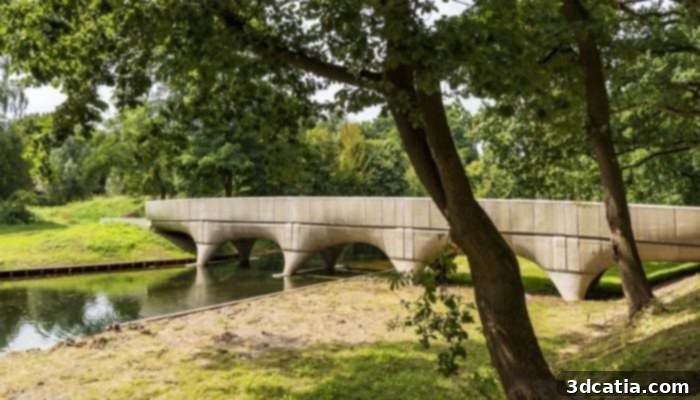
The Technological University of Eindhoven’s Groundbreaking Collaboration
The Technological University of Eindhoven (TU/e) has been at the forefront of 3D printing innovation in construction, particularly with its collaboration on the design of what was, at its completion, the longest 3D-printed bridge specifically built for cyclists. Acclaimed architect Michiel van der Kley, alongside engineering firms Summum Engineering and Witteveen+Bos, partnered with TU/e to bring this visionary 3D model to life. The bridge itself was manufactured at the advanced 3D printing center of Saint-Gobain Weber Beamix, a facility equipped with several BAM robotic arms that enable large-scale concrete printing. Spanning an impressive 29 meters, the bridge was intentionally designed with soft, rounded, and natural shapes. This aesthetic choice ensures that the structure seamlessly integrates with its outdoor environment, offering both functionality and visual harmony. This project not only showcases the robust capabilities of concrete 3D printing for infrastructure but also highlights the potential for creating custom, organic designs that are challenging to achieve with conventional building methods, thus enhancing urban landscapes.
Acciona’s Pioneering 3D-Printed Bridge in Madrid
Marking a significant milestone in civil engineering, Acciona, a prominent Spanish company with diverse business lines spanning energy, infrastructure, and now additive manufacturing, installed one of the world’s very first 3D-printed bridges. Located in Alcobendas, a municipality in Madrid, this concrete pedestrian structure quickly garnered international attention. While Acciona managed the cutting-edge 3D printing process, the conceptual design of the bridge was masterfully crafted by the Institute of Advanced Architecture of Catalonia (IAAC), known for its innovative approaches to urban planning and construction. From a technical standpoint, the bridge is an impressive feat, measuring 12 meters in length and 1.75 meters in width. Its construction represented a pivotal moment for civil engineering in the Iberian country, demonstrating the viability of large-scale 3D printing for public infrastructure. Furthermore, its design is characterized by an organic and biomimetic architecture, gracefully mimicking natural forms and blending harmoniously with its surroundings. This project not only showcased the functional advantages of 3D printing but also its potential to create structures with unique aesthetic qualities and environmental integration.
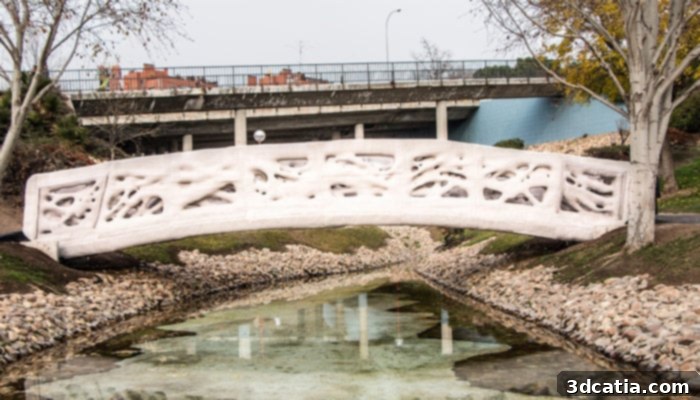
Photo Credit: Acciona
The Netherlands Unveils its First 3D-Printed Bridge
In 2017, the Netherlands proudly introduced its first 3D-printed concrete bridge, a collaborative effort between the Eindhoven University of Technology (TUE) and the construction company BAM Infra. This pioneering structure consists of 800 precisely printed layers of concrete, meticulously fused together to form a robust and functional bridge. Measuring 8 meters in length and 3.5 meters in width, the bridge gracefully spans a ditch, providing a vital connection between two roads in the town of Gemert. A key objective for TUE and BAM Infra was to demonstrate how 3D printing could significantly minimize the amount of concrete required for such a structure compared to conventional building methods. This material optimization not only reduces costs but also lessens the environmental impact associated with concrete production and transportation. The efficiency of additive manufacturing was clearly evident in the construction timeline, with the entire bridge being completed in a remarkably swift three months. This project served as a powerful proof-of-concept, establishing the Netherlands as a leader in applying 3D printing to civil engineering.
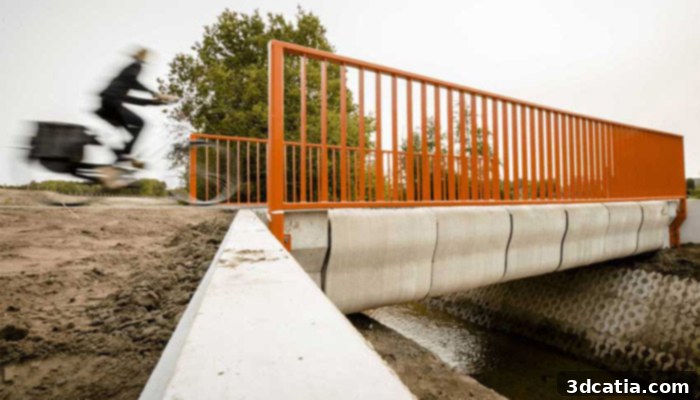
Photo Credit: Bart Maat / EPA
Shanghai’s Longest 3D-Printed Concrete Bridge
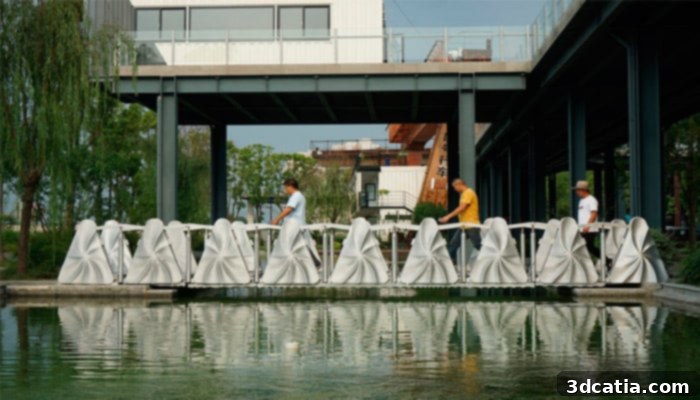
China has also made significant strides in 3D-printed infrastructure, highlighted by Shanghai’s longest 3D-printed concrete bridge. Supported by an impressive 176 individual cement units, this bridge allows pedestrians to cross the Shanghai Canal, offering a new pathway for urban mobility. The bridge was conceptualized and designed by a dedicated team led by Professor Wu Weiguo from Tsinghua University, a renowned institution for innovation. Leveraging additive manufacturing techniques, the structure was built near Wisdom Bay, a hub for technological development. The design of this pedestrian bridge draws inspiration from the historic Anji Bridge in Zhaozhou, China, a marvel of ancient engineering. By applying modern 3D printing to an iconic traditional form, the Shanghai bridge serves as a powerful symbol of 3D technology’s vast potential for diverse engineering projects. Two robotic arms were instrumental in its construction, efficiently creating the complex concrete arch in approximately 450 hours. The project team proudly reports that this advanced construction method resulted in an estimated two-thirds reduction in implementation costs when compared to traditional manufacturing processes, underscoring the economic benefits alongside its structural ingenuity.
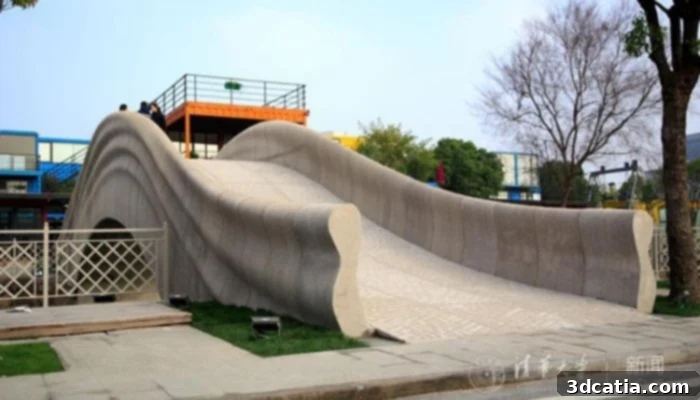
Photo Credit: JCDA
A Groundbreaking 3D-Printed Retractable Bridge
Adding another unique innovation to the world of 3D-printed infrastructure, China unveiled a remarkable retractable bridge, partially designed and fabricated using additive manufacturing. This structure stands out for its unique functionality: it can retract on demand, controlled by a simple Bluetooth-connected button. Unlike fully 3D-printed bridges, this design ingeniously combines conventional assembly with custom 3D-printed components. The bridge is composed of 36 triangular panels, which were custom-made through additive manufacturing in a mere three days. These panels were crafted from a composite material derived from recycled resources, emphasizing sustainability in its construction. Measuring 9 meters in length and 1.5 meters in width, the bridge was strategically installed in Wisdom Bay Park, serving as both a functional passage and a demonstration of advanced engineering and material science. This project exemplifies how 3D printing can be integrated into larger systems to create dynamic, responsive, and environmentally conscious infrastructure solutions, opening new avenues for interactive urban design.
Marine Corps Combat Testing of 3D-Printed Bridges
The application of 3D printing extends beyond civilian infrastructure into critical military operations. In 2019, the United States Marine Corps initiated a specialized training program for its divisions, focusing on the field operation of an Automated Construction of Expeditionary Structures (ACES) printer. This program underscores the military’s growing interest in leveraging additive manufacturing for rapid deployment and construction in challenging environments. While the Marine Corps continues to experiment with large-scale concrete and aluminum printer systems, their strategic vision is to deploy these advanced 3D printers, enabling field engineers to custom-produce essential bridge structures. These bespoke bridges would facilitate the swift and efficient crossing of various land gaps, providing crucial logistical advantages in combat or disaster relief scenarios. Captain Matthew Friedell, team leader of the Advanced Manufacturing Operations Cell in the Marine Corps Rapid Sustainment Office, explained the current focus: “The only restraints right now are working out intellectual property deals with industry.” He anticipates that within the coming years, the additive manufacturing industry and the U.S. Department of Defense will successfully finalize agreements for utilizing proprietary 3D technology, paving the way for revolutionary changes in military engineering and logistics.
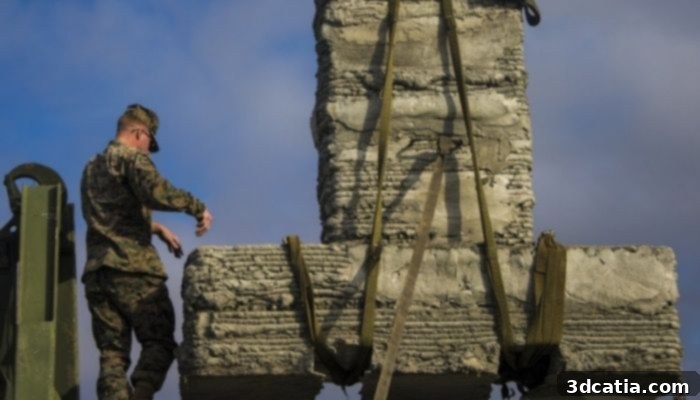
Securing a 3D-printed bridge support column during an exercise at Camp Pendleton, California. (Photo Credit: Marine Corps.)
A Lightweight Thermoplastic Pedestrian Bridge in Rotterdam
A collaborative effort between Royal HaskoningDHV, CEAD, and Covestro has led to the development of an innovative, lightweight 3D-printed pedestrian bridge prototype. This groundbreaking structure was manufactured using a specialized glass-filled thermoplastic composite material, chosen for its exceptional properties. The companies behind this project highlight that fiber-reinforced polymer bridges, like this prototype, are renowned for their significantly longer lifespan and lower life cycle costs compared to traditional steel structures. A notable aspect of this project is its pioneering use of large-scale continuous fiber-reinforced thermoplastic parts in bridge construction via 3D printing technology – a world first. The fabrication utilized fused granulate fabrication (FGF) and Covestro’s Arnite AM8527 pellet material. This innovative approach offers a multitude of benefits, including a reduced construction time, enhanced sustainability due to the material choice, a diminished maintenance burden over its operational life, and a substantially increased lifespan. While currently a prototype, the plan is for this advanced pedestrian bridge to ultimately be installed in the picturesque Kralingse Bos park in Rotterdam, demonstrating practical application and setting a new standard for sustainable urban infrastructure.
China’s Plastic-Based 3D-Printed Pedestrian Bridge
In 2018, a groundbreaking collaboration between the Chinese construction giant Shanghai Mechanized Construction Group Co (SMCC) and 3D filament manufacturer Polymaker resulted in the creation of an original 3D-printed bridge for a public park. This innovative pedestrian bridge, constructed primarily from plastic, showcases the versatility of additive manufacturing beyond traditional concrete or metal applications. The structure measures an impressive 15.25 meters long and 3.8 meters wide, with a substantial weight of 5,800 kilograms. To achieve these dimensions, the companies deployed an XXL 3D printer boasting an enormous print volume of 24 meters in length by 4 meters in width. The material of choice was acrylonitrile styrene acrylate (ASA), a robust engineering thermoplastic, specially reinforced with fiberglass to enhance its structural integrity and durability. Following its successful fabrication, the bridge was installed in 2019 and is projected to have an impressive lifespan of 30 years within the park environment. This project underscores the potential of advanced plastic composites in creating long-lasting, aesthetically pleasing, and environmentally conscious infrastructure solutions, demonstrating a significant leap in material science and large-scale 3D printing applications.
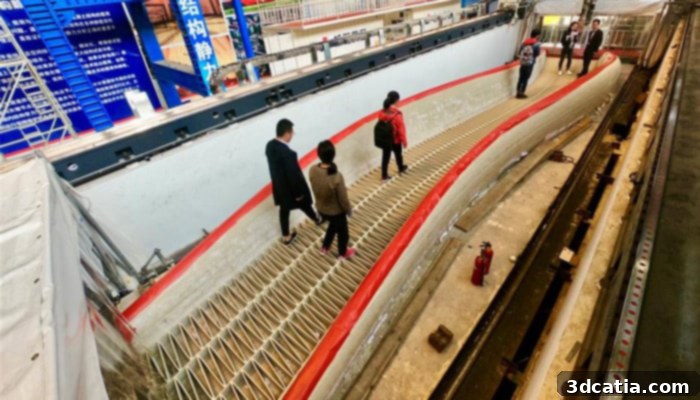
Photo Credit: Ti Gong
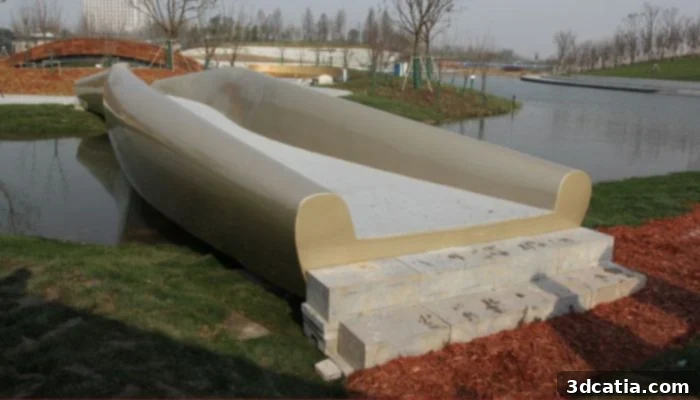
Photo credit: Polymaker
The Diamanti Bridge: A Modular, Sustainable Concept
An international consortium of researchers and companies has developed Diamanti, an innovative modular 3D-printed concrete bridge poised for exhibition at the prestigious Time Space Existence exhibition in Venice in 2025. This ambitious project, spearheaded by Professor Masoud Akbarzadeh in close collaboration with the Swiss company Sika Group, delves into the transformative potential of computational geometry and robotic fabrication. The aim is to significantly enhance efficiency and adaptability within concrete construction, moving towards more flexible and sustainable building practices. The Diamanti bridge is ingeniously composed of nine prefabricated segments. These segments are crafted from a custom cement-based mix and feature hollow geometries, a design choice that strategically reduces the overall material consumption without compromising structural integrity. The assembly process is equally innovative: the segments are connected using post-tensioned steel cables, completely eliminating the need for adhesives. This unique construction method renders the bridge both dismantlable and fully recyclable, highlighting a strong commitment to circular economy principles. To date, two versions of the Diamanti bridge have been constructed: a 2.5-meter prototype, which will be showcased in Venice, and a larger 10-meter version that has undergone rigorous structural testing in France, proving its scalability and robustness.
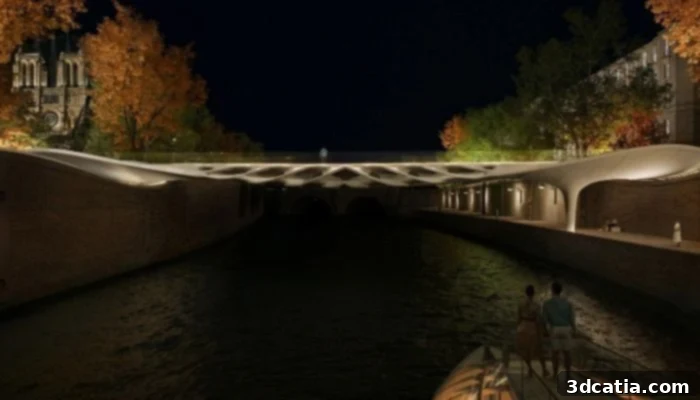
AI-generated image of the planned Diamanti Bridge. (Credits: Massive Form).
The Da Vinci Bridge: Bridging History with Sustainable Innovation
The recently unveiled Da Vinci Bridge in Bari stands as a compelling testament to how 3D printing can seamlessly merge historical engineering vision with cutting-edge sustainable innovation. This remarkable structure was brought to life using WASP’s large-scale 3D printer, a technology renowned for its ability to print with natural materials. The bridge itself was produced in 13 interlocking blocks, meticulously crafted from a unique mortar. This mortar is made from stone waste and lime, ingeniously giving new purpose to byproducts of marble and stone processing, thereby embodying principles of circular economy and waste reduction. Inspired by Leonardo da Vinci’s iconic 16th-century design for a self-supporting bridge, this modern rendition relies on the unparalleled precision of 3D-printed elements to achieve its inherent structural stability without external supports. The Da Vinci Bridge project not only revives and honors da Vinci’s brilliant architectural concept but also powerfully demonstrates how advanced digital fabrication techniques can dramatically reduce the environmental impact in contemporary construction, offering a sustainable path forward for architectural heritage reimagination.
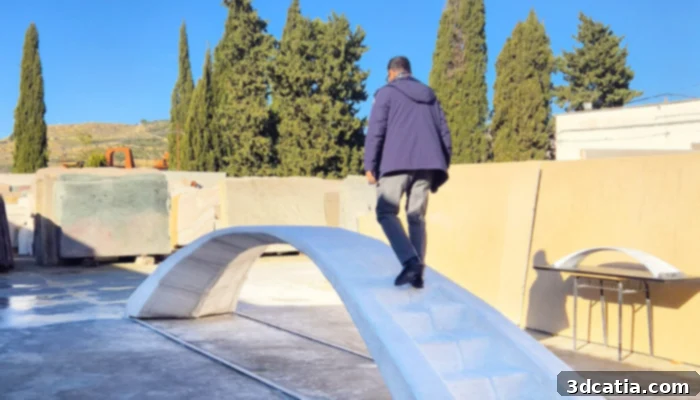
Photo Credit: WASP
The Phoenix Bridge: A Sustainable Vision by Holcim and Zaha Hadid Architects
Concluding our exploration of groundbreaking 3D-printed bridges is the Phoenix 3D-printed bridge, a testament to sustainable innovation designed by the Swiss cement manufacturing giant Holcim. This ambitious project was developed through a powerful collaboration that brought together Holcim’s material expertise with the academic rigor of ETH Zurich, the specialized 3D concrete printing knowledge of incremental3D, and the visionary architectural design of Zaha Hadid Architects. A key highlight of the Phoenix bridge is its commitment to environmental responsibility: it was constructed using an impressive 10 tons of recycled material, significantly reducing its ecological footprint. This innovative approach resulted in a remarkable 25% reduction in the bridge’s carbon footprint compared to conventional methods. Holcim played a pivotal role by developing a custom printing ink, a specialized mix formulated entirely from recycled concrete aggregates. According to the company, the application of additive manufacturing techniques for the Phoenix bridge allowed for an extraordinary 50% reduction in material use while rigorously maintaining the same high level of structural performance and integrity. This project not only showcases the aesthetic possibilities but also the profound environmental and material efficiency benefits of 3D printing in large-scale infrastructure.
These pioneering projects clearly demonstrate that 3D-printed bridges are more than just a novelty; they represent a significant leap forward in construction technology. They offer compelling advantages in terms of material optimization, environmental sustainability, accelerated construction timelines, and unprecedented design freedom. As additive manufacturing continues to evolve, we can expect to see even more innovative and complex structures emerge, further transforming our urban landscapes and connecting communities in smarter, more sustainable ways. The examples presented here merely scratch the surface of what’s possible, hinting at a future where infrastructure is built with greater efficiency, less waste, and more creative flexibility.
What do you think of these innovative 3D-printed bridges and their potential to redefine infrastructure? We’d love to hear your thoughts! Let us know in a comment below or connect with us on our LinkedIn, Facebook, and Twitter pages! Don’t forget to sign up for our free weekly Newsletter here, bringing the latest 3D printing news straight to your inbox! You can also find all our videos on our YouTube channel.