
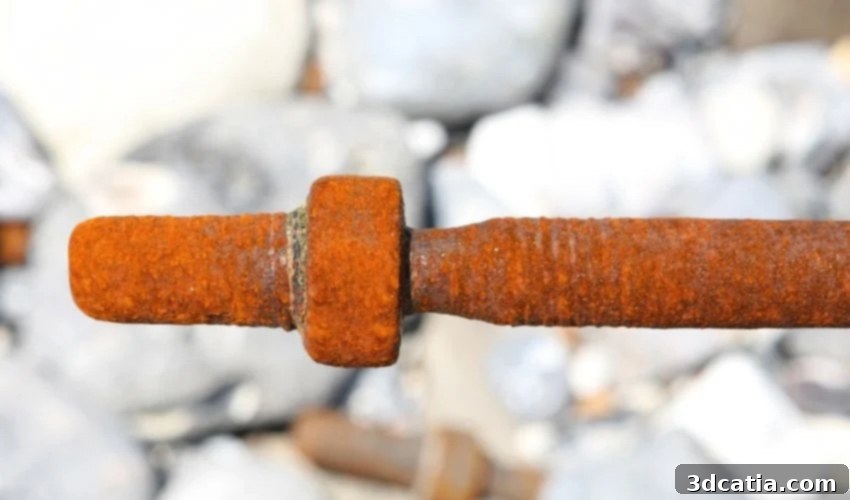
Revolutionizing Metal 3D Printing: Harnessing Oxidation for Superior Material Strength and Durability
Metal 3D printing, a transformative additive manufacturing technology, is rapidly reshaping numerous industrial sectors, from aerospace and automotive to shipbuilding and biomedical engineering. Its unparalleled ability to produce complex geometries, lightweight structures, and customized components has fueled discussions about its ever-expanding potential. Across these industries, engineers are continually pushing the boundaries, developing large-format metal parts and testing these advanced technologies in increasingly extreme environments, including the unforgiving vacuum of space. However, despite the remarkable progress and continuous innovations in this field, engineers face persistent challenges related to material science and technological limitations. Issues such as porosity, anisotropy, and, critically, corrosion, remain significant hurdles. These difficulties must be effectively addressed to ensure the long-term durability, structural integrity, and operational efficiency of additively manufactured parts. But what if these perceived weaknesses could be re-envisioned? What if the very disadvantages associated with metal materials, particularly their susceptibility to oxidation and corrosion, could be transformed into inherent advantages?
This profound and unconventional speculation led Professor Changhong Ke, a distinguished lecturer in the Department of Mechanical Engineering at Binghamton University’s esteemed Thomas J. Watson College of Engineering and Applied Science, to embark on a radical research journey. Professor Ke’s central hypothesis explores whether it is indeed possible to intrinsically strengthen metal materials through a controlled oxidation process. His innovative approach involves embedding specialized nanotubes directly into the metal during additive manufacturing. Through this pioneering technique, he aims to investigate if the typically problematic phenomenon of corrosion, often seen as an inescapable destructive force, can instead be harnessed and strategically utilized to confer positive, reinforcing properties to the material itself.
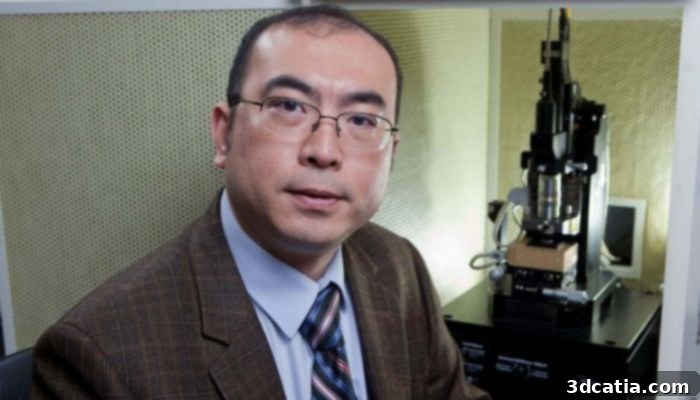
Professor Changhong Ke incorporates nanotubes into additively manufactured aluminum to study the effects of corrosion (photo credits: Jonathan Cohen)
Unlocking Potential: The Strategic Role of Boron Nitride Nanotubes
This bold and forward-thinking assumption is firmly rooted in the distinctive properties of boron nitride, a compound that holds significant promise for profitable integration with metals in advanced applications. Boron nitride is a versatile material already widely utilized across various industries, appearing in products ranging from cosmetics and high-performance pencil leads to specialized components in the dental sector, primarily due to its exceptional thermal and chemical stability, as well as its unique electrical insulation properties. Professor Changhong Ke’s groundbreaking insight suggests that microscopic structures meticulously crafted from boron nitride could possess the inherent capacity to significantly strengthen metals. This reinforcement would enable the metals to exhibit a dramatically reduced reactivity to corrosive, humid environments, such as seawater or industrial chemicals. More remarkably, Ke believes these embedded boron nitride nanotubes could actively contribute to conferring self-strengthening attributes upon the metal. As Professor Ke articulately explains, “You can’t avoid oxidation, so we are trying to take advantage of it by turning it into a new, reinforcing mechanism to make the material stronger.” This philosophy represents a paradigm shift from conventional material design, moving beyond corrosion prevention to corrosion utilization.
Engineering Self-Reinforcement: Controlled Porosity and the ‘Sandwich Structure’
To effectively achieve these desirable self-reinforcing properties within the metal, Professor Ke’s research meticulously focuses on creating a precisely controlled, deliberate porosity within the metallic matrix. This intentional engineering of microstructure is pivotal, as it facilitates and enables a more accessible, and crucially, beneficial oxidation process. In this innovative context, oxidation is no longer a detrimental force leading to material degradation and damage. Instead, it becomes a strategic advantage, a constructive mechanism that contributes to the material’s enhanced performance. The core of Ke’s methodology involves the careful insertion of boron nitride nanotubes into the molten or semi-solid metal during the additive manufacturing process. These nanotubes are incredibly delicate and precise structures, often only a few nanometers in thickness and reaching a maximum length of approximately one hundred micrometers. Their minute dimensions and high aspect ratio make them ideal candidates for nanoscale reinforcement.
Professor Ke vividly describes this sophisticated design using an intuitive analogy, further illustrating the intricate nature of their creation: “We designed this as a sandwich structure,” he explains. “It’s like a hot dog, with the nanotube as the meat and the metal as the bread.” This analogy highlights how the nanotubes are encapsulated and intimately integrated within the metallic matrix. This novel “sandwich structure” is fundamental to the proposed mechanism. It is hypothesized that the carefully controlled porosity around these embedded nanotubes provides micro-channels for the targeted oxidative reactions. As oxidation occurs, instead of leading to destructive rust or material breakdown, it is believed to form stable, interfacially bonded oxide layers or even entirely new composite phases between the nanotubes and the surrounding metal. This newly formed interface or composite layer is what provides the self-reinforcement, enhancing the load transfer capabilities and overall mechanical properties of the material. This deliberate engineering transforms a common material weakness into a strategic architectural strength, paving the way for a new generation of robust, resilient metals.
Metal Oxidation as a Game Changer for Additive Manufacturing?
The ultimate objective of this groundbreaking research is to thoroughly investigate and understand precisely how the controlled oxidation process alters the fundamental bond between the embedded nanotubes and the surrounding metal matrix, and consequently, how this interaction directly influences the self-reinforcement mechanism. To meticulously observe and document these complex processes in real-time and at an unprecedented scale, the dedicated research team leverages the capabilities of a high-resolution scanning electron microscope. This advanced imaging technology allows them to visualize the nanoscale structural changes and interactions as they unfold. Beyond microscopic observation, Professor Ke’s team is committed to rigorously testing their thesis on a larger, macro-scale. This involves conducting comprehensive mechanical tests to quantify how the load transfer characteristics are affected and, more critically, how the engineered oxidation process specifically impacts the stiffness, strength, and toughness of the nanotube-reinforced metal. Furthermore, sophisticated computer models will play an indispensable role in this research. These computational simulations will provide invaluable insights into the underlying physics and chemistry of the self-reinforcement process, helping the team to fully understand the intricate mechanisms at play and predict material behavior under various conditions. This multi-faceted approach, combining experimental observation with computational analysis, ensures a holistic understanding of this innovative material science concept.
Recognizing the immense potential and audacious nature of Professor Ke’s approach, the National Science Foundation (NSF) awarded him a substantial grant of $150,000. This funding was provided through the prestigious Early-concept Grants for Exploratory Research (EAGER) program. The EAGER program is specifically designed to support pioneering, high-risk, high-reward research ideas that, despite being largely untested, demonstrate exceptional promise for delivering truly groundbreaking and transformative results. Such grants are crucial for enabling fundamental research that pushes the boundaries of conventional scientific thought and opens up entirely new avenues for technological innovation.
Transformative Impact: A New Era for Materials Science and Manufacturing
Professor Ke expresses strong confidence in his innovative approach, foreseeing a profound and widespread impact on both the materials science sector and a diverse array of application industries. He believes his work will provide a revolutionary new perspective to the broader scientific community regarding how metal oxidation is perceived and utilized in the context of future material design. As he passionately states, “We’re hoping this will provide a new perspective to the scientific community about how we view metal oxidation in terms of future material design.” This shift in perspective could fundamentally alter the research landscape for metallic materials, particularly those produced through advanced 3D printing techniques. The implications are vast, promising a multitude of exciting applications across various sectors. This research could significantly enhance the performance and longevity of components used in aerospace, defense, automotive, and medical industries, where materials are often exposed to harsh and corrosive conditions. By developing metals that become stronger and more resilient through a controlled oxidative process, rather than being degraded by it, Ke’s work offers a pathway to unprecedented material capabilities. Furthermore, he emphasizes the potential for this innovation to have a broader economic impact, declaring, “That could change the research landscape for these metal materials, particularly for 3D printed metal. It has so many promising applications in different areas, and it even could revitalize U.S. manufacturing competitiveness.” By pioneering such advanced material solutions, the research holds the promise of fostering technological leadership and enhancing industrial capacity. To delve deeper into the specifics of this intriguing research approach and learn more about its ongoing developments, additional details can be found HERE.
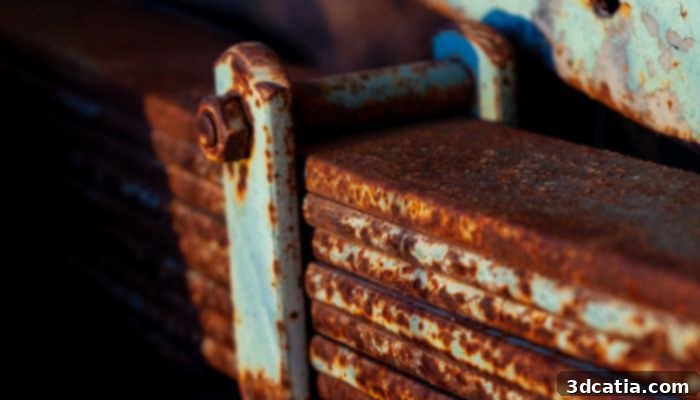
Photo Credits: Pixabay / rperucho
What are your thoughts on this revolutionary concept – the idea that oxidation, traditionally seen as a destructive force, could actually be harnessed to strengthen metals, especially those produced via advanced 3D printing? Do you foresee this approach transforming how we design and utilize materials in demanding applications? We encourage you to share your insights, opinions, and predictions in a comment below. Alternatively, join the discussion and connect with us on our vibrant social media platforms: find us on LinkedIn, Facebook, and Twitter pages! For the very latest updates, news, and breakthroughs in the dynamic world of 3D printing delivered directly to your inbox, don’t forget to sign up for our free weekly newsletter here. You can also explore all our engaging videos and in-depth content on our dedicated YouTube channel, where we regularly feature innovative projects and interviews with industry leaders.
*Cover Photo Credits: Pixabay / robert_owen_wahl