
Unlocking Potential: How 3D Printing Revolutionizes Education and Boosts Engagement in Remote Learning
Over the past year, the additive manufacturing industry, commonly known as 3D printing, has demonstrated remarkable resilience and unprecedented growth. For regular followers of technological advancements, this surge comes as no surprise. The sector has witnessed a flurry of activities, including significant mergers, strategic acquisitions, and numerous companies going public, all pointing to a dynamic and expanding market. Beyond these corporate milestones, several authoritative reports have consistently highlighted the growing power and influence of additive manufacturing across various sectors. Esteemed analyses, such as Ultimaker’s 3D Printing Sentiment Index, the comprehensive Wohlers Report, and HP’s Digital Manufacturing Report, have all converged on a crucial insight: while the global pandemic might have introduced temporary slowdowns, the overarching interest and investment in 3D printing technologies have dramatically intensified. Amidst this broader narrative of industrial expansion, a new and particularly insightful report from MakerBot has brought to light another vital dimension of 3D printing’s escalating importance this year: its profound impact on education and remote learning.
The Growing Imperative for 3D Printing in Education
In recent times, there has been a notable surge of interest in integrating 3D printing into educational curricula, particularly at younger academic levels. This enthusiasm stems from a recognition of 3D printing’s potential to bridge the ever-widening skills gap in today’s rapidly evolving job market. Many companies and educational institutions are eager to invest in this transformative technology, yet a significant hurdle remains: a widespread lack of adequate training and familiarity with additive manufacturing processes. While various existing programs are actively working to address this critical issue, there’s an undeniable consensus that introducing 3D printing technologies to students at an earlier age—especially throughout secondary school and into higher education—will lay a robust foundation for the future growth of additive manufacturing. As these digitally fluent and creatively empowered students eventually enter the workforce, they will drive innovation and fill crucial roles within the industry. It is within this context that MakerBot’s insightful study, the 2nd annual report on Trends in 3D Printing and STEAM Education, sought to delve deeper. The report aimed to comprehensively understand not only how 3D printing is being utilized within classrooms globally, but also how it has demonstrably amplified student engagement and fostered collaborative learning environments, effectively helping to overcome the inherent difficulties associated with remote and virtual learning models during a challenging period.
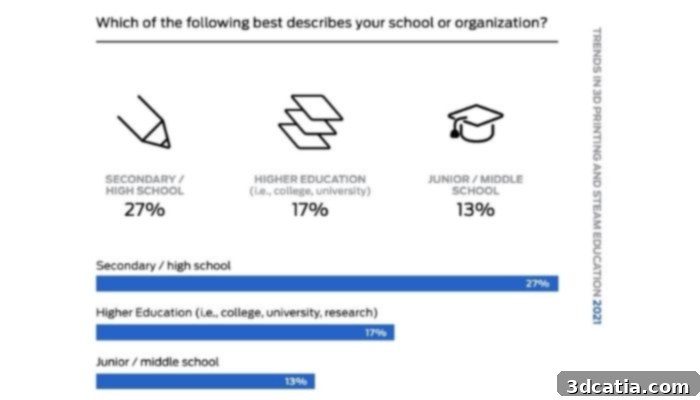
3D printing is being used in schools for a variety of educational levels. In MakerBot’s survey, they found that most of the educators surveyed were working in secondary schools
MakerBot’s Commitment and Comprehensive Findings
It is hardly surprising that MakerBot spearheaded this particular survey, given their long-standing and unwavering commitment to championing 3D printing in educational settings. For years, they have been at the forefront of promoting accessible additive manufacturing solutions, primarily through their intuitive and reliable machines designed specifically for classroom use. Beyond hardware, MakerBot provides a wealth of educational resources tailored for educators, all readily available on their website. These valuable tools include a free 3D printing curriculum planner to help teachers integrate the technology seamlessly, a grand guide offering insights into funding and implementation, and a comprehensive educators’ guidebook to support effective teaching practices. To gather the rich data for their report, MakerBot conducted an extensive survey, reaching out to over 1000 education professionals. These participants represented a diverse array of disciplines and hailed from more than 60 countries across every continent except Antarctica – a truly global snapshot, although it’s worth noting that 79% of respondents were based in North America. All surveyed educators actively incorporated 3D printing as an integral component of their coursework. Their most significant and impactful discovery was that despite the widespread closure of schools throughout the preceding year, these dedicated educators not only continued to leverage 3D printing in their lessons but also found that it played a crucial role in significantly boosting student engagement—a challenge that plagued many educators and students grappling with the exigencies of remote learning during the pandemic.
3D Printing: A Catalyst for Engagement and Practical Learning
The report’s findings underscore the profound impact of 3D printing on student engagement, particularly in challenging remote learning environments. A striking 57% of respondents reported using 3D printing for student-designed prototypes within problem-based learning projects. This approach empowers students to actively tackle real-world challenges, conceptualize solutions, and then bring their ideas to tangible form, fostering deeper understanding and practical skill development. Furthermore, 36% of educators integrated 3D printed parts directly into specific lessons as a deliberate strategy to heighten engagement. These physical models can transform abstract concepts into concrete, interactive learning experiences, making complex subjects more accessible and stimulating. This becomes particularly significant when considering that a considerable 48% of the surveyed educators identified low student engagement as a major obstacle to effective virtual learning. Thanks to the interactive and hands-on nature of 3D printing, educators were able to ignite greater interest in various topics. Students could experience firsthand the immediate results of their creative and problem-solving efforts, observing how their conceptual designs manifested into physical objects. This direct connection between thought and tangible output fostered a powerful sense of accomplishment and ownership over their learning journey, directly counteracting the passive nature often associated with online instruction.
Transforming Learning Experiences: Real-World Application and Skill Development
Beyond mere engagement, 3D printing facilitates a holistic development of critical skills essential for the 21st century. It acts as a powerful tool for cultivating design thinking, iterative problem-solving, and spatial reasoning. When students design and print a prototype, they naturally engage in a cycle of conception, creation, testing, and refinement. This iterative process is fundamental to innovation and directly mirrors real-world engineering and design practices. Moreover, working with 3D printers encourages collaboration, as students often work in teams to bring complex projects to life, learning to communicate ideas, divide tasks, and troubleshoot together. This hands-on experience also democratizes access to advanced manufacturing tools, allowing students from diverse backgrounds to explore digital fabrication and understand the principles behind modern production. The act of seeing an idea materialize from a digital design into a physical object instills a profound sense of accomplishment and reinforces the relevance of theoretical knowledge. This active, project-based learning model not only makes education more exciting but also equips students with invaluable practical skills and an understanding of industrial processes that will serve them well in their future careers, regardless of the path they choose.
Expert Perspective: MakerBot CEO Nadav Goshen on 3D Printing’s Enduring Impact
Nadav Goshen, the insightful CEO of MakerBot, succinctly articulated the transformative power observed in the report, concluding, “For years, we have seen the power of 3D printing used to elevate student learning and development in the classroom. As schools look to bridge the skills gap in today’s workforce, building students’ critical thinking and creative problem-solving skills will be increasingly important. Over the past year, educators took 3D printing one step further, extending its capabilities to support remote education to keep students challenged, collaborative, and–most importantly–engaged.” Goshen’s statement encapsulates the essence of 3D printing’s educational value, highlighting its role not just as a novelty, but as a foundational tool for developing crucial cognitive and practical abilities. He emphasizes that as educational institutions strive to prepare students for a future demanding adaptable skills, 3D printing stands out by fostering the very critical thinking and creative problem-solving capabilities that are in high demand. Furthermore, his observation that educators creatively adapted 3D printing to sustain engagement and collaboration during remote learning periods speaks volumes about the technology’s inherent flexibility and its capacity to maintain effective learning despite unprecedented challenges. This reflects a fundamental shift in pedagogical approaches, where active creation and tangible outcomes become central to the learning process, empowering students to be proactive participants rather than passive recipients of information. You can download the full report for free HERE to explore these findings in greater detail.
The Future of Additive Manufacturing in Academia
The findings of MakerBot’s report provide compelling evidence for the enduring and expanding role of 3D printing in education. As the world continues to embrace digital transformation, the integration of additive manufacturing into curricula from K-12 to higher education will become even more pronounced. This isn’t merely about teaching students how to operate a machine; it’s about fostering a mindset of innovation, enabling them to visualize, design, and create solutions to complex problems. The ability of 3D printing to support remote and blended learning models also positions it as a resilient educational tool, capable of adapting to future disruptions and diverse learning environments. Continued investment in teacher training, curriculum development, and accessible 3D printing hardware will be crucial to fully harness this potential. Ultimately, by empowering students with these advanced manufacturing skills and fostering a spirit of inquiry and hands-on learning, we are not just preparing them for future jobs in the additive manufacturing sector, but equipping them with invaluable life skills that transcend any specific industry, ensuring they are well-prepared to thrive in an increasingly technological world.
What do you think about how 3D printing has been used to bridge gaps caused by remote learning and enhance educational outcomes? We invite you to share your insights and experiences in a comment below or join the conversation on our Facebook and Twitter pages. Don’t forget to sign up for our free weekly newsletter, with all the latest news and innovations in 3D printing delivered straight to your inbox!
*All Image Credits: MakerBot