
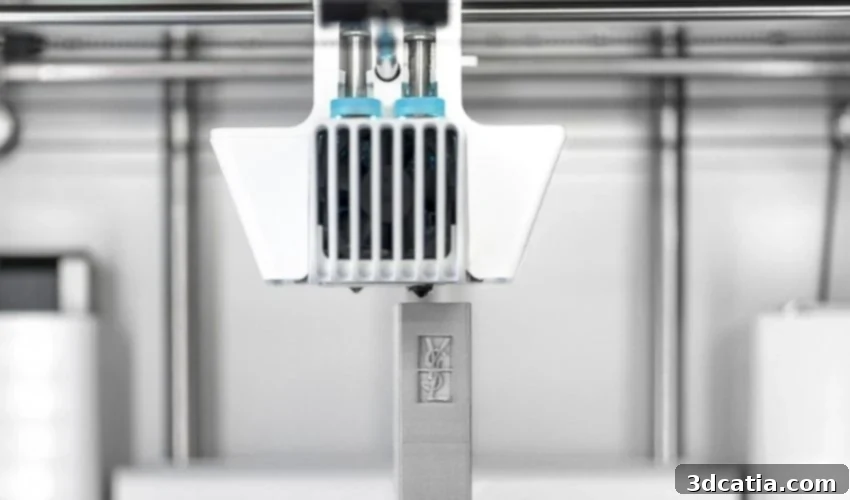
L’Oréal’s 3D Printing Revolution: Enhancing Cosmetic Manufacturing with HP’s Digital Network for Agile Innovation and Sustainability
The landscape of manufacturing is undergoing a profound transformation, with additive manufacturing, commonly known as 3D printing, at its forefront. A prime example of this industrial evolution is the strategic partnership between global beauty giant L’Oréal and technology leader HP. This collaboration highlights how advanced 3D printing technologies are not just theoretical innovations but practical tools driving efficiency, sustainability, and unprecedented levels of personalization in the consumer goods sector, particularly within the competitive cosmetics market.
L’Oréal’s journey into additive manufacturing began long before it became a mainstream discussion. As early as 2017, the company made a significant commitment, announcing that 100 percent of its new product packaging involved 3D printing. This early adoption demonstrated L’Oréal’s visionary approach to integrating cutting-edge technologies into its core operations. Since then, L’Oréal has continuously expanded its application of additive manufacturing processes across various product lines, from rapid prototyping to specialized tooling and even direct part production. This deep integration underscores a broader strategy to embrace digital transformation and harness the entrepreneurial freedom that 3D printing offers.
Recognizing the growing demands for agile and responsive manufacturing, HP has been diligently expanding its Digital Manufacturing Network (DMN). This global network of qualified parts providers is crucial for meeting the dynamic production needs of industry leaders like L’Oréal. The DMN serves as a vital ecosystem, enabling companies to leverage distributed manufacturing capabilities and access specialized 3D printing expertise, thereby enhancing supply chain resilience and accelerating time-to-market for innovative products.
Anne Debauge, Director of Digital Transformation, Packaging & Development at L’Oréal, articulates the essence of this collaboration perfectly: “Customer-centric innovation and sustainable products are at the center of all we do.” She further emphasized, “3D printing gives us this entrepreneurial freedom to offer new customer experiences. Thanks to this collaboration, we are already gaining in agility in our factories and wish to go further by creating new services.” This statement encapsulates L’Oréal’s dual focus on delivering unparalleled value to its customers while also committing to environmentally responsible practices. Additive manufacturing empowers L’Oréal to quickly adapt to consumer trends, experiment with unique designs, and produce customized solutions with greater speed and less waste.
HP’s commitment to advancing industrial 3D printing extends beyond building robust networks. The company has a clear strategic objective to accelerate its mass production capacity, particularly with the growth of its groundbreaking Metal Jet 3D printing platform. Scheduled for commercial availability in 2022, HP Metal Jet promises to revolutionize metal parts manufacturing, offering unprecedented speed, quality, and cost-effectiveness for mass production applications. This advancement will open doors for even more sophisticated and durable components in various industries, including those supporting cosmetic production infrastructure.
Didier Deltort, President of Personalization & 3D Printing at HP, highlighted the broader impact of this technological shift in a press statement: “3D printing is unlocking new levels of personalization, business resiliency, sustainability, and market disruption.” This vision underscores the transformative potential of additive manufacturing not just for individual product innovation, but for re-shaping entire business models and supply chains, making them more adaptable and efficient in an increasingly unpredictable global economy.
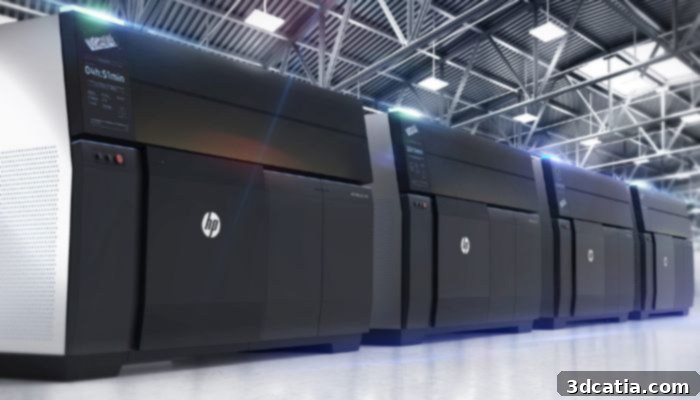
HP Metal Jet 3D printer systems. (Photo Credit: HP)
L’Oréal & HP’s Digital Manufacturing Network: A Synergistic Partnership in Action
The tangible results of the L’Oréal and HP partnership were vividly demonstrated during industry events like Formnext. The showcase offered a compelling look at the high-finish capabilities HP 3D Printing brings to the luxury cosmetics sector. These capabilities are critical for L’Oréal, where product presentation and aesthetic quality are paramount. The collaboration moved beyond theoretical concepts to practical, scaled solutions that directly impact L’Oréal’s operational efficiency and product quality.
A standout example of their joint efforts involved the prototyping and scaling of large volumes of adjustable ‘pucks.’ These pucks are essential components in automated cosmetic production lines, designed to securely hold, guide, and protect individual product containers – such as bottles or jars – as they move through various stages of manufacturing, including filling, capping, and labeling. Traditionally, manufacturing these pucks for different product sizes and shapes could be a time-consuming and expensive process, requiring new molds and significant lead times. With 3D printing, L’Oréal gained the ability to rapidly design, test, and produce these adaptable pucks on-demand, tailored precisely to new product dimensions. This dramatically improved the company’s ability to prototype new products, streamline filling operations, and label items more efficiently. The impact was profound, leading to a remarkable 33 percent cost reduction and an impressive 66 percent time savings in these critical manufacturing processes. This particular case study serves as a powerful testament to the commercial viability and operational benefits of additive manufacturing on an industrial scale.
The success of initiatives like the ‘pucks’ project underscores a burgeoning trend across industries: the increasing demand for scaling up additive manufacturing. This demonstrates a clear shift towards the industrialization of 3D printing, moving it from a niche prototyping tool to a robust method for serial production. Companies are recognizing that AM technologies are not only commercially viable but essential for maintaining competitiveness in a rapidly evolving market. The ability to produce complex parts with speed, precision, and efficiency, coupled with significant cost and time savings, is driving this industrial adoption forward.
The recent global pandemic served as a stark reminder of the critical need for resilient and agile supply chains. During this period of unprecedented disruption, HP’s 3D printing technology proved instrumental in bolstering L’Oréal’s ability to respond effectively to fluctuating customer demands within the dynamic cosmetics market. By enabling localized production, on-demand manufacturing, and rapid iteration of components, additive manufacturing allowed L’Oréal to circumvent traditional supply chain bottlenecks and maintain operational continuity. This flexibility was crucial for a company serving a global consumer base with diverse and constantly evolving preferences.
To ensure seamless management of 3D printing workflows and additive manufacturing fleets, the HP Digital Manufacturing Network is bolstered by HP’s extensive portfolio of additive manufacturing offerings. This includes sophisticated software solutions designed to optimize every stage of the manufacturing process. Key among these are HP 3D API, which facilitates integration and automation, and HP 3D Center, a comprehensive platform for managing printer fleets and production queues. On the hardware front, solutions like the HP Automatic Unpacking Station automate labor-intensive post-processing steps, further enhancing efficiency and scalability. These integrated tools collectively provide a holistic ecosystem for efficient and effective industrial 3D printing, enabling companies to unlock the full potential of additive manufacturing.
This partnership between L’Oréal and HP is more than just a collaboration; it’s a blueprint for the future of manufacturing. It exemplifies how established industries can leverage digital technologies to achieve sustainable growth, foster innovation, and build more robust and responsive supply chains. The ongoing advancements in materials science, printer capabilities, and software intelligence continue to expand the horizons of what’s possible with 3D printing, promising even greater breakthroughs for companies willing to embrace this transformative technology.
What are your thoughts on this transformative collaboration between HP & L’Oréal and its implications for the future of manufacturing and consumer products? We invite you to share your insights in a comment below, or join the conversation on our LinkedIn, Facebook, and Twitter pages! Don’t miss out on the latest advancements in additive manufacturing – subscribe to our free weekly Newsletter here to get the freshest 3D printing news delivered straight to your inbox! For more visual content, explore all our videos on our YouTube channel. You can learn more about HP and its partnership with L’Oréal by reading their official press release HERE.
Cover Photo Credit: L’Oréal