
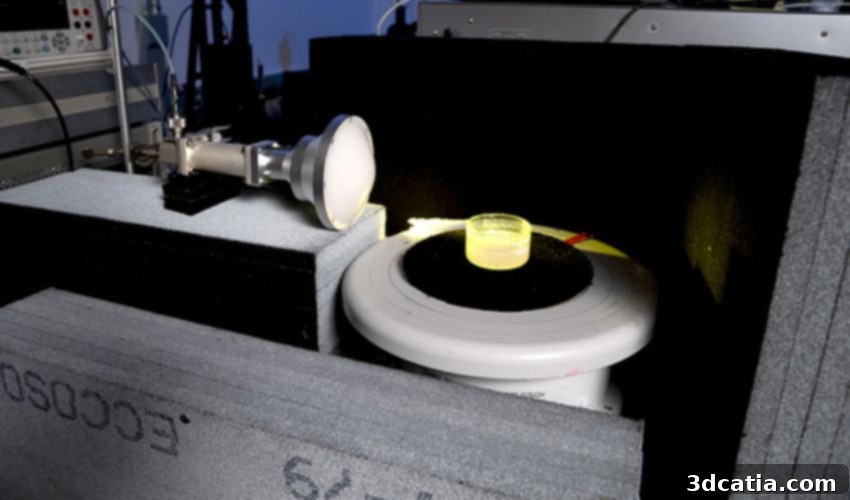
Microwave Volumetric Additive Manufacturing: Revolutionizing 3D Printing with Unprecedented Speed and Material Versatility
The landscape of additive manufacturing is constantly evolving, with researchers relentlessly pushing the boundaries of what’s possible. A groundbreaking innovation from the Lawrence Livermore National Laboratory (LLNL) promises to redefine high-speed 3D printing, offering an unparalleled choice of materials while ensuring superior part quality. This revolutionary approach, dubbed Microwave Volumetric Additive Manufacturing (MVAM), leverages microwave energy to precisely cure materials, overcoming significant limitations of conventional resin-based 3D printing. With MVAM, the potential to work with a broader spectrum of materials, particularly opaque or filled resins, and to produce large-scale components with intricate geometries, moves from concept to tangible reality.
Developments in resin 3D printing technologies, such as Stereolithography (SLA) and Digital Light Processing (DLP), have enabled the creation of incredibly detailed and functional parts. These methods typically rely on light to initiate polymerization, selectively hardening liquid resin layer by layer or volumetrically. While impressive, these light-based techniques, including existing volumetric additive manufacturing systems, share a fundamental limitation: the resin must be transparent or translucent enough for light to penetrate and cure effectively. This constraint severely restricts the types of materials that can be used, rendering many advanced composites, high-performance polymers, and functional materials—which are often opaque or heavily filled—unprintable. Recognizing this bottleneck, the ingenious team at LLNL embarked on a mission to remove this barrier, turning their attention to an alternative energy source capable of deeper, more uniform penetration: microwave energy.
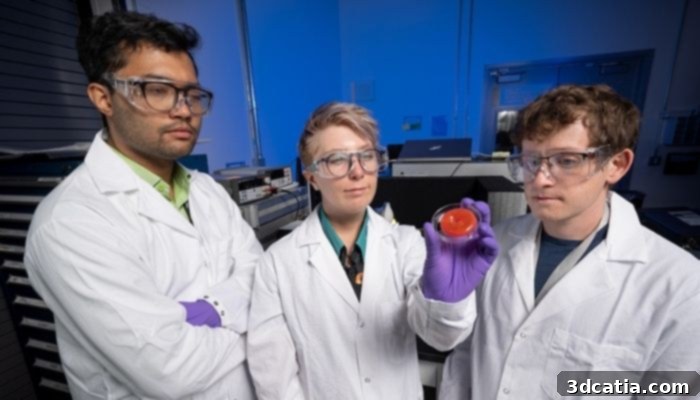
The dedicated research team at Lawrence Livermore National Laboratory pioneering MVAM technology. (Photo credits: Blaise Douros/LLNL)
Indeed, the energy produced by a microwave exhibits a remarkable ability to penetrate deeper into a material’s volume, initiating a more uniform and comprehensive curing process. This distinctive characteristic immediately broadens the spectrum of compatible materials for additive manufacturing. Unlike light, which might only cure the surface or a thin layer, microwaves interact volumetrically, heating the entire material from within. This means that previously challenging materials such as opaque, highly pigmented, or fiber-filled resins can now be processed efficiently. Saptarshi Mukherjee, an applied electromagnetism specialist and one of the lead LLNL researchers, articulates the transformative potential: “I think this is going to revolutionize the way people think about additive manufacturing. If we think of many applications – aerospace, automotive, nuclear industry – their geometries are simple, but they are large and require rapid prototyping. One of the main effects [of MVAM] is that if we can maintain a stock of materials surrounded by an array of microwave antennas, we can now consider creating large simple or complex geometries at scale using microwaves.” This perspective highlights MVAM’s capacity to transcend the limitations of traditional resin 3D printing, especially for demanding industrial applications requiring robust, large-scale parts.
In practical terms, the LLNL team has meticulously developed a sophisticated system capable of precisely controlling microwave beams. The primary objective of this control mechanism is to optimize power delivery and curing time, thereby providing exceptional thermal management throughout the printing process. This precise thermal control is paramount for achieving consistent material properties and preventing defects that can arise from uneven curing. The researchers conducted several rigorous tests to demonstrate the effectiveness and efficiency of this innovative technique. In initial experiments, they achieved successful resin curing in just 2.5 minutes using a moderate power output of 40 watts. Pushing the boundaries further, they discovered that by increasing the microwave power, they could dramatically accelerate the curing process, achieving solidification speeds of approximately 6 seconds. Such rapid curing times represent a significant advancement, offering unprecedented throughput for additive manufacturing workflows.
Complementing their experimental work, the LLNL team utilizes an advanced wave calculation model. This powerful computational tool allows them to precisely understand how microwave energy propagates within the resin volume and, critically, how this energy distribution directly impacts the curing stage. This detailed insight enables fine-tuning of the microwave parameters for different material chemistries and desired mechanical properties, ensuring optimal and predictable outcomes. Co-investigator Johanna Schwartz underscores the expansive opportunities this brings: “We have a unique opportunity to broaden the definition of what is ‘printable’, accessing chemistries not previously possible in light-based systems.” This means MVAM is not just about printing faster or with more materials; it’s about unlocking entirely new material formulations and functionalities. It would then be possible to effectively process opaque and composite resins, leading to the creation of parts with significantly expanded properties, such as enhanced strength-to-weight ratios, superior thermal stability, improved electrical conductivity, or customized aesthetic finishes, depending on the filler materials chosen.
The ability to use these advanced materials holds profound implications across various high-tech sectors. For aerospace and defense, MVAM could facilitate the rapid production of lightweight, high-strength components from carbon fiber-reinforced polymers, directly contributing to fuel efficiency and structural integrity. In the automotive industry, manufacturers could rapidly prototype and produce functional parts from engineering-grade plastics and composites, shortening development cycles and enabling greater customization. The nuclear industry, which demands materials capable of withstanding extreme radiation and temperatures, could leverage MVAM to fabricate specialized components from previously unprintable, high-performance opaque resins. Beyond these, the technology could revolutionize the medical device sector by enabling the creation of biocompatible parts with integrated functionalities, or in the energy sector for custom tooling and components. The versatility of MVAM promises to extend the reach of additive manufacturing into new applications where traditional methods have been constrained by material limitations or the need for large, robust structures.
Despite its immense promise, the 3D printing process developed by LLNL is still in its infancy and faces several significant hurdles that need to be overcome before widespread commercial adoption. One of the most prominent challenges is the considerable price of high-power microwave energy devices. Saptarshi Mukherjee openly discusses this financial barrier: “High-power microwave devices are extremely expensive – a one-kilowatt pulsed microwave amplifier system can cost between $50,000 and $100,000.” Such substantial capital expenditure could deter potential adopters, especially smaller businesses. To mitigate this, the LLNL team is proactively looking into innovative ways to reduce these costs, specifically by exploring the possibility of designing or building some of these critical circuits and hardware components themselves. This internal development strategy aims to dramatically lower expenses and comprehensively demonstrate the overall viability and economic benefits of the MVAM concept, paving the way for larger projects or external sponsors to confidently invest in the technology’s future. Further research and engineering efforts will also focus on scaling up the technology for industrial production, ensuring safety standards, and developing a broader range of optimized microwave-curable materials.
The pioneering work at Lawrence Livermore National Laboratory with Microwave Volumetric Additive Manufacturing represents a truly exciting advancement in the field of 3D printing. By skillfully leveraging the unique properties of microwave energy, the researchers have effectively sidestepped the long-standing limitations imposed by material transparency in light-based resin systems. This breakthrough not only promises to accelerate printing speeds but, more importantly, unlocks an entirely new realm of material compatibility, allowing engineers and designers to utilize opaque, filled, and composite resins that were previously off-limits. The implications are far-reaching, enabling the creation of larger, more durable, and functionally superior components across industries from aerospace to automotive, and beyond. As this technology continues to mature and the team addresses the initial cost challenges, MVAM is poised to become a cornerstone in the evolution of industrial additive manufacturing, fundamentally changing what is possible to print.
While we await further developments and the eventual commercialization of this groundbreaking technology, the official press release from LLNL provides additional details and insights, which you can read HERE. The promise of MVAM to blend high-speed production with unparalleled material versatility marks it as a truly transformative innovation.
What do you think of this revolutionary 3D printing technology developed by LLNL? Do you believe it will fundamentally alter the current additive manufacturing market? Share your insights in a comment below or join the conversation on our LinkedIn, Facebook, and Twitter pages! Don’t miss out on the latest 3D printing news; subscribe to our free weekly Newsletter here, delivered straight to your inbox. You can also explore our video content on our YouTube channel.
*Cover photo credits: Blaise Douros/LLNL