News
What Is Over-Extrusion and How Can It Be Avoided?
Additive manufacturing enables the creation of intricate and detailed structures, offering unparalleled design freedom to users. According to the latest Hubs Report for 2023, FDM printing technology, also known as fusion layering, stands out as the most popular 3D printing&hellip
- 3 min read
- News
- Six more stories
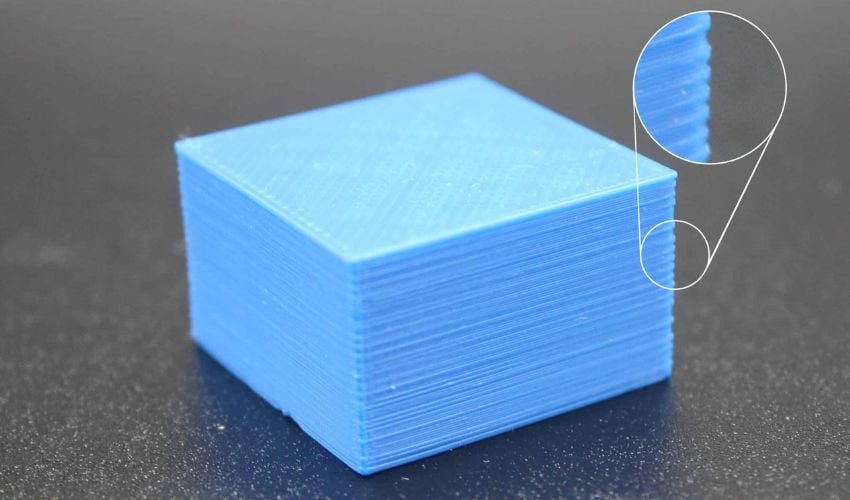
Additive manufacturing enables the creation of intricate and detailed structures, offering unparalleled design freedom to users. According to the latest Hubs Report for 2023, FDM printing technology, also known as fusion layering, stands out as the most popular 3D printing process due to its ease of use and user-friendly nature. However, like any printing method, errors can occur during the fusion layering process, resulting in unaesthetic or unusable prints. We have previously discussed issues such as elephant foot, stringing, and warping. Now, we would like to address another common problem that may arise during FDM printing: over-extrusion.
Over-extrusion happens when the 3D printer’s extruder deposits an excessive amount of material, often leading to bulging and swelling at the edges of printed parts. Additionally, the individual layers may have inconsistent thicknesses, resulting in uneven and unappealing surfaces. Over time, this excessive material flow can even cause nozzle clogging. In the following sections, we will examine the causes of over-extrusion and provide you with potential solutions to avoid this error in future prints.
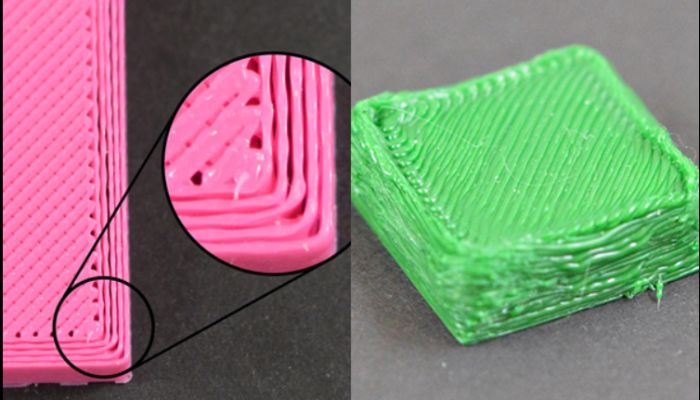
Over-extrusion manifests itself in over-swelling edges and a lack of precision and detail (photo credits: Creality)
In most cases, over-extrusion can be attributed to excessive printing temperature. When the temperature setting on the 3D printer is too high, the filament melts too quickly, and the extruder loses control over the flow rate. Consequently, higher temperature settings result in a more fluid material for extrusion. In such cases, the cooling fan fails to rapidly cool down the filament, leading to uncontrolled and excessive material flow through the nozzle. Another contributing factor to over-extrusion is the diameter of the filament used. If the filament has a smaller diameter than the nozzle, it can pass through too quickly, causing over-extrusion. Similarly, incorrect filament diameter settings in the slicer software can also lead to incorrect flow rates and over-extrusion. Additionally, improper calibration of the flow rate (known as the extrusion multiplier in slicer software) can contribute to over-extrusion.
More from the desk
Six other notes from the rest of the bench.
 ApplicationsSURGE Aims to Predict Life of Critical Military Parts During ProductionThe Defense Advanced Research Projects Agency (DARPA) works to advance technology for United States national security. Created in 1958 in response to the Soviet Union’s 1957 launch of Sputnik, the agency positions itself as the nation’s commitment “to never agai
 NewsMick Fanning surfs on a 3D printed surfboardWhile the automobile and aerospace industries have typically been the dominate leaders in 3D printing technology, new industries are beginning to take notice of this technology’s capabilities. The sporting industry is now a contender within the 3D printing technology race,
  ApplicationsAnsys Additive Simulation and Aconity3D Cooperate to 3D Print Flawless Bicycle FrameBrightlands Chemelot is one of four innovation campuses located in Limburg, the Netherlands. Here, designers, researchers, and engineers have collaborated to create a fully 3D printed bicycle, one of the first of its kind, using high-performance materials and additive manufacturi
 NewsBack Care, the 3D Printed Support Fully Adapted to Each BodyWho hasn’t experienced back pain due to poor posture or uncomfortable seating? What if we told you that 3D printing, combined with artificial intelligence, could solve this problem? That’s the idea behind Alemki Robotix, a start-up that’s not yet well…
 News5 Real-World Applications of 3D Printing We Saw at RAPID + TCT 2026One of the most common questions surrounding additive manufacturing is also one of the simplest: what is 3D printing actually being used for today? Not in research labs or concept demonstrations, but in real-world applications delivering tangible results. To answer…
 Applications#3DExpress: Partnership Seeks to Further Silicone 3D PrintingIn this week’s 3DExpress, start off with a new French partnership between Lynxter and 3Deus that could help advance silicone additive manufacturing in the industrial and healthcare sectors. Then learn about Creality’s latest launch and how the combination of chocolate