News
What Does Resolution Mean in 3D Printing?
In 3D printing, resolution generally refers to the degree of detail and precision a printer can achieve when creating an object, but more specifically, it refers to the minimum feature size of the X, Y and Z axes. The XY…
- 3 min read
- News
- Six more stories
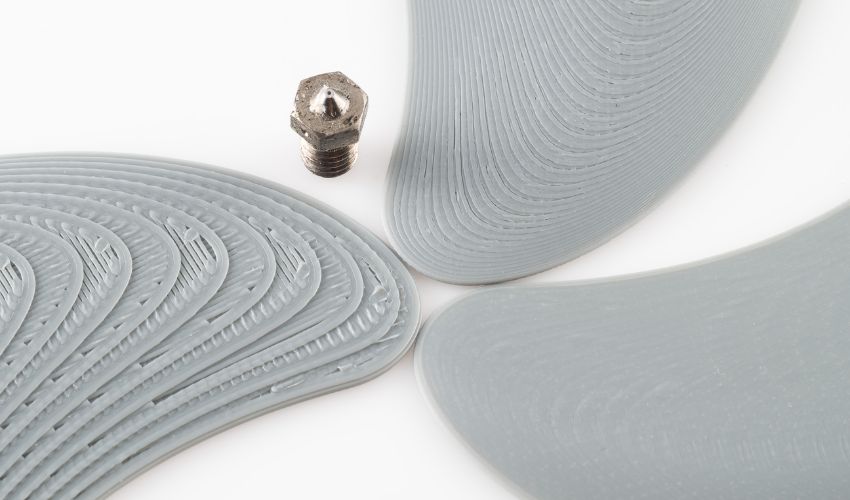
In 3D printing, resolution generally refers to the degree of detail and precision a printer can achieve when creating an object, but more specifically, it refers to the minimum feature size of the X, Y and Z axes. The XY plane is horizontal, and the Z-axis, which is vertical, refers to layer height. So, resolution in 3D printing should correspond to two numbers: the measurements of the XY plane and the Z-axis. We often think of resolution in terms of images on a screen: i.e., the pixel density of a television, and we know that the smaller the pixel, the higher the resolution. For 3D printing, know that a voxel is the 3D equivalent of a pixel.
Resolution is important because it determines the level of detail in the final product, influencing the aesthetics, functionality and surface quality of a print. However, be careful not to confuse resolution with dimensional accuracy and tolerance. Accuracy refers to a printer’s ability to produce parts with the desired measurements, and tolerance refers to the allowable deviation in the dimensions of a printed object compared to its original design specifications.
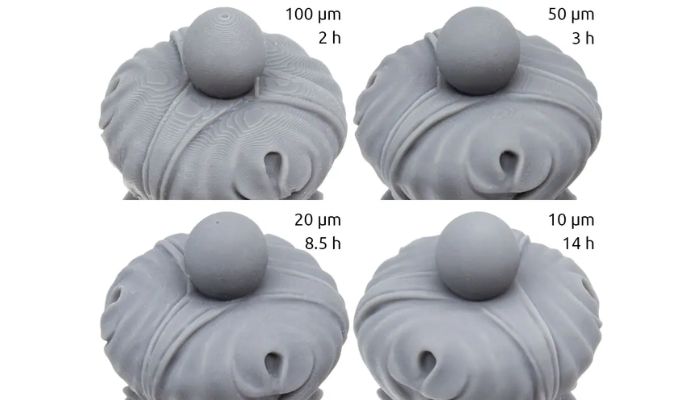
An object printed with SLA with four different layer heights (Image credit: Ameralabs)
If you are searching for a high-resolution 3D printer, you should find one that performs well in the X, Y and Z dimensions. Generally, lower numbers mean smaller, more defined details. Keep in mind that resolution is relative to the type of 3D printing technology being used. In this article, we will discuss it relative to FDM and vat photopolymerization.
More from the desk
Six other notes from the rest of the bench.
 GuidesWhy are there so few Women in 3D printing, and can we change that?3D printing is an innovative, fast-growing market which is predicted to grow exponentially in the next 10 years. However, it is also a male dominated industry, with only approximately 13% of workers being women. Why is 3D printing such a…
 Printers3Dnatives Lab: Testing the Anycubic Kobra S1 3D PrinterThe consumer 3D printing market is evolving rapidly, with increasingly high-performance, affordable machines. Among the new products recently launched, the Anycubic Kobra S1 Combo stands out with its closed design, CoreXY architecture, compatibility with the ACE Pro multi-materia
 NewsAdditive manufacturing shows strong growth despite the global health crisisIGO3D, the first European distributor of additive manufacturing solutions, masters a wide range of 3D printing technologies. This year, the company was voted the Growth Champion 2021 by FOCUS Business magazine for the second year in a row. This award…
 NewsUniversity of North Dakota to 3D Print Nuclear Reactor ComponentsAdditive manufacturing is known for producing complex parts that are subject to many safety and efficiency requirements. In the case of nuclear reactors, the importance of detail is paramount, and 3D printing has proven itself in the past. For example,…
 NewsSolize Corporation and HP Partner with Nissan to Create Aftermarket PartsOnce again, the automotive and additive manufacturing industries are working together. As part of Nissan’s NISMO Heritage Parts program, Solize and HP are working together to produce 3D printed aftermarket parts for the Skyline GT-R R32 / R33 / R34. And…
 News3D Printed Spikes From BMW Are Being Used to Make Bobsledding FasterIn the sports sector, 3D printing is continuously being used to customize equipment for athletes, even at the highest levels. The increased relevance of 3D printing was once again demonstrated by the German Bobsled, Luge and Skeleton Federation (BSD). In…