Printers
Knust-Godwin uses VELO3D’s metal AM system to create meter-tall parts
It’s been a busy first half of the year for VELO3D: the company launched a new metal 3D printer, and raised $28 million in a Series D funding round. A few days ago, the company also revealed it had raised…
- 3 min read
- Printers
- Six more stories
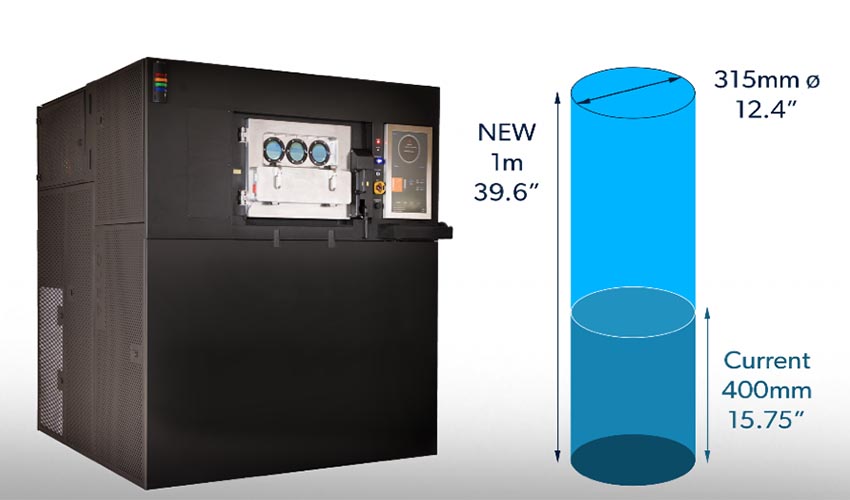
It’s been a busy first half of the year for VELO3D: the company launched a new metal 3D printer, and raised $28 million in a Series D funding round. A few days ago, the company also revealed it had raised an additional $12 million from new strategic investors, bringing total funding to $150M. During the launch, the company revealed that their next-generation metal AM system was developed with a focus on build-chamber size. According to the manufacturer, the 3D printer’s 1-meter vertical axis makes it the world’s tallest metal powder bed fusion system with a closed chamber. VELO3D also announced its first customer will be Knust-Godwin, an established precision-machining shop that is looking to expand into new industries and has recognized the tremendous potential of industrial metal 3D printing. The company should start shipping its new system in Q4 of 2020.
VELO3D’s Sapphire system relies on its proprietary technology to build metal parts without support structures. Support structures add considerable design and manufacturing constraints and are common in many metal AM technologies, including the most widely used technology, Laser Powder Bed Fusion. The ability to create metal parts without these constraints is one of the main benefits of VELO3D’s system. Mike Corliss, Vice President of Technology at Knust-Godwin, and Zach Murphree, Vice President, Technical Partnerships at VELO3D, are working together to bring the Sapphire system into Knust-Godwin’s fold of high-end manufacturing processes in order to leverage the benefits of 3D printing.
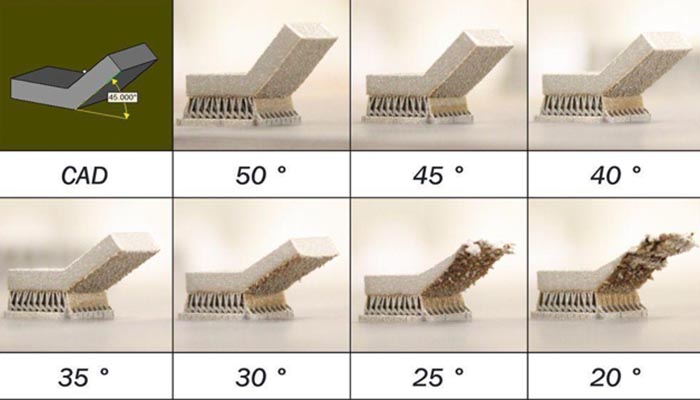
Support structures have always been a requirement to prevent warpage. VELO3D’s support-less process enables you to print low angles without part failure | Credits: Protolabs
What are the advantages of investing in metal AM?
Even though subtractive manufacturing will most likely always play an important role in production, AM has a key role to play too. Over the past 8 years, Knust-Godwin has been investing in metal AM, even though it still relies primarily on subtractive methods to manufacture its products. The precision-machining shop realized early on that it could apply additive manufacturing to many of the parts it produces. Mike Corliss explains: “We’re sure it will help reduce machine time, queue time, and even help reduce constraints with geometry—including the weight of the part and the size of the part—in some areas.”
More from the desk
Six other notes from the rest of the bench.
 NewsKIMYA Closes Due to Economic DifficultiesKIMYA, a French company and subsidiary of ARMOR GROUP, has just announced the closure of its production site based in Les Sorinières, Loire-Atlantique, France, and thus the sale of its business. This decision, which will result in the loss of…
 ApplicationsHitachi Rail to Adopt Additive Manufacturing in Factories in the U.S. and ItalyOne of the sectors where we see the increasing use of 3D printing is the railroad industry. This is due to the fact that it faces the constant challenge of needing to supply parts with advanced properties in a short…
 NewsScan the World Calls to Immortalize Cultural Heritage After Easter Island FireLast week, a fire on Rapa Nui, colloquially often referred to as Easter Island in English, damaged many of the more than 1000 Moai statues located there. The damage was extensive and cannot be undone, with more than 100 hectares…
 ApplicationsUSS Essex Becomes First American Ship With a Metal 3D Printer OnboardYou may remember last year when the Naval Postgraduate School announced a partnership with Xerox to use the ElemX 3D printer to explore the capabilities of 3D printers for the Navy and Marine Corps. Well it seems that it has…
 NewsResearchers create bio-inspired flexible armor using 3D printingNature has a way of designing structures that is often optimal. This is the reason why a number of research teams around the world are developing bio-inspired designs. At Virginia Polytechnic Institute and State University, research led by Ling Li…
 PrintersLab 3Dnatives: testing the BQ Witbox 2 printerAfter the success of BQ’s first Witbox printer, the Spanish brand has released the second version, Witbox 2. Known for its A4 format printing, the first version of the Witbox was released back in 2013, with the second version released…