News
US Air Force sponsors the development of a 3D printed runway mat
ITAMCO (Indiana Technology and Manufacturing Companies) has been working with a Purdue University professor, Pablo Zavattieri, to develop a unique 3D printed runway mat for Expeditionary Airfields for US Air Force. Last year the team was competing in Phase 1 of SBIR…
- 3 min read
- News
- Six more stories
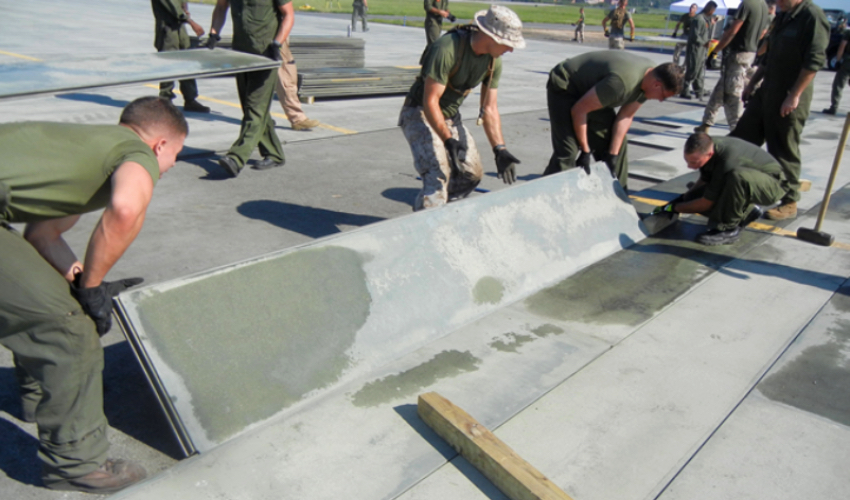
ITAMCO (Indiana Technology and Manufacturing Companies) has been working with a Purdue University professor, Pablo Zavattieri, to develop a unique 3D printed runway mat for Expeditionary Airfields for US Air Force. Last year the team was competing in Phase 1 of SBIR (Small Business Innovation Research), where they had to present the project plan, taking into account the feasibility and technical merit of the additively manufactured portable runway mat. Their project won, so they were eligible to compete in Phase 2. It was recently announced that ITAMCO and Purdue University were awarded a $1 MILLION grant to build the runway for US Air Force, thus the partners are now moving to the prototyping and testing stage.
Runway mats are a critical component of Expeditionary Airfields (EAFs) for the military. They are designed to be placed on weaker ground surfaces to enable military aircraft to land and takeoff. For decades, the United States military was using a portable runway made with an aluminum plank matting, AM-2. This matting has served them well since the Vietnam War, but the materials and technology are outdated. Therefore, the Air Force is looking forward to using the new 3D printed product conceived by ITAMCO and Purdue University.
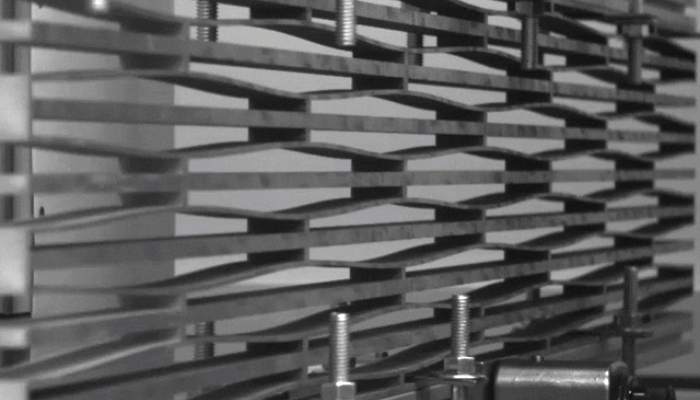
Products made with PXCM geometry have the ability to change from one stable configuration to another stable configuration and back again. (Image courtesy of Purdue University)
The objective of the research led by professor Pablo Zavattieri was to develop a robust sheet or roll technology that serves as an alternative to the AM-2 mat for temporary or expeditionary flight operations. The design of the matting solution is composed of an upper surface that mates with a lower surface and contains a type of architectured material called Phase Transforming Cellular Material (PXCM) geometry to mitigate anticipated loading and shear stresses. The ideal solution to manufacture such product was metal 3D printing.
More from the desk
Six other notes from the rest of the bench.
 NewsH (Earring); the 3D printed hearing aid jewelleryWhen it comes to relieving the daily lives of people with disabilities, 3D technologies can be useful. It offer the possibility of creating products adapted to each individual and sometimes to completely unpack the person concerned. In any case, this is the feeling…
 MaterialsRethinking the AM Workflow: Montana Mixers on Solving Problems Before the PrinterAs additive manufacturing moves into production, the conversation is starting to change. Instead of asking whether a part can be printed, manufacturers are asking whether they can print it the same way every time. More often than expected, the answer…
 NewsTOP 5 Videos: 3D printed meat, a hybrid chair and much more!This week we found the top 5 videos about 3D printing and the way additive manufacturing is shaping our society. The technology has infiltrated many sectors, from medical to automotive! Check out our selection of the week to keep up with the innovations! This week we…
 NewsReplique & Siena Garden: 3D-Printed Spare Parts for Outdoor FurnitureIt’s become a fact of life: your beloved piece of furniture gets worn down or breaks, but no spare part is available on request from the manufacturer. Annoying when the entire furniture would then need to be replaced—which is no…
 ApplicationsTeam Penske Has Incorporated its First SLA 3D Printer Into Production Processes3D printing is becoming an increasingly coveted technology in the automotive sector, especially for the big teams. This is because it can reduce the time needed to produce parts so they can be tested more quickly. For Team Penske, a…
 ApplicationsCollPlant and United Therapeutics accelerate kidney bioprintingWhat if you could 3D print your kidney? This is what CollPlant Biotechnologies and United Therapeutics Corporation are looking to do: they have just expanded their current partnership to produce and use a human collagen-based bioink to accelerate human kidney…