Applications
Ursa Major’s 3D Printed Hadley Engine Takes First Flight
Additive manufacturing is soaring higher and higher as it continues to cement its place in the space industry. Case in point, only two years since emerging on the Aerospace AM scene, Ursa Major has announced the first flight of its…
- 3 min read
- Applications
- Six more stories

Additive manufacturing is soaring higher and higher as it continues to cement its place in the space industry. Case in point, only two years since emerging on the Aerospace AM scene, Ursa Major has announced the first flight of its Hadley engine, which was made using 3D printing along with other techniques, during a test of the Stratolaunch’s Talon-A1 (TA-1) testbed. The news marks “a major leap forward toward the first flight test of a privately funded hypersonic vehicle,” according to the company.
To give some context, Colorado and Ohio-based Ursa Major was founded in 2015 by former SpaceX and Blue Origin propulsion engineer Joe Laurienti. The company puts itself forward as the leading independent rocket propulsion provider in the United States, as well as the first American company to fire an oxygen-rich staged combustion engine (previously only done in Russia). Ursa Major became more widely known in the 3D printing sector as well in 2022 with the announcement that its Advanced Manufacturing Lab in Youngstown, Ohio had delivered its first copper-based, 3D-printed rocket engine combustion chambers. Now it has shown its growth with the first flight of its 3D printed Hadley engine.
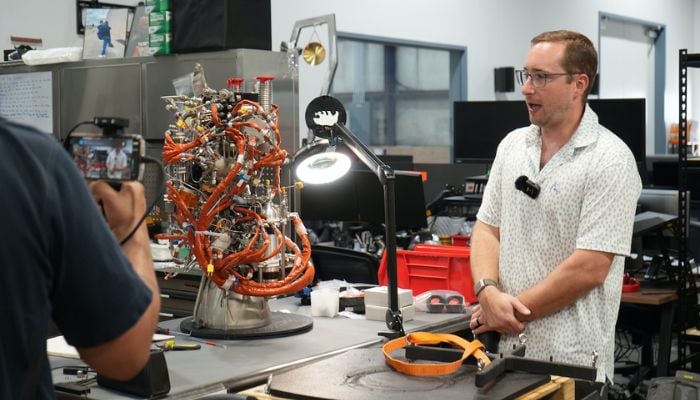
Joe Laurienti with the Hadley engine
The First Flight of the Ursa Major Hadley Engine
As mentioned, the Hadley engine’s first flight was powering the TA-1 testbed during a test over the Pacific Ocean. Though Stratolaunch has stayed quiet on many of the details of the test out of respect to its customers, the company did announce that the test reached high supersonic speeds approaching Mach 5. This is the limit wherein speed becomes hypersonic, or five times the speed of sound.
More from the desk
Six other notes from the rest of the bench.
 NewsTop 5: Flashforge Review From 3Dnatives LabHello everyone and welcome to our top 5 videos of the week! We hope you are all looking forward to Christmas and enjoying our ongoing 3D printing news and content. In our video selection for this week, we have a…
 NewsIs the 3D Printing Market Consolidating?Over 2021, we saw a flurry of mergers and acquisitions throughout the additive manufacturing industry. It seemed that the industry was maturing and consolidation would continue, especially into 2022. However, a recent report from IDTechEx suggests this might not actually…
 NewsThe Industrial 3D Printing Market is Expected to Reach $107.7B By 2031There is no doubt that the additive manufacturing sector is booming. According to the recent study released by Allied Market Research, the industrial 3D printing market is expected to reach a value of $107.7 billion by 2031, representing a Compound…
 ApplicationsDubai Starts Trial Operation of 3D Printed AbraNever let it be said that the United Arab Emirates is a stranger to innovative technologies. In Dubai, the country’s most populous city, especially, we have seen a number of projects using 3D printing in recent years. And now there…
 NewsSPEE3D’s Cold Spray Additive Manufacturing Technology & EMU for On-Demand ManufacturingSPEE3D is an innovative provider of metal-based additive manufacturing technologies. The Australian company focuses on the development and distribution of machines and integrated system solutions using its patented Cold Spray Additive Manufacturing technology. The products enable
 NewsBCN3D Reveals its New Resin Technology, VLM, for Multi-Material 3D PrintingAlready present for 10 years on the FDM printer market, BCN3D has reached a turning point today with the unveiling of a new technology. After 3 years of research and development, the Barcelona-based manufacturer will be releasing its “Viscous Lithography…