Guides
Urban Reef on Using 3D Printing and Natural Materials for Greener Cities
Additive manufacturing is a focus of interest in many fields because of its potential not only in terms of digitizing manufacturing, but also for more sustainable production. For example, there are currently a number of projects using natural materials as…
- 3 min read
- Guides
- Six more stories
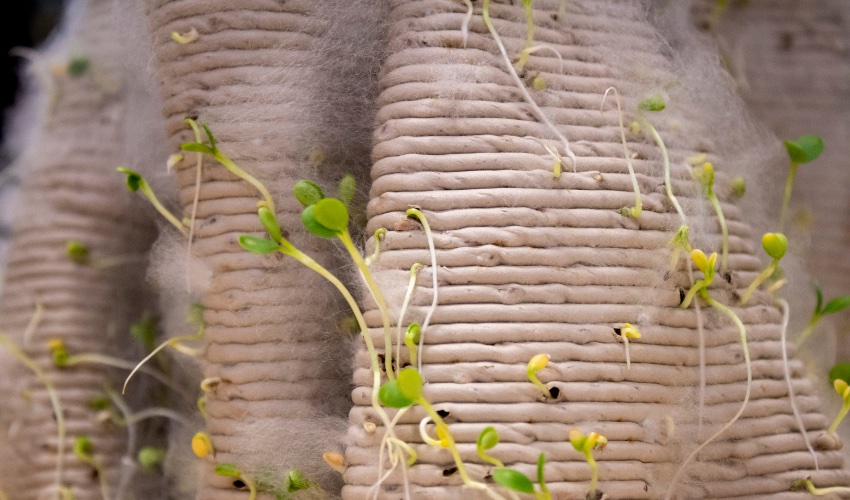
Additive manufacturing is a focus of interest in many fields because of its potential not only in terms of digitizing manufacturing, but also for more sustainable production. For example, there are currently a number of projects using natural materials as 3D printing materials including clay, soil, food waste, coffee, and more! Additive manufacturing makes it possible to transform these materials, by recycling or taking them from nature, and make many previously unimaginable applications with them. This can be seen as well with Dutch startup Urban Reef, which has combined cutting-edge technologies, 3D printing and natural materials to imagine and design greener, more inclusive and welcoming cities. They have developed structures called Reefs that they hope will help revolutionize the cities of tomorrow, thus providing a viable solution to climate change and pollution reduction challenges. To learn more, we interviewed one of the co-founders, Max Latour.
3DN: Could you introduce yourself and your connection to 3D printing
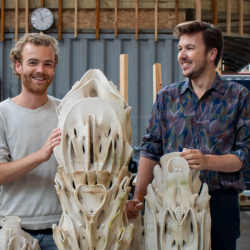
Max Latour (left) and Pierre Oskam (right)
I’m Max Latour, one of the founders of Urban Reef and a computational designer with a background in architecture. I initiated my studies at the faculty of architecture at the TU Eindhoven, where I had my first brief encounters with 3D printing. After completing my bachelor’s degree, I moved to the TU Delft for my master’s, drawn by its emphasis on architectural design. Here I started to develop my interest in computational design.
Initially, my obsession was with designing organic shapes, but this quickly evolved into an interest in natural morphogenetic processes and the potential of translating those into design tools. Eventually I graduated my master’s degree at the Robotic Building Lab, a studio within the faculty of architecture using computational design tools and 1:1 prototyping using robotic manufacturing processes.
More from the desk
Six other notes from the rest of the bench.
 NewsGrib3D, the Free 3D Modelling App based on Augmented Reality3D modelling is a key step in the manufacturing process of a product, especially when it comes to 3D printing. It involves specific knowledge and skills that are not always easily acquired. For this reason, several software companies have developed…
 NewsSAHIF Leads the Charge for Earthquake-Proof 3D Printed Housing in South AfricaEarthquakes are one of the scarier natural phenomena in the world. Though most are mild, those that are particular shallow or strong can cause unbelievable devastation such as the one that hit Turkey and Syria earlier this year which, according…
 ApplicationsVolkswagen is working to keep old cars alive with 3D printing3D printing technology has certainly found its place within the automotive industry, such as seen with major brands BMW and Audi, long time users of additive production for rapid prototyping. Just like any technology, 3D printing has changed a once…
 NewsHawaiian Students 3D Print Molds for Local Chocolate ShopAs part of a new 3D printing project, a group of students from the Department of Mechanical Engineering at the University of Hawaii recently teamed up with a local chocolate shop. The goal of the collaboration of these students and…
 ApplicationsA 3D printed electric motorbike prototype coming from PolandPiotr Krzyczkowski is a young Polish designer who wanted to create his own brand of electric motorcycles, Falectra. He wanted to offer city dwellers a comfortable, economical and more environmentally friendly solution. In order to convince various investors, he designed…
 News3D Printed Sushi Could Be the Food of Choice for Space TravelersOver the past few years, we have seen a number of applications for 3D printing in both food and space. Now, the two are getting combined. Engineers at IHI Aerospace and Yamagata University, in partnership with Nordson EFD Japan, have…