News
University of Bristol Tests 3D Concrete Printing for Earthquake Safety
In recent years, 3D concrete printing has increasingly established itself as a legitimate technology in the construction industry. It can be used to produce buildings faster and more cost-effectively, so experts see great potential in 3D concrete printing to address…
- 3 min read
- News
- Six more stories
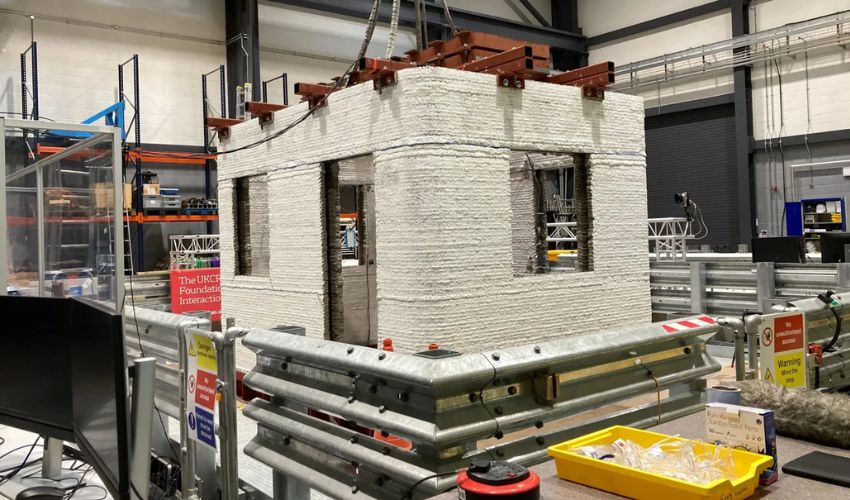
In recent years, 3D concrete printing has increasingly established itself as a legitimate technology in the construction industry. It can be used to produce buildings faster and more cost-effectively, so experts see great potential in 3D concrete printing to address housing shortages or construct sustainable buildings in difficult environments. So, researchers at the University of Bristol are now investigating how a 3D printed concrete building would withstand an earthquake.
Project leaders Professor Anastasios Sextos and Dr. Raffaele de Risi saw a fundamental research gap in additive manufacturing, which they want to address by collaborating with the University of Bristol. According to them, the experiment aims to “fill the knowledge gap surrounding the dynamic response of 3D-printed units, particularly how they perform under recorded and simulated seismic events.” To do this, the researchers are using the UK’s largest vibrating plate, on which the team is testing an almost life-size 3D printed house made of concrete.
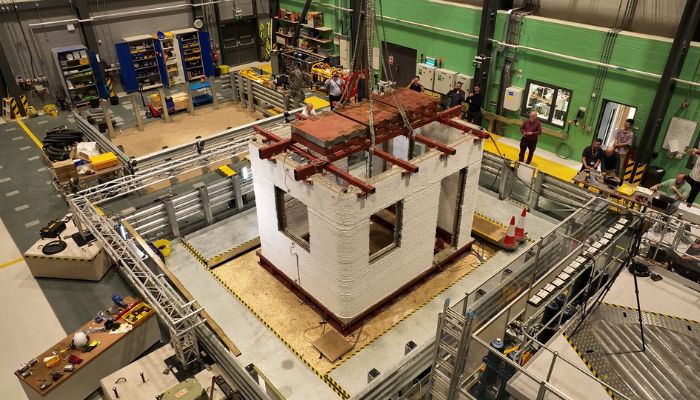
The model house on the UK’s largest vibratory plate
Why Is Research Important?
Additive manufacturing in the construction industry promises the fast and sustainable production of durable and cost-effective buildings. However, the special manufacturing technology differs fundamentally from conventional construction methods due to the layer-by-layer application of the printed material. How such buildings react to seismic forces has not been sufficiently investigated, according to the research team. Additive manufacturing would produce new variables that exceed previous knowledge on earthquake resilience in buildings. Unique material properties and geometries through printing processes make predictions even more complicated.
More from the desk
Six other notes from the rest of the bench.
 NewsTop 5 Videos: Using FDM to Print Ceramic and Metal FilamentsIn this week’s top 5, check out the latest webinar from 3Dnatives, “How Can You Use FDM to Print Ceramics and Metals?” Though ceramic and metal filaments are becoming increasingly common, especially for those using FDM for industrial purposes, there…
 NewsUsing Coffee to Provide Sustainable 3D Printing MaterialsAs additive manufacturing has opened up new creative avenues, there are those who take an interest in setting an early precedent by producing environmentally friendly materials to lead the charge in sustainability. Creating such recycled filament and green materials is…
 NewsHow Light Reflections Could Revolutionize 3D Metal PrintingMost people have probably never heard the term caustics, yet we encounter this phenomenon every day. You can see it in the dancing patterns of light at the bottom of a swimming pool or on shiny metal surfaces. But behind…
 GuidesKniterate, the knitting machine inspired by 3D printingEver wanted to create your own clothing without limits? Well now you can thanks to Kniterate, a knitting machine that uses techniques similar to those found in 3D printing. The founders of this Spanish startup, Gerard Rubio and Triambak Saxena, were…
 News3D printing copper on surfaces can kill COVID-19 virusThe Australian company SPEE3D has developed and tested a fast and affordable way to 3D print antimicrobial copper onto metal surfaces. Laboratory tests have shown that touch surfaces modified by this process kill up to 96% of SARS-CoV-2 – the…
 NewsCustomised and 3D Printed Insoles from ECCOThe Danish shoe manufacturer, ECCO showcased its customised shoes at Bon Marché Rive Gauche in Paris. For the first time in Europe, visitors will be able to test QUANT-U, a project in collaboration with Dassault Systèmes, which aims to create…