Applications
Ukraine Integrates 3D Printing into Secure Military Supply Platform
The Ukrainian Ministry of Defence has recently announced a significant expansion of its current secure digital “Component Library,” a platform that now offers more than 170 domestically produced parts and manufacturing services, including advanced 3D printing capabilities. The in
- 3 min read
- Applications
- Six more stories

The Ukrainian Ministry of Defence has recently announced a significant expansion of its current secure digital “Component Library,” a platform that now offers more than 170 domestically produced parts and manufacturing services, including advanced 3D printing capabilities. The initiative is designed to connect Ukrainian defense manufacturers, strengthen local supply chains, and reduce dependence on foreign suppliers during the ongoing Russo-Ukrainian War.
The Component Library functions as a closed online database where only verified Ukrainian producers can list and source components for weapons and military equipment. Available items include antennas, batteries, FPV drone frames, flight controllers, propellers, and specialized electronic modules. Alongside physical parts, the platform provides access to 11 types of services such as CNC machining, casting, and 3D printing. These capabilities allow manufacturers to quickly produce precision components, adapt designs on the fly, and respond to urgent battlefield needs.
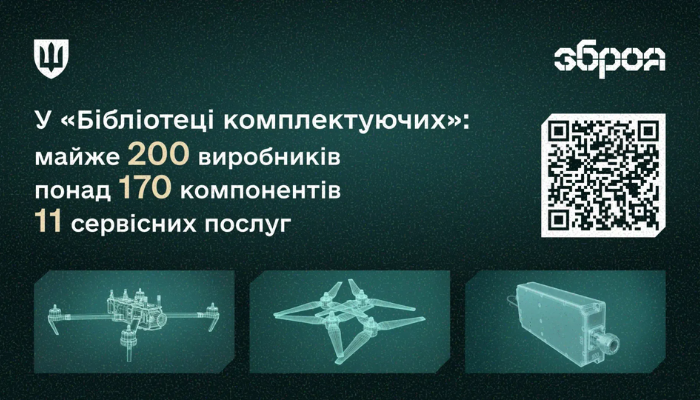
(Translation: In the Ukrainian MoD ‘Components Library’ there are over 200 manufacturers, more than 170 components, and 11 services that can be accessed.)
3D printing is emerging as a key tool within this system. By integrating additive manufacturing services into the platform, Ukrainian defense companies can rapidly prototype and fabricate complex parts directly inside the country. This is particularly valuable for small batches of customized components, where traditional supply chains can be slow or disrupted. Localized production through 3D printing reduces the time between design and deployment, allowing units to receive critical equipment faster.
More from the desk
Six other notes from the rest of the bench.
 PrintersPrusa SL1, an open-source 3D resin printer for $ 1,599Famous Czech manufacturer Josef Prusa, behind the open-source 3D printers of the same name, recently unveiled a brand new SLA machine, the Prusa SL1. In the continuity of its expansion – the company today employs 320 people, Prusa has decided to expand its…
 ApplicationsAerospace at RAPID + TCT 2025: Sintavia in the SpotlightOne of the things that we have noticed at RAPID + TCT this year, is undoubtedly the clear focus on applications. From conference sessions to exhibitor booth, we are seeing more concrete examples of how 3D printing can be used,…
 News3Dnatives’ Parent Company SPE to Merge with Plastics Industry AssociationThe Society of Plastics Engineers (SPE), which has been the parent company of 3Dnatives since 2023, announced today that their Board of Directors has voted to join forces and merge with the Plastics Industry Association (PLASTICS). This union of two…
 NewsSafeguarding Māori Heritage with 3D PrintingWith the development of 3D technologies, additive manufacturing has been a revolutionary medium for the creation of parts and objects that have previously been limited in availability, material and construction time. Not least among these has been 3D printed musical…
 NewsTop 5 Videos Of The Week: additive manufacturing for aerospace…This week we found the top 5 videos about 3D printing and the way additive manufacturing is shaping our society. The technology has infiltrated many sectors, from medical to automotive! Check out our selection of the week to keep up with the innovations! This week we…
 ApplicationsTriastek’s Latest 3D Printed Drug for Ulcerative Colitis Can Target the Colon Directly3D printing is increasingly making its way into healthcare, including in pharmaceuticals. Indeed, a few different companies are exploring the use of additive manufacturing to create custom drugs for better treatment of diseases. Now one of the largest, Chinese manufacturer&hellip