News
Tree Column, Blast Studio’s Column 3D Printed Out of Mycelium and Waste
While we are used to seeing 3D printing associated with plastic and metal, more and more initiatives are combining the technology with natural materials. London-based design studio Blast Studio recently developed a 3D printing method using mycelium, also sometimes called…
- 3 min read
- News
- Six more stories
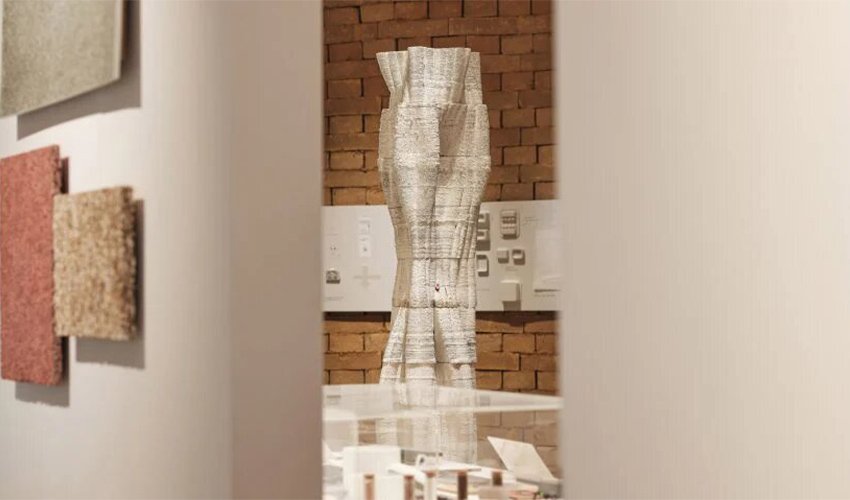
While we are used to seeing 3D printing associated with plastic and metal, more and more initiatives are combining the technology with natural materials. London-based design studio Blast Studio recently developed a 3D printing method using mycelium, also sometimes called shiro, which is an underground network of fungal threads or hyphae. Using its additive manufacturing process, Blast Studio has designed a column called “Tree Column”. The name is derived from its ridged and wavy structure, which is reminiscent of tree trunks.
Measuring more than two meters high, “Tree Column” provides the necessary strength and growing conditions for mycelium. With this project, the studio aims to provide both a structure capable of growing edible mushrooms but also able to be a part of constructions. Paola Garnousset, co-founder of Blast Studio, explains the designers’ motivation: “Our vision is to start a new type of living architecture that could self-repair and be harvested to feed people. The idea would be to 3D print a living structure in situ, which would be inoculated with different varieties of mushrooms, some with high structural resistance and some delicious ones.”

Mushrooms can grow on the Tree Column (photo credits: Blast Studio)
Creating The Tree Column
In order to design “Tree Column”, Blast Studio didn’t just use mycelium. The British designers first harvested used coffee cups from the streets of London, then mixed them with the mushroom spawn. In addition, to allow the mushrooms to grow, the artists incorporated paper into their bio-material. Once this step was complete, they then used a 3D printer based on extrusion technology to build the column. To do so, they printed 10 individual modules and then assembled them, ultimately resulting in “Tree Column.”
More from the desk
Six other notes from the rest of the bench.
 Guides#3DStartup: AMendate develops topology optimization softwareNot only the printers and filaments play a crucial role in additive manufacturing. Equally important is the software with which the models are edited. For this, AMendate developed a topology optimization software. Topology optimization is a process by which basic shapes…
 NewsApple Is Taking a Close Look at 3D Aluminum Printing for Its New ProductsWhile currently speculative, rumors suggest Apple is accelerating its adoption of additive manufacturing, specifically metal and aluminum 3D printing, across its product lineup. Building on last year’s successful use of 3D-printed titanium for the Apple Watch and the iPhone Air’s
 ApplicationsAirBike, the 3D Printed Flying Motorcycle Reinventing Aerial MobilityIs it a bird? Is it a plane? No, but it does seem to be a motorcycle straight out of a science-fiction movie. This week, Polish start-up Volonaut unveiled the AirBike, a flying motorcycle. Yes, you read that right: this…
 MaterialsTop 5 Videos: Mimaki & Open BionicsThis week’s Top 5 Videos showcases some of the most unbelievable 3D printing updates we’ve seen in recent times. These include incredibly detailed full-color 3D prints by Mimaki, amazing 3D printed prosthetics by Open Bionics, and Qlone’s 3D scanning app…
 PrintersDyze Design on the Acceleration of 3D Printing through High-Speed ExtrusionThe market for 3D printers continues to grow, and as machines become more reliable and faster, extruders, hotends and nozzles are now components that can limit the capabilities of a printer. The Canadian company Dyze Design wants to offer a…
 PrintersFormlabs unveils its first SLS printer: the Fuse 1At the Formlabs Digital Factory conference yesterday, Formlabs made their big announcement of a new 3D printer, the Fuse 1, and a system called Form Cell, that will manage a fleet of Form 2 3D printers. Known for their SLA…