News
The World’s Largest 3D Printed Pavilion is in Nanjing, China
Located in Nanjing, China, this 3D printed pavilion project is considered to be the largest one created to date. The structure has been developed at the Happy Valley amusement park in Nanjing, which officially opened its doors in mid-November last…
- 3 min read
- News
- Six more stories
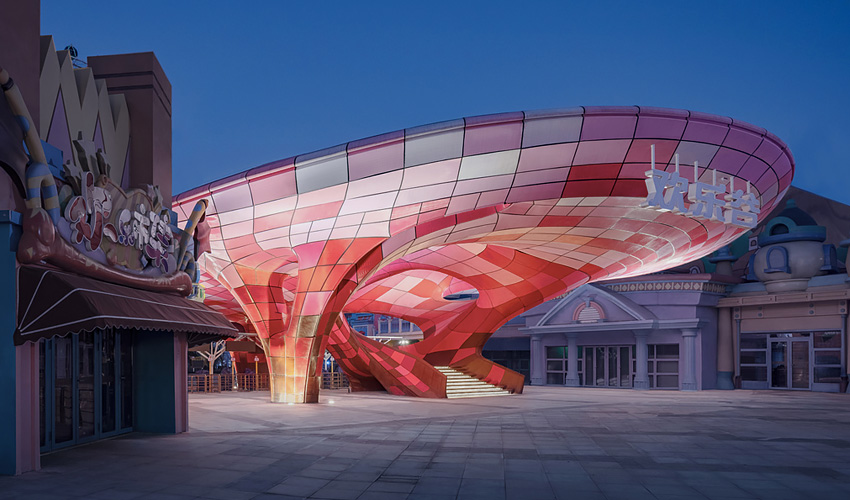
Located in Nanjing, China, this 3D printed pavilion project is considered to be the largest one created to date. The structure has been developed at the Happy Valley amusement park in Nanjing, which officially opened its doors in mid-November last year 2020. The design was proposed by Archi-Union Architects and Fab Union, and they claim that it is intended to reflect an avant-garde structure standing tall and fascinating as a futuristic wonder, opening the way to another dimension.
This is not the first time that additive manufacturing has been used in projects for the construction of architectural structures in public locations. Just considering pavilions, we have already see the Deciduous, a 3D printed pavilion made from recycled plastic bottles, and the R-IGLO, a pavilion made from recycled PET. Both projects show the potential of 3D technology as well as the ability to reuse materials for use as manufacturing materials. However, this new pavilion located in China challenges architecture and construction on a higher level thanks to its highly original and innovative design.
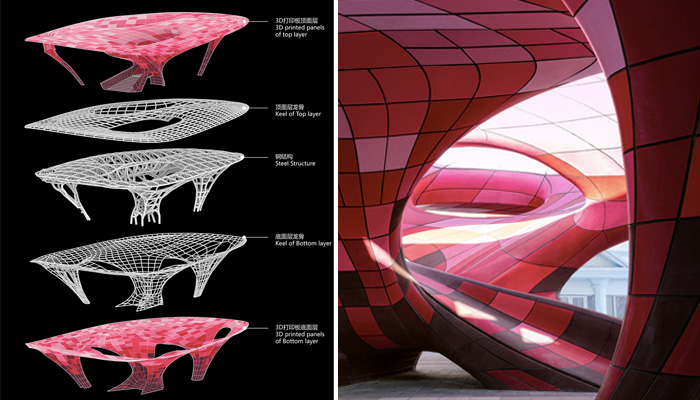
On the left, the 3D mesh of the structure. On the right, the interior of the pavilion.
The 3D printed pavilion
In more concrete terms, the 3D printed pavilion at Happy Valley in Nanjing is about 170 feet (52 meters) long and 85 feet (26 meters) wide. In addition, the projection area is around 14,552.8 square feet (1352 m²), with an unfolded surface of 20,989.6 square feet (1950 m²). The most characteristic feature of this structure is its multidimensional hyperbolic geometry that allows an overhang of up to 30 meters, which provides unique spatial experience. In terms of design, 6 shades of pink were used for each segment using the color pixel collage algorithm. Each of the panels was then 3D printed following the established pattern. After repeated testing of resistant materials the team opted for an outdoor UV-resistant color-modified thermoplastic that can achieve 256 colors with precise parametric color printing technology.
More from the desk
Six other notes from the rest of the bench.
 News3D Printing: A Summary of 20172017 was an eventful year in 3D printing and additive manufacturing. 3D printing startups received hundreds of millions of dollars in investments, announced intentions to build 3D printed supercars and flying cars, and well-established names like GE and HP made…
 GuidesWhy does BMW bet on additive manufacturing?Large industrial groups are among the first users of additive manufacturing, convinced of the advantages that technology offers today. The German group BMW is a perfect example of this. While announcing the opening of a new additive manufacturing center in 2019, they recently&hel
 NewsTop 5 Videos: Optimizing your 3D printing designThis week we found the top 5 videos about 3D printing and the way additive manufacturing is changing production. The technology has infiltrated many sectors, from medical to automotive – check our selection of the week to keep up with the innovations! If you enjoy these, you&hell
 GuidesWhat is the Status of Women in the 3D Printing Industry?International Women’s Day takes place every year on March 8th. According to the United Nations, it is a global day that celebrates the achievements of women around the world as well as the progress that has been made up to…
 NewsUbisoft Turns to 3D Printing to Create Futuristic Costumes in Just Dance 2023For over 14 years, Just Dance, a game that (as the name suggests) has been designed to get you dancing, has amazed users. Starting on the Wii all the way back in 2009, this year Ubisoft released the 14th version…
 MaterialsAn Organic 3D Printed Shoe CollectionThe ORGANIC shoe collection is a collaboration between Lucie Trejtnarová, a postgraduate student at Tomas Bata University in Zlin, Czech Republic, materials manufacturer, Fillamentum and the design studio, Malai Design & Materials. As its name suggests, this shoe collection i