Guides
The Not-To-Be Missed Post-Processing Solutions at Formnext 2023
Post-processing is a key step in the 3D printing process and is an increasingly important area of focus in the industry. Whether it is to improve the aesthetics of a 3D-printed part or to optimize its properties, post-processing techniques are…
- 3 min read
- Guides
- Six more stories
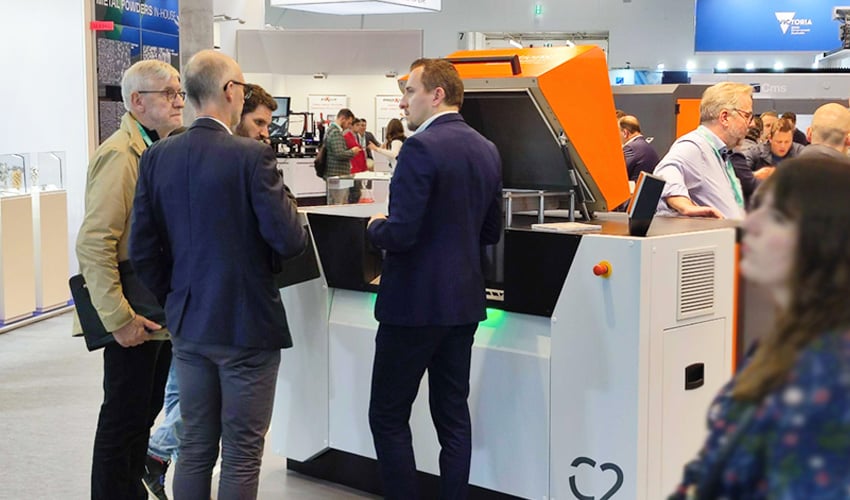
Post-processing is a key step in the 3D printing process and is an increasingly important area of focus in the industry. Whether it is to improve the aesthetics of a 3D-printed part or to optimize its properties, post-processing techniques are numerous and require not only appropriate machines or tools, but also personnel trained in the process to be performed, safety measures to be observed, careful planning already at the time of part design, and more. The challenge in recent years, therefore, is the optimization of these processes and their automation, which is necessary to reduce production time and costs. On the positive side, post-processing solutions and specialized players in this market segment are growing. We saw this at this year’s Formnext, where there was no shortage of novelties and innovations, and where new players were added to solutions from players already established in the field. So we have selected for you the most interesting post-processing solutions we saw at Formnext 2023! We have listed them below in alphabetical order.
Addiblast Mars, Automated Depowdering for Metal 3D Printing
When using powder 3D printing technologies, it goes without saying that depowdering is one of the most important post-processing steps. Similar to the removal of supports in FDM, depowdering ensures that the part is fully taken out of the powder cake and all excess powder is removed. But it can be difficult to do. Slovenian company Addiblast, however, may have the solution. This year at Formnext, it has shown both its polymer and metal depowdering solutions, including the MARS03. The MARS, or Metal Additive Removal System, line has been designed and optimized specifically for the removal of final powder, even from complex geometries such as parts with internal channels. The process in the MARS03 is entirely automated though manual work is also possible thanks to the inclusion of heavy-duty gloves. The full workspace measures 850 mm x 900 mm x 1000 mm though the build plate volume is smaller at 400 mm x 400 mm x 400 mm. .
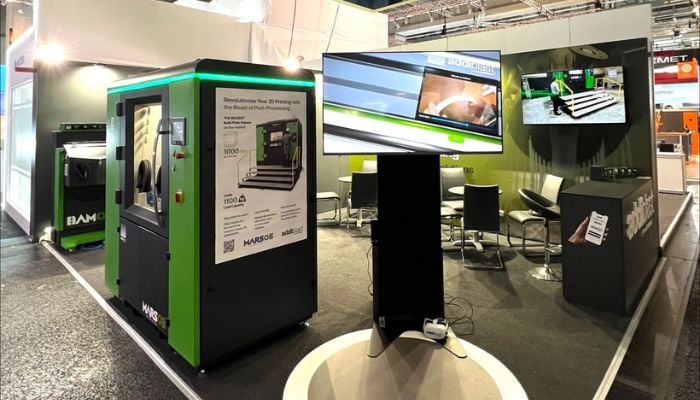
Photo credits: Addiblast
AM Efficiency and its All-In-One Solution for Polymer Powder 3D Printing
One company that is quickly making a name for itself in the realm of post-processing is the Swedish company AM Efficiency. The company has two automated and scalable solutions that can clean, color and polish 3D printed parts. The first is the CCP-10 which has been developed specifically for post-processing parts made using desktop or small SLS machines (though is compatible with any polymer powder bed technologies including MJF, SAF and HSS) such as those from Sinterit, Formlabs and Wematter. It is office-friendly with a cabinet volume of 440 liters with a drum diameter of 55cm and depth of 30 cm. Moreover, it is possible to do cleaning, coloring and polishing all in the same unit, helping users to save space. Meanwhile, the second solution, the CCP2, has the same benefits and capabilities but is significantly larger with a cabinet volume of 990 liters and a drum volume of 65 liters. Both machines have been fully optimized not just for efficiency but for sustainability as their systems do not use toxic chemicals, ensuring no negative impact on the environment. You can find out more about their machines HERE.
More from the desk
Six other notes from the rest of the bench.
 ApplicationsDental 3D Printing To Be Valued at $7.9 BillionResearch firm Markets and Markets recently released its new report on dental 3D printing, which is expected to generate $7.9 billion by 2027, growing at an annual rate of 20.2% from this year. This study is divided into the most…
 News3D Printing Thermoset Materials Without Supports: A Faster New ApproachWhat if resin 3D printing could eliminate support structures entirely and make fabrication easier? That is the question explored by researchers at Xiamen University and the University of California, Berkeley. Together, they developed a new method for creating parts from…
 NewsTop 5 Videos: Artificial intelligence and 3D printing …This week we found the top 5 videos about 3D printing and the way additive manufacturing is changing production. The technology has infiltrated many sectors, from medical to automotive – check our selection of the week to keep up with the innovations! If you enjoy these, you&hell
 News6K Additive Shows Its Sustainable, Metal Powders for Additive ManufacturingIt goes without saying materials and additive manufacturing go hand in hand. Whether metals, polymers or ceramics, the right material is critical for ensuring that users can produce parts with the right properties and characteristics. This is especially the case…
 GuidesCarbon Talks Staying on the Cutting Edge of Resin 3D Printing at RAPID + TCTIf you are interested in resin 3D printing, you have probably heard of Carbon. The company has made quite a name for itself with its innovative DLS process that includes a pocket of air to ensure easier and faster printing.…
 MaterialsBespoke Car Manufacturer Arash Uses MakerBot & Carbon Fiber For Electric HypercarUK-based hypercar manufacturer Arash Motor Company is leveraging the efficiencies of 3D printing in its car factories in order to accelerate car production. While Arash has been using MakerBot 3D printers for numerous years, the company has just recently introduced…