News
GE, COBOD and LafargeHolcim create taller wind turbines using concrete 3D printing
GE, COBOD and LafargeHolcim worked together to develop a 3D printed concrete base to support larger wind turbines, capable of reaching 200 meters in height to capture stronger winds, and therefore offer more efficiency. The goal of the partnership is…
- 3 min read
- News
- Six more stories
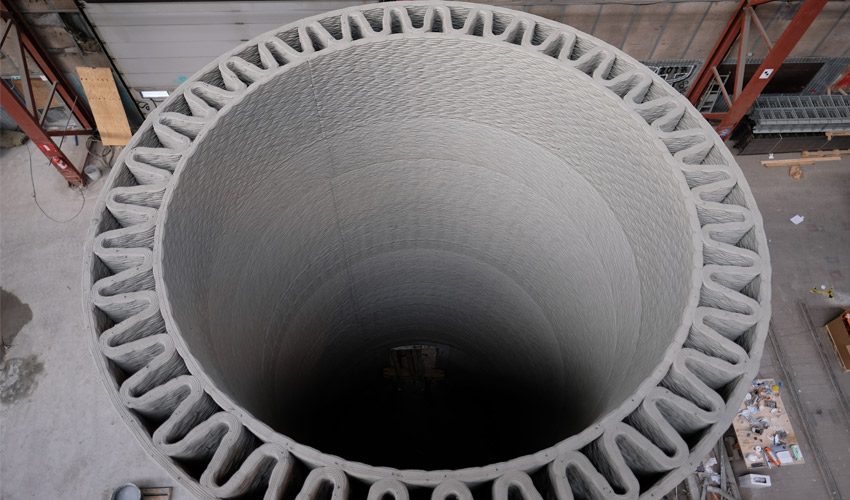
GE, COBOD and LafargeHolcim worked together to develop a 3D printed concrete base to support larger wind turbines, capable of reaching 200 meters in height to capture stronger winds, and therefore offer more efficiency. The goal of the partnership is to boost global renewable energy production while lowering the cost of energy. A fine example of the potential of concrete 3D printing!
Today, the majority of wind turbines are generally no more than 100 metres high, limited by the 4.5 metre base diameter. Indeed, not everything that is wider can be transported by road, and if it can it is quite expensive to do so. This poses a number of constraints for the construction of wind turbines. As you know, additive manufacturing makes it possible to reinvent the supply chain, removing logistical limitations, since local manufacturing is preferred. Thanks to 3D technologies, companies are no longer dependent on transportation constraints, and can produce what they want at any time. The case of wind turbines is no different: concrete 3D printing makes it possible to design the base of the device directly on site, thus offering the possibility of enlarging its diameter and height.
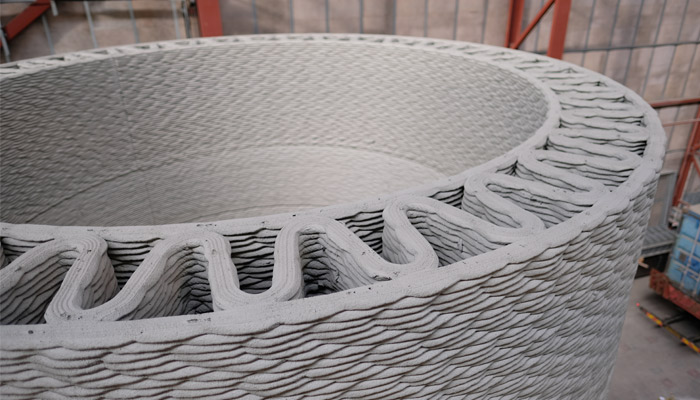
The partners used 3D concrete printing to design taller wind turbines | Credits: GE
But why increase the height of a wind turbine? It is important to know that a 5 MW wind turbine of 80 m height generally produces 15.1 GWh per year. By increasing the height of the same wind turbine to 160 m, it could produce 20.2 GWh per year, an extra 33%. This increase in height can therefore generate more energy, while concrete 3D printing lowers manufacturing costs. Matteo Bellucci, Head of Advanced Manufacturing Technologies for GE Renewable Energy, explains: “3D printing is in GE’s DNA and we believe that additive large format manufacturing will revolutionise the wind industry. Concrete 3D printing has progressed significantly over the last five years and we believe it is moving closer to a real application in the industrial world. We are committed to taking full advantage of this technology both for the design flexibility it allows and for the logistical simplification it offers on such massive components“.
More from the desk
Six other notes from the rest of the bench.
 NewsTurkish Aerospace Industries to Receive World’s Largest Electron Beam DED 3D PrinterAmerican company Sciaky, Inc. has announced that it will be delivering the world’s largest electron beam directed energy deposition (DED) 3D printer to Turkish Aerospace Industries (TAI). The customized 300 Series Electron Beam Additive Manufacturing (EBAM) system will be u
 ApplicationsResearchers develop 3D printed human heart model for surgical planningAt Carnegie Mellon University in Pittsburgh, a team of researchers has developed a printing method called FRESH (Freeform Reversible Embedding of Suspended Hydrogel), which is able to produce a human heart model to help surgeons in their operations. Using alginate…
 GuidesThe Faces of Additive Manufacturing: Hanan GothaitWe continue our series on the personalities that have shaped and impacted the additive manufacturing world with our second personality, Hanan Gothait, CEO of XJet. He is behind multiple projects and the patented technology launched by the company also known…
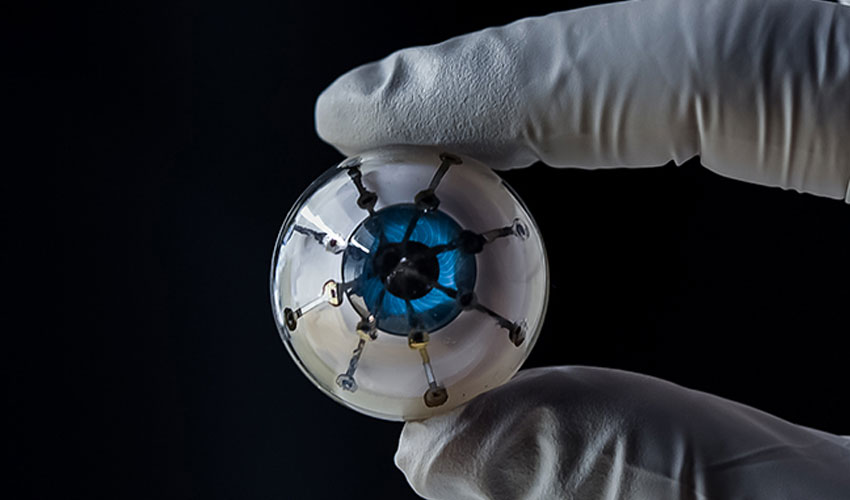 NewsResearchers creates prototype of a 3D printed bionic eyeThe University of Minnesota (UMN) McAlpine research group claims to have successfully 3D printed optoelectronic devices using polymeric photodetectors on hemispherical surfaces. These first prototypes could accelerate the development of a 3D printed bionic eye to help people with
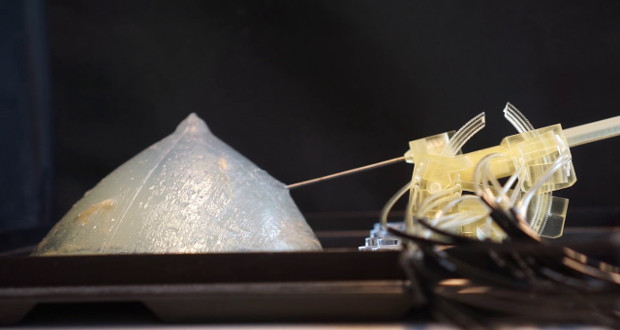 ApplicationsResearchers develop 3D printed breast cancer detecting robot3D printing has touched a number of different industries, but one that has seen significant innovations over the last couple years has been none other than the medical field. Thanks to its ease of adoption, 3D printing is helping to…
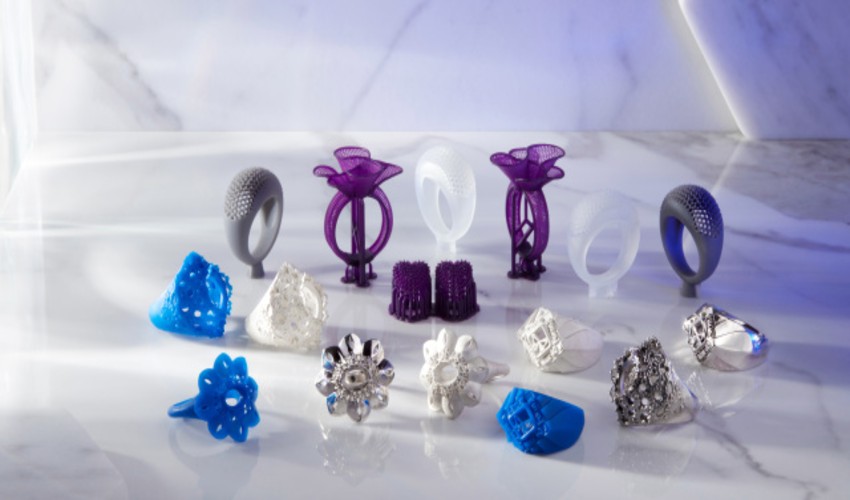 MaterialsCastable Wax 40 Resin: the new resin from FormlabsFormlabs has added a 30th patented material to its catalog! During the Consumer Electronic Show (CES) in Las Vegas, which took place virtually this year, the American manufacturer presented its new resin intended for jewelers: the Castable Wax 40 Resin. To develop…