News
Stringing in 3D Printing: What Is It and How Do You Fix It?
When it comes to 3D printing, as with any manufacturing process, it goes without saying that users will not always be completely satisfied with the results. It can often happen that, due to different circumstances, the 3D printed part does…
- 3 min read
- News
- Six more stories
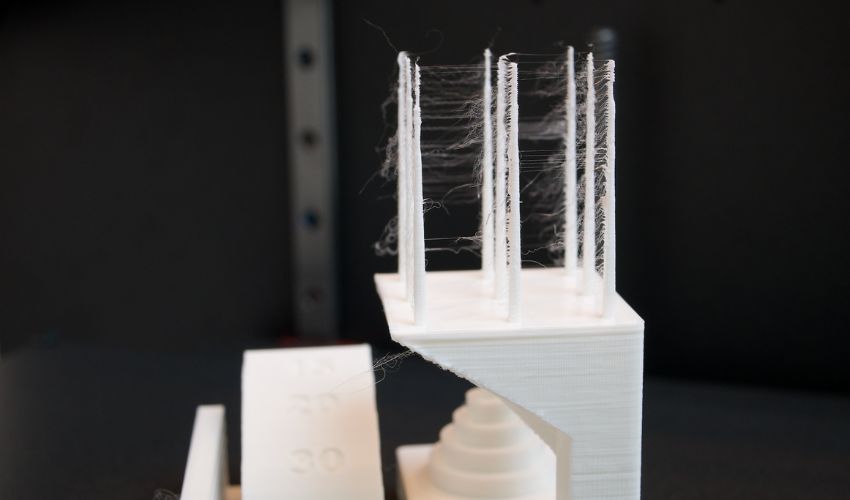
When it comes to 3D printing, as with any manufacturing process, it goes without saying that users will not always be completely satisfied with the results. It can often happen that, due to different circumstances, the 3D printed part does not quite meet expectations and may therefore not be usable. One of these problems is what is known as stringing in 3D printing. As the name already suggests, stringing results in extremely thin, unintentional plastic threads on the part, reminiscent of a spider’s web. These unsightly strings are a common 3D printing issue. Moreover, currently there are no machine applications that can be used to remove these threads, so this must be done by hand or alternatively with heat. Add on to that the fact that these threads can occur in large quantities, depending on the part, it is safe to say that the removal process can be quite complicated. We have looked more closely at stringing during 3D printing and explain how it occurs and what you can do about it.
The use of 3D printers thrives on almost daily innovations, so it is often unavoidable that challenges can also arise in connection with this. Stringing basically occurs when using filaments, essentially the strings are fine, melted filament threads that settle in places other than they are supposed to be on the 3D printed object. This can usually happen due to incorrect settings, so that the filament continues to drip out of the nozzle even though the extruder is about to move to another location to continue FDM 3D printing.
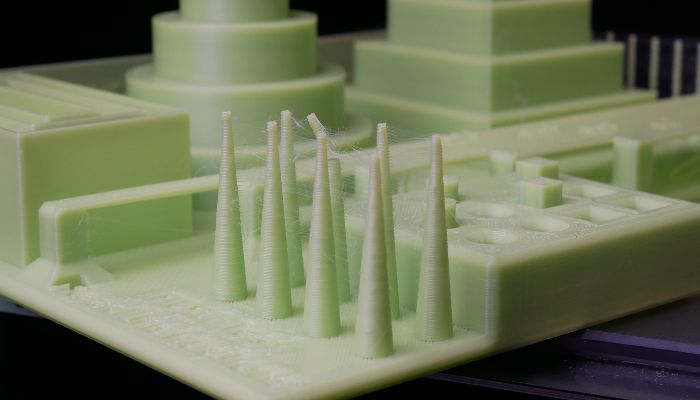
Photo Credits: Elliot Saldukaite/3Dnatives
Here’s how you can visualize the process: If you’ve ever used a hot glue gun, you’ve probably noticed that even after you stop squeezing the hot glue gun, it still creates more melted glue. This is because there is too much pressure inside the gun. We can also apply this to the effect of stringing in 3D printing: a filament with a size of 1.75 mm, for example, and a nozzle with a size of 0.4 mm – here, too, there is pressure that causes the filament to flow further out of the nozzle resulting in these threads. Theoretically, of course, this shouldn’t happen, but there are a few things you can keep in mind to ensure that the melted filament is really only applied to those parts of the print where you really want them to be.
More from the desk
Six other notes from the rest of the bench.
 NewsTop 5 Videos: 3D Printing a Spacesuit for “A Thousand Suns”Welcome to our compilation of this week’s most compelling 3D printing highlights. We kick off this week’s edition with a video from BlackMilk Studio, featuring director Ruairi Robinson as he details the use of 3D printing to create the spacesuit…
 SoftwareTopology Optimization vs. Generative Design: Which Modeling Tool Should You Choose?There is a constant race for even faster production, parts meeting higher demands and to surpass our current accomplishments. To achieve this, the products we manufacture have to be optimized in one way or another, so that they perform even…
 GuidesTCT Show 2017 Open their doors this September in BirminghamTCT Show is one of the largest 3D printing events in the world and will be taking place in Birmingham, England in only a couple weeks. This event is known for both wowing their visitors and bringing together some of…
 NewsOPPO Uses 3D Printing to Create a Crease-Free Foldable SmartphoneAre we seeing a new trend in additive manufacturing? Just last week, we told you about Apple’s new products and their use of this technology. This week, it’s Chinese manufacturer OPPO’s turn, as the company has announced a new foldable…
 SoftwarePrint&Go Acquires Astroprint in Order to Improve User ExperienceThe additive manufacturing market is constantly changing. This can be shown by the fact that one of the most prominent trends in recent years includes the merging of organizations and the signing of collaboration agreements and even the purchase of…
 MaterialsBraskem to Expand 3D Printing Material Portfolio Through taulman3D AcquisitionWhen it comes to additive manufacturing, materials are key to getting parts with the desired properties. It should thus come as no surprise that the material 3D printing market has been developing rapidly over the past few years, with many…