News
The Complete Guide to Stereolithography (SLA) in 3D Printing
Stereolithography (SLA) is a 3D printing process that uses an ultraviolet (UV) laser to cure and harden liquid photopolymer resin, building objects one thin layer at a time. It belongs to the family of technologies known as vat photopolymerization, and…
- 3 min read
- News
- Six more stories
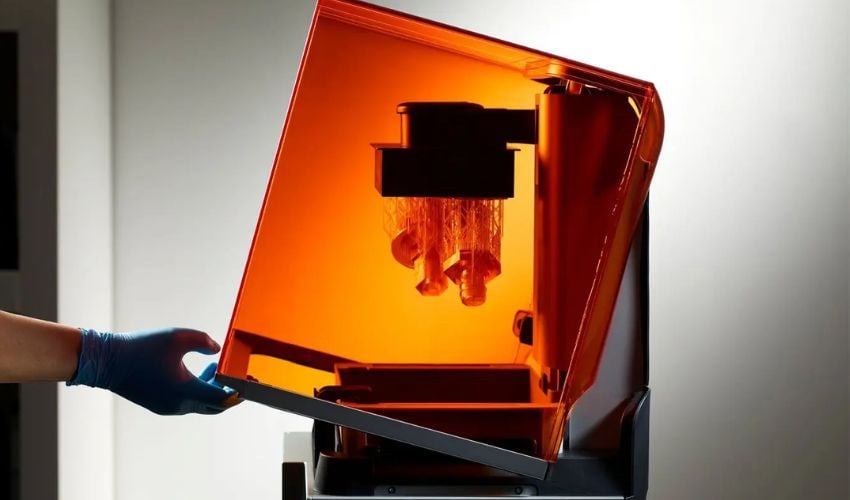
Stereolithography (SLA) is a 3D printing process that uses an ultraviolet (UV) laser to cure and harden liquid photopolymer resin, building objects one thin layer at a time. It belongs to the family of technologies known as vat photopolymerization, and is commonly referred to as resin 3D printing. Valued for its fine detail and smooth surface finish, SLA is widely used for prototyping and for producing casting patterns.
Stereolithography is one of the earliest 3D printing methods. The technology was patented in 1984 by Charles “Chuck” Hull, and the first commercial machine was developed by 3D Systems in 1988. Decades later, the technology remains a major force in the industry. The global stereolithography 3D printing market was estimated at USD 2.91 billion in 2025 and is expected to reach USD 21.98 billion by 2035, according to Spherical Insights.
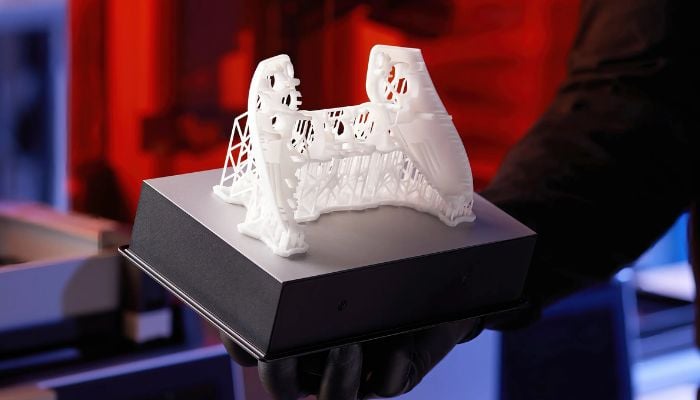
A part from the Formlabs Form 4. (Photo Credit: Formlabs)
But how does it work? Find out below in our complete guide to stereolithography. For hardware recommendations, see our Top 10 resin 3D printers.
More from the desk
Six other notes from the rest of the bench.
 Materials3D Printing Revolutionizes Refractory Alloys for Hypersonic ApplicationsIn high-stakes industries like aerospace and defense, the demand for advanced materials that can endure extreme environments is relentless. Refractory alloys, known for their exceptional resistance to heat and wear, are becoming indispensable in these fields. Among them, Niobium
  Printers#3DStartup: Apis Cor, Creators of the 3D Printed HouseIf you’ve been on the internet in the last year, you may have seen the viral clip of a 3D printed house built in just 24 hours. Apis Cor are a Russian company who built a whole, functional house in…
 ApplicationsEric Schmidt, Former Google Head, Becomes CEO of Relativity SpaceFrom Sillicon Valley to space! Eric Schmidt, who was CEO of Google from 2001 to 2011, has taken over as CEO of Relativity Space. The news comes alongside a significant investment by Schmidt himself in the company, sources tell The…
 NewsLa Pâtisserie Numérique develops a slicer for food 3D printing3D printing food presents a number of challenges even though it allows to create more complex shapes and geometries, adding originality to dishes. Marine Coré Baillais has set herself the goal of meeting these challenges by launching La Pâtisserie Numérique.…
 ApplicationsA 3D Printed Ferry Could Be Part of the 2024 Summer OlympicsThe Summer Olympics are still a year away, but it already seems that 3D printing will have its own role to play. French inland waterway authority, Vois Navigables de France (VNF) has been seeking environmentally friendly river shuttles for the…
 GuidesExclusive interview with aRks 3D, the creators of the 3D printed bikinisA few weeks ago, we presented you with the first collection of 3D printed bikinis by the Italian design studio aRks 3D. The swimsuit is fully customized, perfectly adapted to your body and is environmentally friendly with a recyclable printed…