Applications
#Startup3D: FIDENTIS Redefines Dentures with Multi-Material 3D Printing
Dentistry is a field where precision, aesthetics and functionality must coexist in perfect harmony. This technically demanding sector has benefited greatly from advances in 3D printing. Among the young companies transforming dental production methods, FIDENTIS® stands out. A spin
- 3 min read
- Applications
- Six more stories
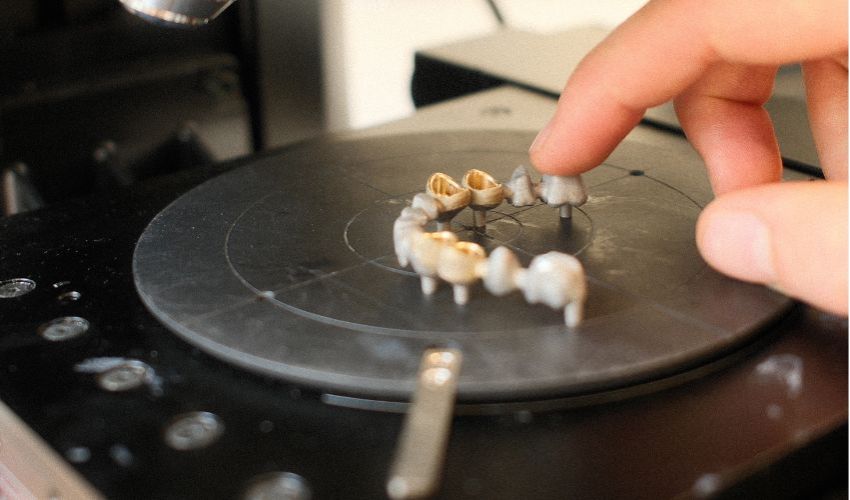
Dentistry is a field where precision, aesthetics and functionality must coexist in perfect harmony. This technically demanding sector has benefited greatly from advances in 3D printing. Among the young companies transforming dental production methods, FIDENTIS® stands out. A spin-off from the Fraunhofer IGCV institute, this start-up has attracted attention with a multi-material 3D printing solution specially designed for telescopic prostheses. Their technology goes beyond current standards: it combines laser powder bed fusion with a robotized system capable of depositing other materials in the same process. We recently spoke to Max Horn, co-founder and CEO of FIDENTIS, to learn more about their approach.
3DN: Can you introduce yourself and tell us how FIDENTIS was born?
FIDENTIS® was born as a spin-off from Fraunhofer IGCV, recognized worldwide as one of the leaders in multi-material additive manufacturing research applied to metals. As a researcher at this institute and doctoral student at TUM, I contributed, alongside my colleagues, to the development of this innovative technology back in 2017. Today, we are using this very process to produce dental prostheses.
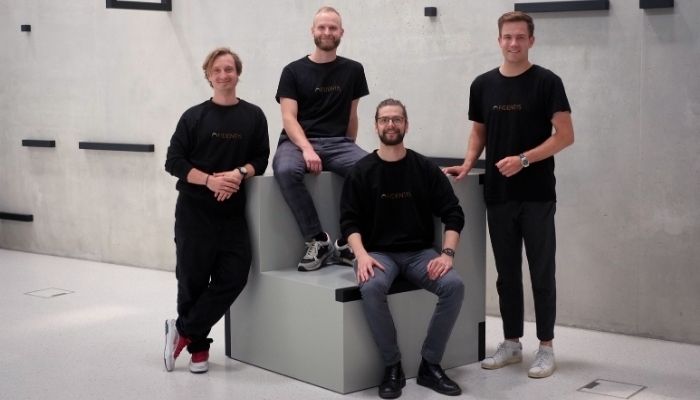
The FIDENTIS team. From left to right: Max Horn, Timo Schröder, Lukas Langer and Johannes Lauer.
3DN: Why have you chosen to focus on dentures?
A few years ago, Josef Schweiger—one of Germany’s most renowned dental technicians—discovered our manufacturing technology, originally developed for sectors such as aeronautics and toolmaking. He immediately saw its potential for the dental industry. Since then, we have pooled our skills and, with our respective teams, are continuing to develop this technology to make it compatible with precious metals and capable of meeting the exacting standards of dental prosthetics.
More from the desk
Six other notes from the rest of the bench.
 SoftwareThingiverse: An Online Platform for Free STL FilesFor anyone immersed in the world of additive manufacturing, Thingiverse is a cornerstone of the 3D printing community. As one of the industry’s most influential file-sharing platforms, it hosts a massive library of millions of user-generated designs, primarily available as&
 GuidesWhat Were the Most Innovative 3D Startups in 2022?As we at 3Dnatives do every year, now that it is December, we want to take the opportunity to review some of the most outstanding 3D startups in 2022. Over the past 12 months, we have interviewed 3D printer manufacturers,…
 NewsAn Adaptive Nozzle for Both Fast and Accurate 3D Printing From Johns HopkinsWhen it comes to 3D printing, many users find themselves facing a choice of either a high resolution or a high speed. It is indeed challenging to reconcile both without compromising. Printing nozzles with a small diameter enable intricate details…
 NewsHow Researchers Are Using Holograms to Improve 3D PrintingCan holograms improve the additive manufacturing process? This is the subject of a study by a team of scientists from EPFL and the University of Southern Denmark. They sought to understand how to perfect tomographic volumetric additive manufacturing (TVAM). Instead…
 MaterialsNew Sustainable Resin for 3D Printing Developed at Penn StatePennsylvania State University, better known as Penn State, has often been cited as being at the forefront of numerous advances in 3D printing technologies, such as recent research utilizing 3D printing in the fight against breast cancer. Now, a team…
 NewsFizik 3D Prints Bicycle Saddles that Adapt to the Cyclist’s PositionFizik is an Italian bicycle equipment brand that belongs to the Selle Royal group. Mainly known for its saddles and shoes for cyclists, the company recently unveiled a brand new concept of modular saddles for its Argo series. It interested…