Materials
UT Austin Unveils New 3D Printing Method for Advanced Electronics
A research team led by The University of Texas at Austin has introduced a new 3D printing technique that could redefine how semiconductor components are designed and produced. The method, known as Holographic Metasurface Nano-Lithography (HMNL), offers a way to…
- 3 min read
- Materials
- Six more stories

A research team led by The University of Texas at Austin has introduced a new 3D printing technique that could redefine how semiconductor components are designed and produced. The method, known as Holographic Metasurface Nano-Lithography (HMNL), offers a way to print chip packages and electronic structures at speeds and levels of complexity that traditional manufacturing cannot match.
Semiconductor fabrication is typically slow and expensive, relying on a long sequence of material deposition, masking, etching, and packaging steps. Each stage increases cost, limits design flexibility, and produces waste. HMNL replaces much of this workflow with a single 3D printing process that patterns advanced electronics in one pass. The technology can fabricate multi-material, three-dimensional structures that integrate metals and polymers in highly detailed geometries.
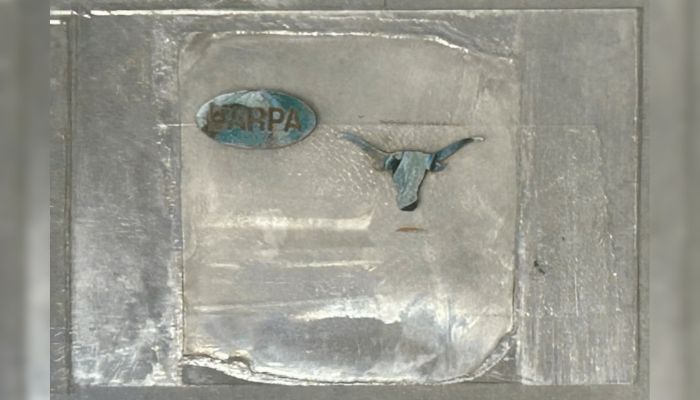
An example of the Holographic Metasurface Nano-Lithography (HMNL) method on a semiconductor.
At the center of the process are metasurfaces, ultra-thin optical masks that contain dense patterns of encoded information. When illuminated, these surfaces project holograms into a hybrid resin that solidifies into precise microstructures. Researchers say HMNL can reach features smaller than a human hair and can create forms that are impossible to achieve with step-by-step lithography. This opens the door to new component categories such as fully 3D printed capacitors, non-planar chip packages, and electronics shaped to fit robotics or aerospace systems where space is limited.
More from the desk
Six other notes from the rest of the bench.
 NewsNot a New Printer, A New Material: Nano Dimension’s ATARU ExplainedAt Formnext 2025, one trend is unmistakable: additive manufacturing is shifting firmly toward real production. Nano Dimension is at the center of that shift, showing how materials, not just machines, are driving the next leap forward. Known for its intelligent…
 NewsThe Tallest 3D Printed Building in the World Unveiled in Saudi ArabiaIt has been a busy year for 3D printed construction projects. From Zero Net Energy buildings to 3D printed schools and holiday parks and more, never before has additive manufacturing seemed to have such a crucial role in the building…
 NewsMIT Students Create 3D Printer That Turns Food Waste into Functional ObjectsBiru Cao and Yiqing Wang, two graduates from MIT, recently developed a new desktop 3D printer called FOODres.AI.The system combines artificial intelligence, object recognition, and additive manufacturing to convert household food waste such as fruit peels, coffee grounds, and lef
 NewsIs the implementation of 3D printing in education a necessity?A new school year has begun and with it learning and preparing the youth for the future. Recently, 3D printing in education has become more widely known. Despite 3D printing being relatively new on the mainstream market, more and more…
 NewsNovak Djokovic’s Jacket at The French Open: A 3D-Printed Wolf and Real ClayThe 2026 Roland-Garros Tournament kicked off last week, and we can’t pass up the chance to highlight Novak Djokovic’s entrance. The Serbian player arrived wearing a jacket featuring a 3D-printed wolf and real clay from the legendary Parisian court. The…
 GuidesTop 8 3D Printing Personalities in 2017Most 3D printing news revolves around 3D printers and scanners, rather than people. This can mean that the people behind these innovative products don’t receive the limelight. Therefore, we have created our Top 10 3D printing personalities of 2017, with descriptions of why&