Printers
Quantum X, the new cutting-edge system for microfabrication
Microfabrication is an emerging segment of additive manufacturing that will open the door to a number of very promising applications. There are not many companies in this field, however we have observed the last few months that these players are…
- 3 min read
- Printers
- Six more stories
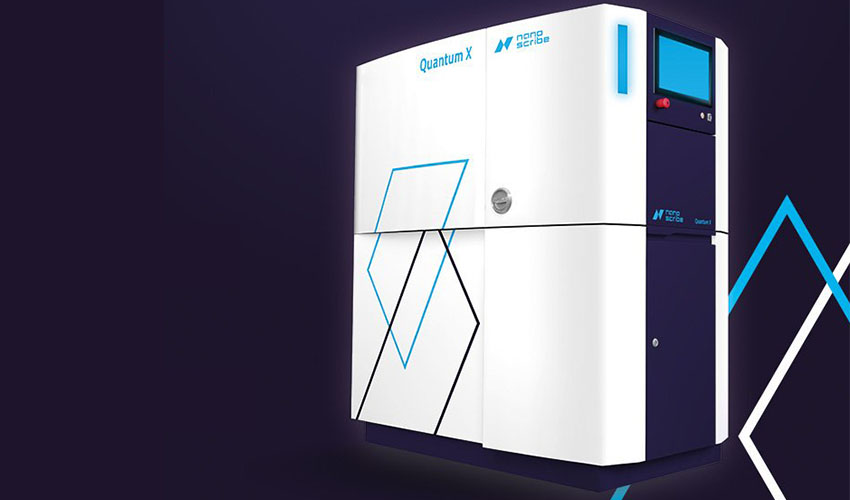
Microfabrication is an emerging segment of additive manufacturing that will open the door to a number of very promising applications. There are not many companies in this field, however we have observed the last few months that these players are developing new solutions for this growing market and receiving more and more attention for it. Just recently, the 3D printer manufacturer Nanoscribe unveiled its newest 3D printer, the Quantum X. This system is designed for the microfabrication of prototypes and masters in industrial production processes. In other words, this printer is able to produce tiny objects using the company’s patent-pending 2GL (Two-Photon Grayscale Lithography) technology.
The Quantum X system is a machine that offers high speed, complete design freedom and high precision in order to create very small yet complex structures. As with all 3D printing technologies, the aim is for the user to benefit from shorter design iteration cycles and cost-effective manufacturing. Nanoscribe explains that this system is ideal for refractive microoptics and multi-level diffractive optical elements. In other words, micro lenses, as small as 200 microns.
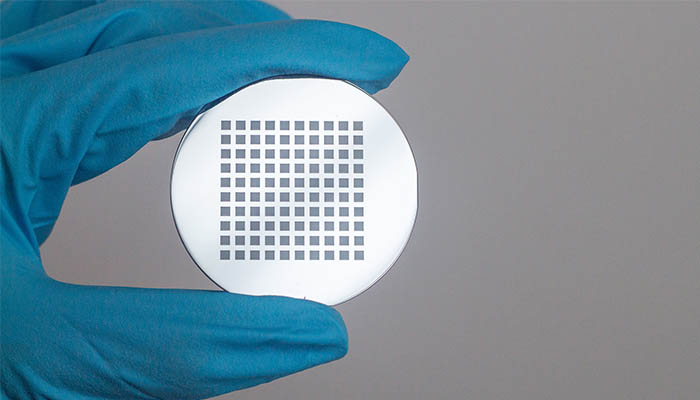
Micro-optics directly printed on a two-inch wafer without the need for additional lithography steps or mask fabrication | Image: Nanoscribe
A cutting-edge system for microfabrication
Nanoscribe explains that the 2GL technology combines additive microfabrication with ultra-fast voxel size tuning. On their website, you can read: “Quantum X controls the voxel size along one scanning plane using synchronized laser power modulation at high speeds. In this manner, complex shapes are produced and variable feature heights are achievable within one scan field. Discrete and accurate steps as well as essentially continuous topographies can be printed on up to six-inch wafer substrates without the need for additional lithography steps or mask fabrication.”
More from the desk
Six other notes from the rest of the bench.
 ApplicationsBioprinted skin and bones for astronautsThe European Space Agency (ESA) is currently working on a process for bioprinting human tissues from cells to better treat astronauts on mission to Mars – who have left for years of travel. In collaboration with the Dresden University of…
 NewsPlast’if transforms employees waste into 3D objects3D printing is a technology that could help raise awareness about ecology and recycling issues: there have been many initiatives by companies to tackle those issues through this technology; whether it is to make objects more environmentally friendly or address social…
 SoftwareOctoPrint, the application to control your 3D printerOctoPrint is a controller application for 3D printers: open-source and free, it allows you to manage all your prints remotely and to control your machines with peace of mind. It works directly on your web interface, you just need to…
 Printers3Dnatives Lab: Our Test of the Zortrax M200In January of 2013, Dell made headlines when the announced their order of no less than 5,000 3D printers from the young Polish manufacturer Zortrax. The Zortrax M200 has a rather seductive appearance the seduced us here at 3Dnatives to do…
 Applications3DPRINTUK 3D Prints Car Parts For Team Bath Racing3D printing is now indispensable to the automotive industry. Most major companies, such as Nissan and Audi, have already turned to the technology to streamline their production, thanks in part to the time savings and cost reductions that additive manufacturing…
 NewsDesktop Metal introduces H13 steel to its range, for hot and cold tooling applicationsThe American manufacturer Desktop Metal announced the arrival of its metal 3D printing solutions to Europe last July and is now expanding its range of compatible materials. It is adding the tool steel, H13. This tool steel is a metal…