Materials
PVA vs HIPS: How to Choose the Right 3D Printing Support Material
If you want to print objects with complex geometries, steep overhangs, long bridges and cavities, you cannot avoid support structures. With powder-based printing technologies, these are not required, as the powder itself is able to support the printed structure. However,…
- 3 min read
- Materials
- Six more stories
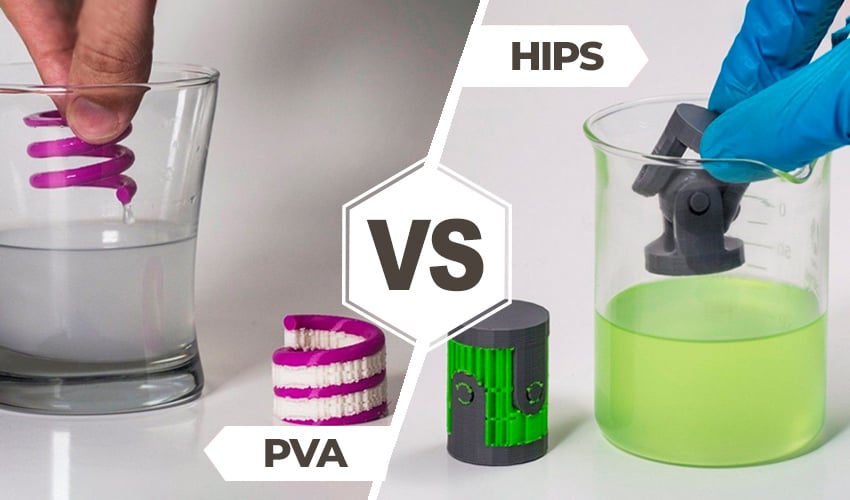
If you want to print objects with complex geometries, steep overhangs, long bridges and cavities, you cannot avoid support structures. With powder-based printing technologies, these are not required, as the powder itself is able to support the printed structure. However, when printing with filaments or resin, it is necessary to include support structures to ensure that the final object survives the print in one piece. Two materials that are frequently used for supports are PVA and HIPS, which we will examine in more detail in this article specifically in their use in FFF printing.
The requirements for support materials are diverse and therefore choosing the right one can be difficult. After all, the supports should be as easy to remove as possible after printing and should not leave any traces on the printed object. Moreoever, in the best case, it will also be a different material to the one used for the printed object itself. Therefore, it is recommended to use an FFF printer with dual extruders, thus reducing the printing time and also the risk that the two materials mix and affect each other unfavorably. Fortunately, in the filament market there are those that are suitable or even specifically designed for printing supports. We took a closer look at two of them, contrasting PVA and HIPS in their characteristics, printing properties and applications. PVA is a material primarily used as a soluble support material in FDM 3D printing, while HIPS is often used both as a support material and as a printing material for stand-alone parts. Though we will focus mainly on its use as a material for support structures.
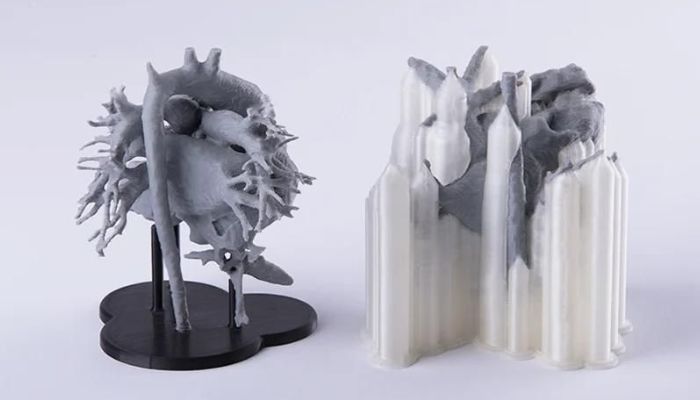
Complex 3D-printed object with supports made of PVA (photo credits: Zortrax)
Properties of PVA and HIPS
Both PVA and HIPS are thermoplastic polymers. PVA stands for polyvinyl alcohol and is formed by the alkaline hydrolysis or saponification of polyvinyl acetate (PVAC) by splitting chemical bonds through a reaction with water. HIPS on the other hand is formed from a mixture of high impact polystyrene and polybutadiene rubber, hence the name High Impact Polystyrene. It is thus a copolymer that combines the elastic properties of rubber with the strength of polystyrene.
More from the desk
Six other notes from the rest of the bench.
 ApplicationsInfographic: 3D Printing in the Automotive SectorThe automotive sector was one of the first industries to use 3D printing. Indeed, it was the first to use the technologies to create prototypes as well as to gradually move towards integrating end-use parts. And the importance of additive…
 ApplicationsAnatomic Implants Seeks FDA Clearance for World’s First 3D Printed Toe Joint ImplantIn partnership with AddUp, Anatomic Implants, a medical device startup in Washington, DC, has announced its intention to submit a 510(k) clearance for the world’s first 3D-printed toe joint replacement. While the use of 3D printed implants within the medical industry&hellip
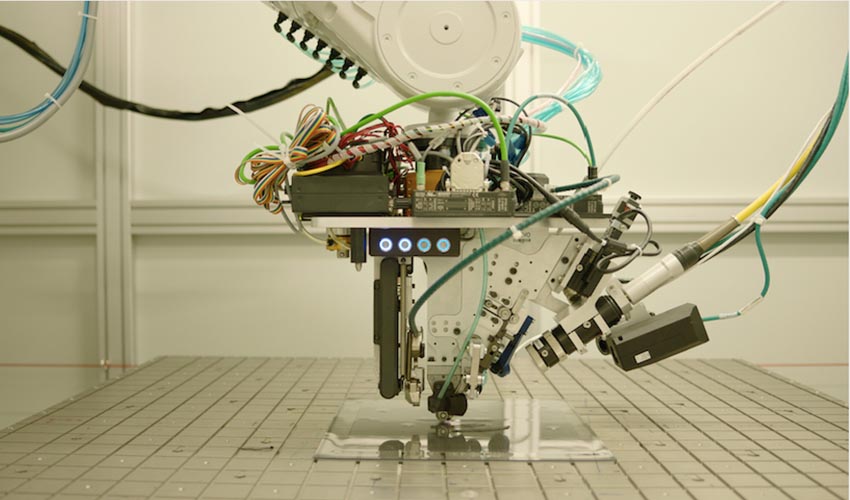 GuidesAREVO launches world’s first high-speed AM composite systemAREVO, a young Californian company, is known for having developed an additive manufacturing platform to transform composites production in the AM sector. As you may know, composites represent a growing segment in this industry, and have started competing with some…
 NewsWhy Use Isopropyl Alcohol (IPA) in 3D PrintingWhen just starting out with a resin 3D printer, it is important to be well-informed, not only about the various options available, but also about the tools needed to optimize prints. From material selection to practical advice, our site has…
 PrintersMakerBot launches SKETCH Classroom for students and teachersOver the last few months, the education system, and more particularly the school system has become aware of the huge potential and need to educate their students on 3D printing. This demand has been heard by MakerBot, one of the…
 NewsADDITIV Design World, The Virtual Event Dedicated to Design for Additive ManufacturingAfter the success of our previous ADDITIV virtual events, which have brought together additive manufacturing professionals with key players in different industries, the leading virtual event platform for additive manufacturing is back once again. This time, join us on May…