News
Post-processing trends report reveals current methods and challenges
PostProcess Technologies has just released its annual report on post-processing trends in additive manufacturing. This second edition highlights the main methods available in the industry, and the challenges AM users face regardless of the additive manufacturing technology they u
- 3 min read
- News
- Six more stories
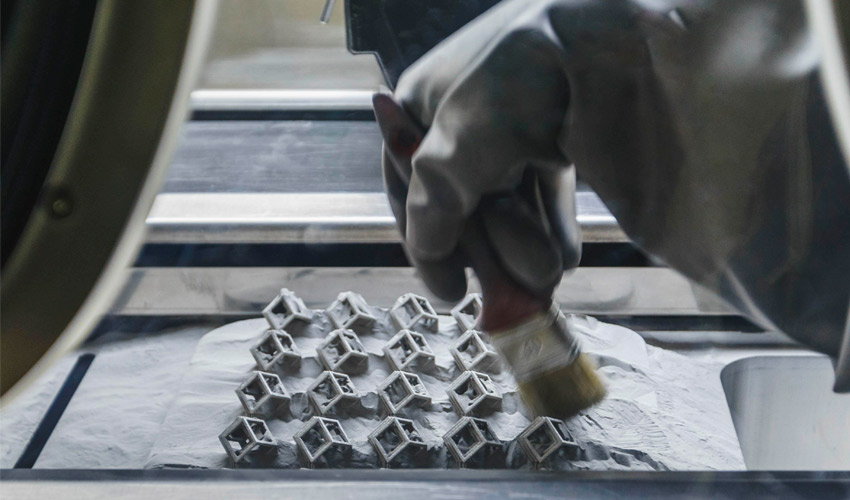
PostProcess Technologies has just released its annual report on post-processing trends in additive manufacturing. This second edition highlights the main methods available in the industry, and the challenges AM users face regardless of the additive manufacturing technology they use. This year, most respondents agreed that post-processing methods are complex and that the search for a skilled workforce that knows how to deal with these post-processing techniques remains one of the biggest challenges, if not a barrier to entry, in the market today. It should be noted, however, that automated solutions are increasingly becoming available, they are also more efficient than previous solutions. This should reassure manufacturers who are more oriented towards mass production.
If post-processing trends are now the subject of an annual report, it is because they are an integral part of the additive manufacturing process. The AM process begins with modeling and ends post-treatment of the part with steps that include surface finishing, removing support materials, etc. It is an important link in the chain that must be taken into consideration. And yet, 20% of the participants say that they do not quantify the expenses associated with post-processing. This is still a high statistic when you consider its importance in the workflow, regardless of the technology employed. It should also be noted that 70% use at least two different technologies – material extrusion remains in the lead followed by photopolymerization and powder bed processes (SLS and LPBF). The more manufacturing processes are used, the more post-treatment methods are used.
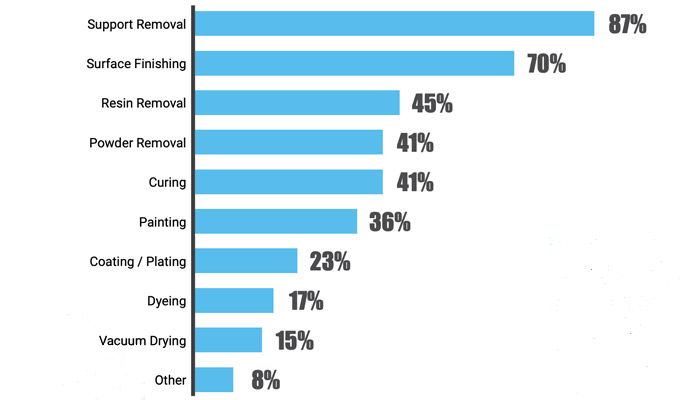
Post-processing methods used
Methods used and challenges encountered
Just like last year, the report finds that the most common method used is the removal of printing supports (87%), followed by surface finishing (70%) and finally the removal of materials – resin first (45%) then powder (41%). The study points out that the increase in the number of methods makes the manufacturing process more complex: there is more equipment, more software, while quality level must remain constant. Users can be confronted with deadline issues, but above all of a lack of skills as there are currently very few trainings around this. Knowing how to handle a part once it has come out of the machine is not straightforward, especially when we are talking about industrial parts. Therefore, this qualification is a major challenge for many of the participants in the study, especially for those who use powder bed and photopolymerization processes.
More from the desk
Six other notes from the rest of the bench.
 SoftwareChiTuBox, the Slicer Designed for Resin 3D PrintingWhen it comes to 3D printing software, one of the most critical are slicers, which are used to prepare a 3D model for printing. These intermediaries convert the 3D model into a series of thin layers and generates a G-code…
 NewsHawaiian Students 3D Print Molds for Local Chocolate ShopAs part of a new 3D printing project, a group of students from the Department of Mechanical Engineering at the University of Hawaii recently teamed up with a local chocolate shop. The goal of the collaboration of these students and…
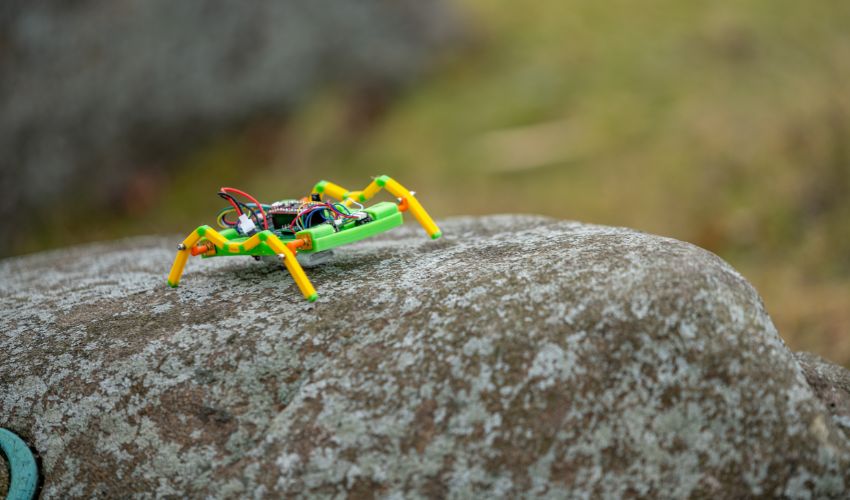 GuidesDr. Markus Nemitz Talks 3D Printing and Swarm RoboticsA few years ago, we told you about an incredible project to create 3D printed robots for search-and-rescue operations. The man behind it, Dr. Markus Nemitz, has not stopped there. In the time since, Dr. Nemitz has continued to use…
 NewsLeading Innovations on Display at Formnext 2021As you may already know, what truly astonished us this year was how much AM has advanced since the last physical Formnext, all the way back in November 2019. From the growing importance of industrialization in the sector as well…
 NewsSteakholder Foods Is Developing 3D Printed Seafood ProductsThe popularity of meat products has declined significantly in recent years. The reasons for this include the increasing awareness of animal suffering and negative effects on our environment due to high greenhouse gases, for example. To minimize the aforementioned consequences,&he
 GuidesThe Faces of Additive Manufacturing: Terry WohlersAfter Avi Reichental, Hanan Gothait, and Gil Lavi we continue our series on additive manufacturing personalities with Terry Wohlers. The well-known additive manufacturing expert has been active in the industry for over 30 years and is the man behind the famous…