Guides
Philipp Aduatz on Using 3D printing to Design Colorful Concrete Furniture
Design freedom is one of the most important strengths of additive manufacturing. This is why various 3D printing processes are also being used more and more frequently in the creative industry. They offer unprecedented possibilities in the design process, meaning…
- 3 min read
- Guides
- Six more stories
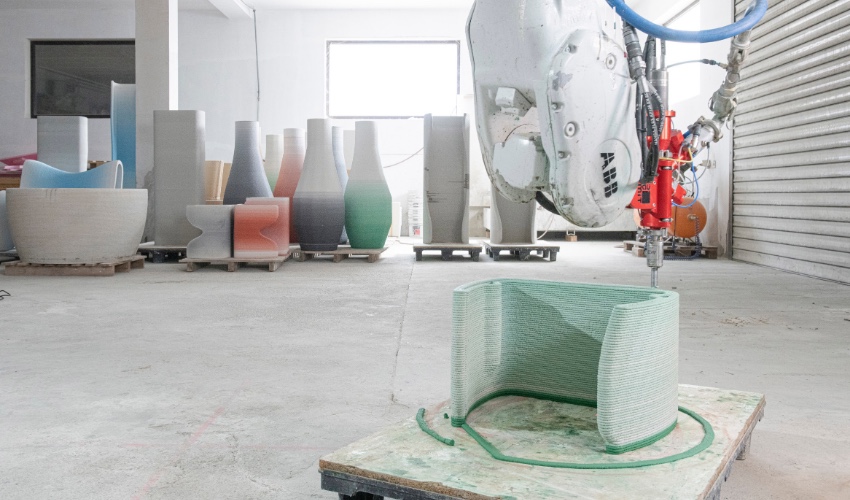
Design freedom is one of the most important strengths of additive manufacturing. This is why various 3D printing processes are also being used more and more frequently in the creative industry. They offer unprecedented possibilities in the design process, meaning that there are fewer and fewer limits to creativity. For example, there is already technology can be used to replicate natural forms (bionics) or to create experimental designs. For Austrian product designer Philipp Aduatz, 3D printing has become an integral part of his design work for years. His designs are a prime example of how to take advantage of additive manufacturing. From creating the first prototype to 3D printing limited edition furniture. Philipp Aduatz spoke with us about the application of additive manufacturing to his business and explains how the technology influences his design process.
3DN: Can you briefly introduce yourself and your work?

Philipp Aduatz
I am a product designer from Vienna and my work is at the interface of design and art, notably working with technology and material sciences. My process is characterized by both experimental and scientific theoretical features and the result are objects in small limited editions. 3D printing has always played a role in my work. Since 2005, I have used it primarily to quickly produce small working models in the design process. In recent years, however, it is mainly the possible dimensions in 3D printing that have changed and since 2018 I also produce large objects in 1:1 scale.
3DN: What are the advantages of additive manufacturing in the design and manufacturing process of your objects?
For me personally, there are several advantages. The most important one for me is that no complex mold construction is necessary for production. This is primarily an economic advantage. In the past, I always had to incur large financial expenses for the production of models and molds, but this is completely eliminated by using additive manufacturing. Furthermore, minor changes and optimizations can always be made during pilot production. Even in production, adjustments can still be made if necessary. In the past, this was not possible for me; once molds were produced, it was impossible to make any more changes here. And last but not least, new forms of design expression are also a significant advantage of 3D printing; the aesthetic dimension in particular is an interesting aspect for designers.
More from the desk
Six other notes from the rest of the bench.
 ApplicationsWas the Artemis II Toilet 3D-Printed in Titanium? What We Really KnowThe Artemis II mission launched on April 1, carrying four astronauts on the first crewed flight around the Moon in more than half a century. On board was the Universal Waste Management System (UWMS), the first functional toilet to travel…
 SoftwareideaMaker: The Free Slicer from Raise3DAs you probably know, slicers are a critical step when 3D printing a part. As an intermediary between the 3D model and the 3D printer, slicers allow the machine to understand the information in the 3D model thanks to a…
 NewsHow 3D Printing Will Change Manufacturing3D printing is a special type of digital fabrication called additive manufacturing. The difference between additive manufacturing and traditional techniques is that objects are created layer-by-layer, so there is minimal loss of material. This creates a potential for a more&helli
 ApplicationsDubai Starts Trial Operation of 3D Printed AbraNever let it be said that the United Arab Emirates is a stranger to innovative technologies. In Dubai, the country’s most populous city, especially, we have seen a number of projects using 3D printing in recent years. And now there…
 NewsTop 5 Videos: 3D Printed Telescopes Transform Stargazing ExperiencesWelcome to our compilation of this week’s top 3D printing videos. This week, we commence with an inventive project by Ten Telescopes, aiming to make stargazing in Ontario more accessible through intricately crafted 3D printed telescopes. Moving forward, we explore…
 ApplicationsResearchers at ETH Zurich Study 3D Printed Breast TissueUnfortunately, research on the female body, particularly concerning health, remains largely neglected. Researchers at ETH Zurich now want to change this with their groundbreaking study of breast milk cells. Specifically, how breast milk is produced within the body has not…