Applications
Olli 2.0: what are the new features?
You most likely remember Olli, the 3D printed minibus designed by the American Local Motors. A small revolution in the automotive sector that already demonstrated at the time that additive manufacturing has a real advantage in this demanding industry. The…
- 3 min read
- Applications
- Six more stories
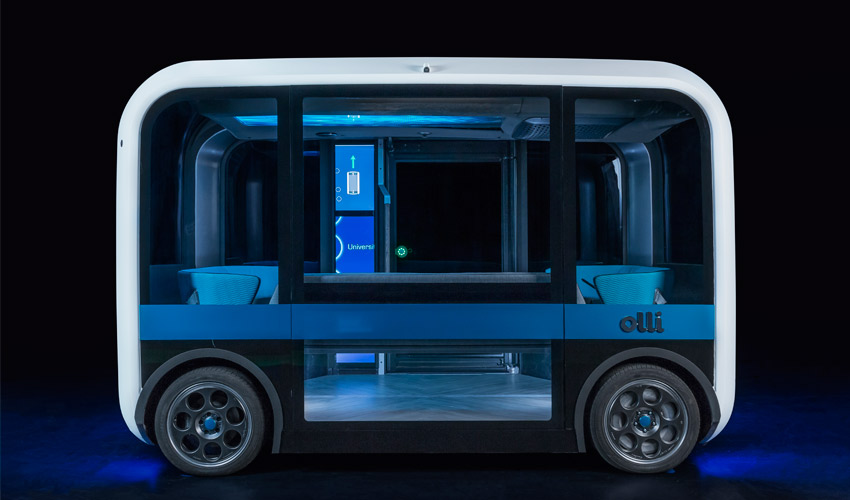
You most likely remember Olli, the 3D printed minibus designed by the American Local Motors. A small revolution in the automotive sector that already demonstrated at the time that additive manufacturing has a real advantage in this demanding industry. The vehicle is back in the spotlight: the manufacturer reveals Olli 2.0, an improved version of the one presented in 2016. Note that Olli 2.0 has more 3D printed parts than its predecessor as well as two additional seats and programmable lighting.
In 2016, Local Motors presented its new concept of an autonomous shuttle, Olli, capable of transporting a dozen people, answering their questions and analysing information from its environment thanks to the presence of numerous sensors. The small vehicle was partially 3D printed using Big Area Additive Manufacturing technology and was deployed in several areas of the United States, including university campuses – where it allows students to easily travel – hospitals and military bases. Although the solution is effective, Local Motors wanted to make some improvements on Olli, to reveal Olli 2.0.
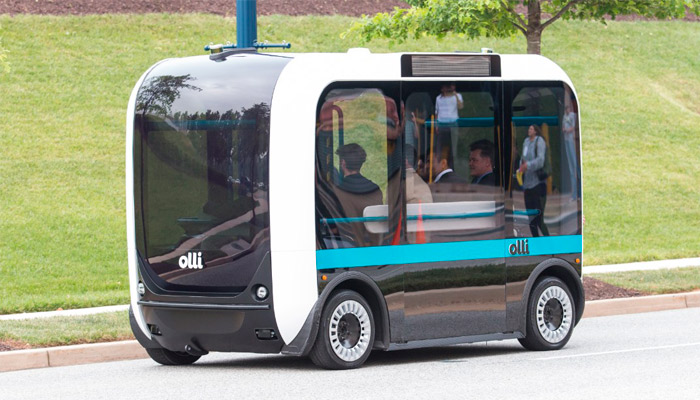
The first version of Olli
Olli 2.0, an optimised version of Olli
The manufacturer claims that 80% of Olli 2.0 parts have been 3D printed, using the same technology used 3 years ago, the process takes about 10 hours. The main benefit of 3D printing for Local Motors is that it can quickly offer iterations and easily test different versions. Still electric, the minibus has a range of 160 km (compared to 60 km for the first version) and a maximum speed of 40 km/h. It has an autonomy capacity of level 4, i.e. it can drive without any human intervention within a given perimeter. One of the main changes is certainly the position of the electric motors: they are no longer on the axles but integrated directly into the 4 wheels.
More from the desk
Six other notes from the rest of the bench.
 ApplicationsKnee replacement with additive manufacturing and artificial intelligenceThe Italian medical implant manufacturer, REJOINT, announced it is using GE Additive’s Electron Beam Melting (EBM) technology to additively manufacture knee implants. The medical company aims to offer a customized medical solution to patients. Both additive manufacturing and arti
 NewsTop 5 Videos of the Week: 3D printed multifunctional robots…This week we found the top 5 videos about 3D printing and the way additive manufacturing is shaping our society. The technology has infiltrated many sectors, from medical to automotive! Check out our selection of the week to keep up with the innovations! This week we…
 NewsThermwood 3D prints a hull mold for a 51-foot long yachtThe manufacturer of large-format additive manufacturing solutions, Thermwood, has recently 3D printed several sections of a mold of the hull for a 51-foot long yacht. Using carbon fiber reinforced ABS, the company developed a part that was strong enough, demonstrating that additi
 News3D printed fashion at the Met Gala 2019!The Met Gala is undoubtedly one of the most famous fashion evenings in the world, bringing together celebrities and young designers to promote innovation and design. This Met Gala 2019 saw some amazing creations combining craftsmanship and 3D printing: designer…
 ApplicationsThe growing market for additive manufacturing in the medical sectorSME is an American professional association that recently unveiled their Medical AM3DP 2018 Annual Report, which provides a global overview of the impact of additive manufacturing in the medical sector – highlighting the importance of technological innovation to improve the
 MaterialsRotterdam will have a 3D printed pedestrian bridgeIn Rotterdam, Netherlands, the first 3D printed pedestrian bridge is being built, and should be installed before the end of 2020. Currently, it’s a wooden footbridge that exists in the Kralingse Bos, soon to be replaced by a lightweight 3D…