News
Could Okara Be a New Material for Food 3D Printing?
Cuisine has always been creative and original, constantly reinventing itself to satisfy our taste buds. This is why many chefs and amateurs imagine unusual recipes, based on foods you might not expect. This is the case for a team of…
- 3 min read
- News
- Six more stories
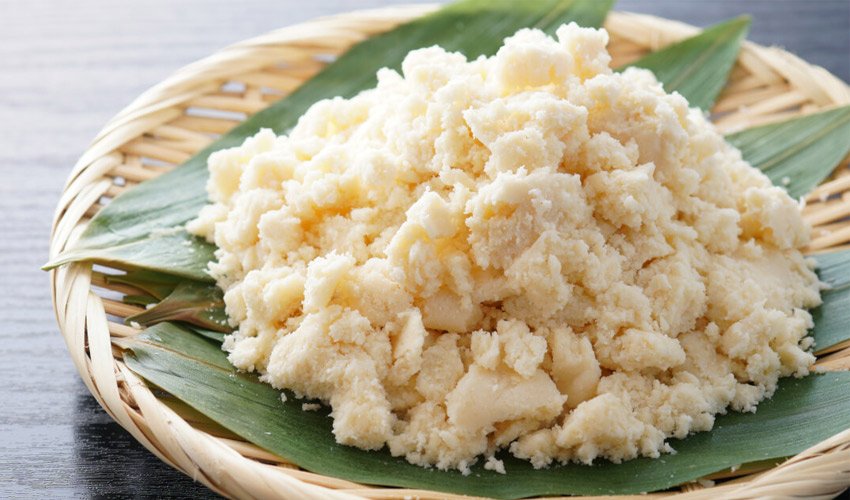
Cuisine has always been creative and original, constantly reinventing itself to satisfy our taste buds. This is why many chefs and amateurs imagine unusual recipes, based on foods you might not expect. This is the case for a team of researchers in Singapore who decided to okara and 3D printing to propose unique dishes. But what exactly is okara? It is the soy pulp, or tofu dregs, recovered during the manufacturing of vegetable milks, particularly soy milk though also tofu. It is therefore a nutrient-rich by-product that has no taste in itself but is used as a base for plant-based alternatives. Now, it is apparently also a 3D printing material.
The research team published a study last November titled 3D Printing of Okara Ink: The Effect of Particle Size on the Printability. In their publication, the team explains that they studied the appropriate size and concentration of okara particles to allow it to be 3D printed without additives. Many producers would add additives to the food, such as carob flour, glycerin, xanthan gum, κ-carrageenan gum, or whey protein isolate, to alter the rheological properties, which would affect the structure and malleability of the product. This research project thus joins the many initiatives mixing 3D printing and food, for example Barbara Gollackner who used food waste to design 3D printed kitchen utensils.
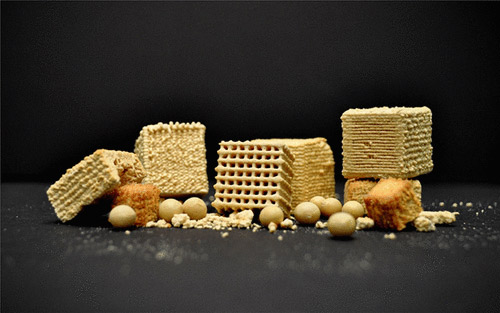
3D printed okara-based foods (photo credit: ACS Food Science & Technology)
A healthy snack without additives
Through an analysis of different okara textures, the researchers were able to determine the optimal ink variables for the food to be printable without additives. The measurements ultimately revealed that particle size had a significant influence on 3D printability. After several trials, the final formula for Okara inks was finally found: with 33% (w/w) Okara powder and a particle size of less than 100 μm, the material is printable without additional rheology modifiers. This ratio would lead to a flow stress of 200 ± 40 Pa and a storage modulus of 23300 ± 300 Pa.
More from the desk
Six other notes from the rest of the bench.
 PrintersIs 3D printing in an office space dangerous for your health?New studies have confirmed that particles emitted from 3D printers can negatively impact indoor air quality and have the potential to harm respiratory health. Invented 30 years ago, the unintended adverse impacts of 3D printing on human health are not…
 NewsNew York Bill Proposes Background Checks on 3D Printer BuyersAfter a raft of busts in New York which led to the discovery of several caches of ghost guns, made of untraceable weapon components made from 3D printers, lawmakers in the empire state have now put forward a piece of…
 NewsEuropol Concerned About Growing Number of 3D Printed WeaponsIn recent years, an increasing amount of 3D printed weapons has been seized in Europe, which is raising concerns for the European Police Office (Europol). For that reason, a conference was recently held to bring together a number of professionals…
 ApplicationsApplication of the Month: SprintRay 3D Printed Teeth RestorationAdvanced digital workflows and additive manufacturing are transforming the field of restorative dentistry. In this feature, we highlight a full-mouth rehabilitation case managed by Dr. Guvinder Gakhal, where SprintRay 3D printed crown resin was used to restore a patient with&hell
 NewsnFrontier Unveils UILA, a 3D Printed Hyrbid Electric Cargo Bike and Electric VehicleOnce again, 3D printing has been used for an innovative and sustainable new solution. This time, nFrontier, a Berlin-based innovation studio, has unveiled UILA, a revolutionary vehicle that is essentially a hybrid between an electric cargo bike and a small…
 NewsHypsole Launches the World’s First 3D-Printed Cleat GuardsSports equipment is not always cheap, which is why parents always teach their offspring to handle expensive shoes, equipment and gear with care. However, looking after and caring for sports equipment often involves a lot of effort and time. Who…