News
New Liquid Metal Printing Process Is 10X Faster
What if you could 3D print large-scale metal parts quickly and cheaply? That’s the question posed by a team from MIT, and more specifically the MIT Self-Assembly Lab, who set out to circumvent the current limitations of metal 3D printing.…
- 3 min read
- News
- Six more stories
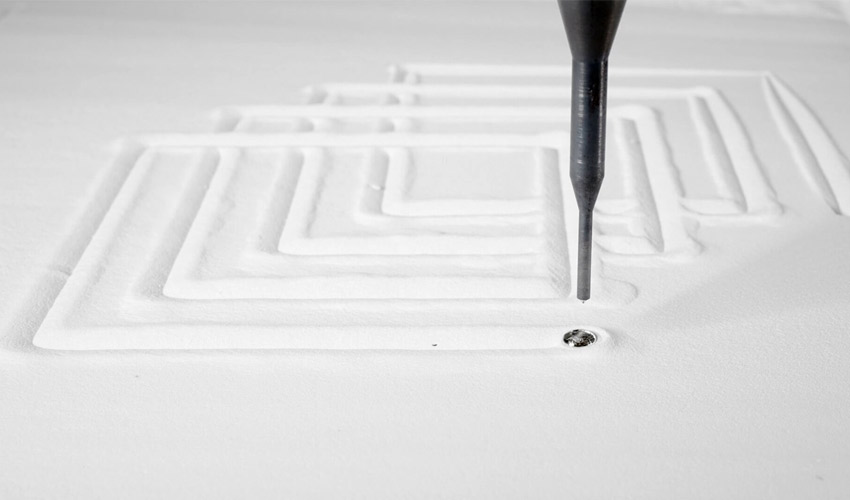
What if you could 3D print large-scale metal parts quickly and cheaply? That’s the question posed by a team from MIT, and more specifically the MIT Self-Assembly Lab, who set out to circumvent the current limitations of metal 3D printing. They have developed a process called Liquid Metal Printing (LMP), which is similar to free-form casting: in concrete terms, molten metal is extruded into a vat of 100-micron glass beads (reminiscent of powder) following a predefined path. From there, the material can harden and form the desired part. No support is required, as the glass beads act as a mold for the molten metal. So far, the team has carried out several experiments with aluminum and achieved very high printing speeds: the process is said to be 10 times faster than other metal technologies on the market, whatever the size of the part.
3D printing in a granular substance is nothing new in itself, but it is generally done with polymers and silicones. Using metals is more complex, not only because of the melting temperature required, but also because of extrusion constraints – molten aluminum can’t be extruded through just any nozzle without corroding and destroying it. Skylar Tibbits, associate professor in the Department of Architecture and co-director of the Self-Assembly Lab, and his colleagues have been working to overcome the volume and time limits imposed by metal additive manufacturing. Today, only the WAAM process can handle large volumes, but it remains too slow compared with so-called traditional manufacturing methods. This is where LMP comes in, seeking to reconcile speed and large format.

Molten metal is deposited in the powder pan
How Does Liquid Metal Printing Work?
The LMP machine is made up of three essential parts: the nozzle and a custom-built electric furnace, the print bed and a temperature regulator that ensures meticulous control of the aluminum temperature from the furnace to the nozzle. This custom-built 5 kW furnace is the heat source and can contain a graphite crucible to keep the metal molten before extrusion. The nozzle itself posed a number of challenges: in all additive manufacturing processes, one of the issues is to ensure corrosion resistance of the machine’s mechanical components. As you can imagine, molten metal cannot be extruded through just any nozzle. The team therefore carried out several tests before creating a ceramic nozzle.
More from the desk
Six other notes from the rest of the bench.
 News3D printing, the future El Dorado of the job market?In 2014, 3Dnatives France published a study on recruitment in the 3D printing industry with the goal of showing how technology has led to an increased demand for diverse profiles to join the industry. Recently the Orientation Council, (a body that is…
 NewsBack Care, the 3D Printed Support Fully Adapted to Each BodyWho hasn’t experienced back pain due to poor posture or uncomfortable seating? What if we told you that 3D printing, combined with artificial intelligence, could solve this problem? That’s the idea behind Alemki Robotix, a start-up that’s not yet well…
 ApplicationsLondoner Becomes the First to Receive 3D Printed, Functional HandThe landscape of prosthetics has been rapidly evolving, seeing many technological advancements since its collaboration with 3D printing. Against this backdrop, a hand amputee from London has recently become the first individual to benefit from Open Bionic’s cutting-edge 3D
  Applications$2 Million Research Grant Will Allow 3D Printing of Pediatric Medical DevicesA multi-disciplinary US team has been granted $2 million to use 3D printing in medical research. The team, from the University of Texas at Austin and Penn State, was given the money by the National Science Foundation’s LEAP-HI program for…
 NewsBinder Jetting, the 3D Printing Technology That Transforms Production MethodsBinder Jetting is a 3D printing process that is becoming increasingly popular with additive manufacturing users. One of the players in this niche is Desktop Metal. The company is a global leader in Binder Jetting 3D printing and also has…
 PrintersBambu Lab Issues Update on A1 3D Printer RecallFollowing the initial Bambu Lab announcement of a recall earlier this year, U.S. Consumer Product Safety Commission, has formalized this (5 months later), confirming that it has impacted approximately 12,800 units of A1 3D printers sold before January 30, 2024.…