News
NC State Researchers Develop Novel 3D Printable Jelly
Over the years, researchers have combined 3D printing and hydrogels for a variety of different innovative projects including a lifelike model of a human heart, cancer treatment, artificial muscle tissue able to adapt its color and shape according to light,…
- 3 min read
- News
- Six more stories
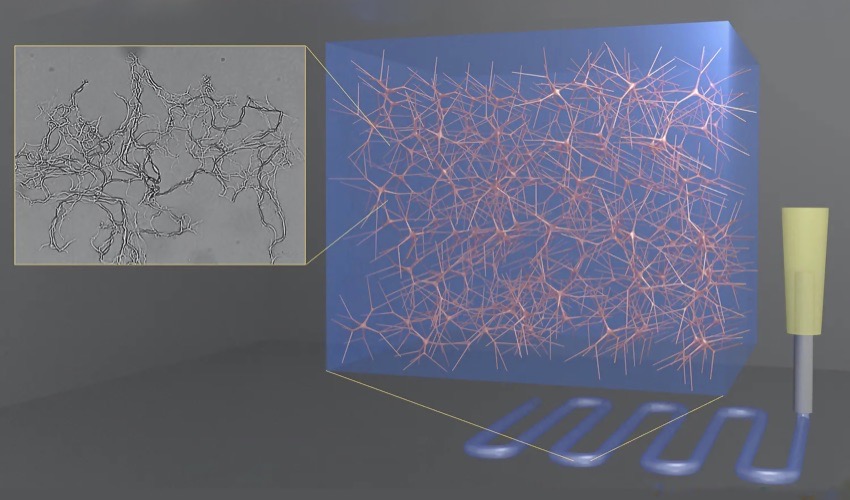
Over the years, researchers have combined 3D printing and hydrogels for a variety of different innovative projects including a lifelike model of a human heart, cancer treatment, artificial muscle tissue able to adapt its color and shape according to light, and even biocompatible hydrogel models. Now, a team of researchers from North Carolina (NC) State University has combined two physical forms of the same seaweed material to create a homocomposite hydrogel with improved and highly controlled properties. According to the university this method could have applications in biomedical materials. For example, soft robotics, biological scaffolds for growing cells, strengthened 3D-printed bandages or even patches for wound healing or drug delivery.
Hydrogels are 3D printable, water-based substances resembling jelly. Typically, they are composed of chemical compounds found in seaweed and algae, often used as thickening agents and in wound dressings, called alginates. Hydrogels are a distinctly useful material for the reason that they are, at once, both strong and flexible. The possession of both these qualities is possible, as Orlin Velev, S. Frank and Doris Culberson Distinguished Professor of Chemical and Biomolecular Engineering at NC State and corresponding author of the paper explains, because “water-based materials can be soft and brittle”. It is thanks to this quality that hydrogels are well suited to such a wide range of applications.
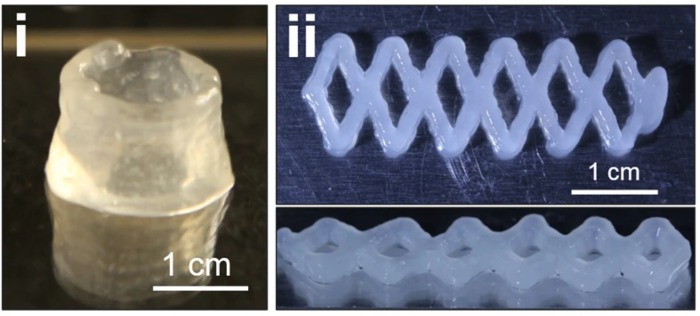
Images of extruded homocomposite hydrogel paste that has been layered in 3D. (Photo Credit: NC State University)
However, the hydrogels developed by NC State were created by merging micro- and nano-sized networks of the same materials harnessed from seaweed and are thus homocomposite materials. They are therefore distinct from typical hydrogels for the reason that they being “soft fibrillar alginate particles inside a medium of alginate – are really two hydrogels in one: one is a particle hydrogel and one is a molecular hydrogel. Merged together they produce a jelly-like material that is better than the sum of its parts, and whose properties can be tuned precisely for shaping through a 3D printer for on-demand manufacturing.”
More from the desk
Six other notes from the rest of the bench.
 Applications#3DExpress: The First Metal 3D Printer Is Going to Outer SpaceOnce again, it is time to take a look back at some of the news that has marked the additive manufacturing sector this week. And we’re starting with a piece of news that truly does show that not even the…
 News3D Daily Show #1: Reporting Directly from Formnext!Formnext, the international trade fair for additive manufacturing, officially opened its doors today. The event is taking place in Frankfurt from November 16th to November 19th, 2021. To let you follow what’s happening at the event from the comfort of…
 ApplicationsUW-Madison Engineers Achieve Zero Gravity 3D Printing of RAMStudent engineers at the University of Wisconsin-Madison have taken a giant leap toward self-sustaining space exploration by successfully 3D printing Random Access Memory (RAM) devices in zero gravity. This achievement, realized in March 2024, represents a significant advancement
 SoftwareRhino: What Do You Need to Know About the 3D Modeling Software?One of the most popular 3D modeling software is Rhinoceros 3D, also known as Rhino. Based on NURBS (Non-Uniform Rational Basis Splines) geometry, this surface modeling software is commonly used for architecture, prototyping, engineering, jewelry and industrial, graphic, naval and
 NewsSmartpod, 3D Printed Mobile Workspaces to Work From Home AnywhereCalifornia-based design studio Denizen has re-imagined flexible workspaces with its new Smartpod — a 3D printed mobile office that can be installed anywhere. The structures are capsule-like and integrate all the equipment necessary to make work from anywhere possible, even&hellip
 NewsReverse Engineering Helps Ford to Revive Michigan Central StationAlready a veteran in the technology, Ford has been using additive manufacturing for many years. While the automaker usually applies 3D printing to design parts for cars, this time the American company used 3D technologies to renovate the Michigan Central…