Applications
NASA 3D prints a rocket engine for its Artemis exploration mission
NASA is preparing to send men to the Moon – and then further to Mars – as part of its Artemis space exploration mission. For this space voyage, the American agency has decided to rely on metal additive manufacturing, more…
- 3 min read
- Applications
- Six more stories
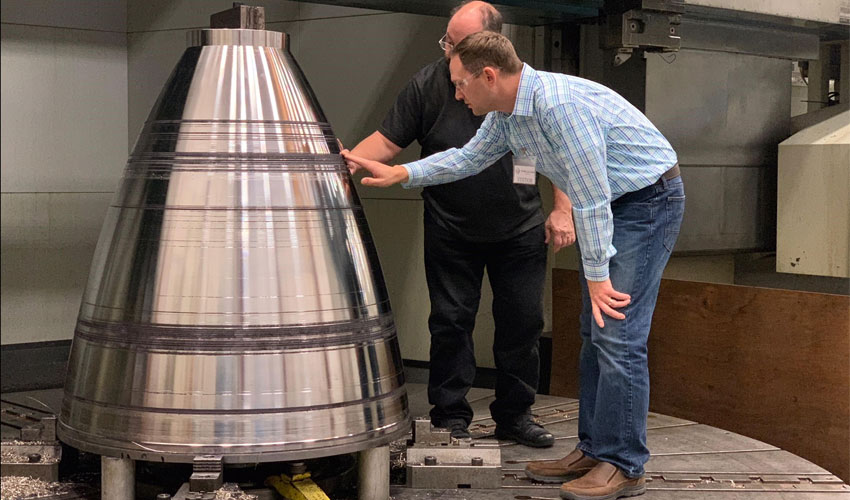
NASA is preparing to send men to the Moon – and then further to Mars – as part of its Artemis space exploration mission. For this space voyage, the American agency has decided to rely on metal additive manufacturing, more precisely, on Blown Powder Directed Energy Deposition, a 3D printing technique similar to DED technology. Thanks to this technology, NASA is designing the rockets of tomorrow: the RAMPT (Rapid Analysis and Manufacturing Propulsion Technology) project aims to additively manufacture large engines of space rockets. In order to test the metal 3D printing technology and confirm its advantages, the teams have designed a nozzle with a diameter of one meter and a height of 0.9 meters with integrated cooling channels.
NASA has been exploring the potentials of additive manufacturing for several years, mostly focusing on metal 3D printing that would allow the agency to design components for its satellites and rockets faster while maintaining their strength and complexity. In April 2019, NASA launched the RAMPT Project to develop new design and manufacturing methods that would improve combustion chamber and nozzle performance, all while reducing costs. Thus, RAMPT mainly focuses on the two heaviest components of the engine system that are also the most expensive to produce today. Ultimately, the goal is to fully integrate new manufacturing processes – including 3D printing – on a national scale, characterize the materials and, of course, test the results. It is in this context that NASA has created a 3D printed nozzle made of metal.
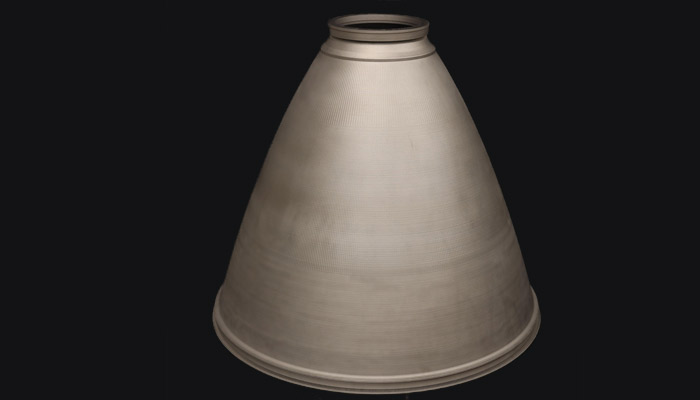
The 3D printed nozzle. (Image credits: NASA)
The RAMPT project is based on the Blown Powder Directed Energy Deposition technology, which consists of injecting metal powder into a laser-heated molten metal basin. A print head, attached to a robotic arm, moves according to the pre-determined pattern and manufactures the part layer by layer thanks to an optical laser that hardens the blown powder. It is practically the same technique as DED, which is known for its ability to repair metal parts and manufacture large parts, such as rocket engine nozzles. Paul Gradl, co-principal investigator at RAMPT, explains: “It’s a challenging process to manufacture the nozzles traditionally, and it can take a very long time. Blown Powder Directed Energy Deposition additive manufacturing allows us to create very large-scale components with complex internal features that were not previously possible. We’re able to significantly reduce the time and the cost associated with the fabrication of channel-cooled nozzles and other critical rocket components“.
More from the desk
Six other notes from the rest of the bench.
 GuidesLayer One: Makers of the Hybrid FDM & SLA 3D PrinterOur startup of the month for December is Layer One. Layer One is a company that created a hybrid 3D printer that combines FDM and SLA technologies. We have already discussed the main types of FDM 3D printer on our site.…
 NewsThe Complete Guide to Directed Energy Deposition (DED) in 3D PrintingDirected Energy Deposition (DED) is a more complex 3D printing process, typically used to repair or add additional material to existing components. It is completely possible to fabricate parts from scratch using this technology, but it is often used for…
 MaterialsGetting Started With 3D Printing: Choosing the Right ResinIf you are reading this, you have probably taken the plunge and purchased your first resin 3D printer. But now it’s time to consider another crucial element: the choice of resin. The resin you use plays a decisive role in…
 MaterialsMaterialise on Using Sustainable Materials to 3D-Print Designer EyewearOne of the many benefits of using 3D printing for the manufacture of products is that it enables companies to move from away mass-production to mass-customization — offering a selection of colors and styles to suit the tastes of each…
 NewsMick Fanning surfs on a 3D printed surfboardWhile the automobile and aerospace industries have typically been the dominate leaders in 3D printing technology, new industries are beginning to take notice of this technology’s capabilities. The sporting industry is now a contender within the 3D printing technology race,
  NewsTop 5: A New 3D Printed Car Created by Lexus and Inspired by Black Panther: Wakanda ForeverAnother week has come to an end which means it is, of course, time for our weekly top 5 3D printing videos of the week! First, Lexus shows off its new 3D printed car, produced jointly with Carbon and adidas,…