News
Mummy Research Used 3D Printing to Reveal Archaeological Secrets
In ancient Egypt, preparation of the dead was an important occasion, one which would allow the person to pass into the afterlife. Embalmers performed mummification of deceased people, protecting the body from the decay of the human or often animal…
- 3 min read
- News
- Six more stories
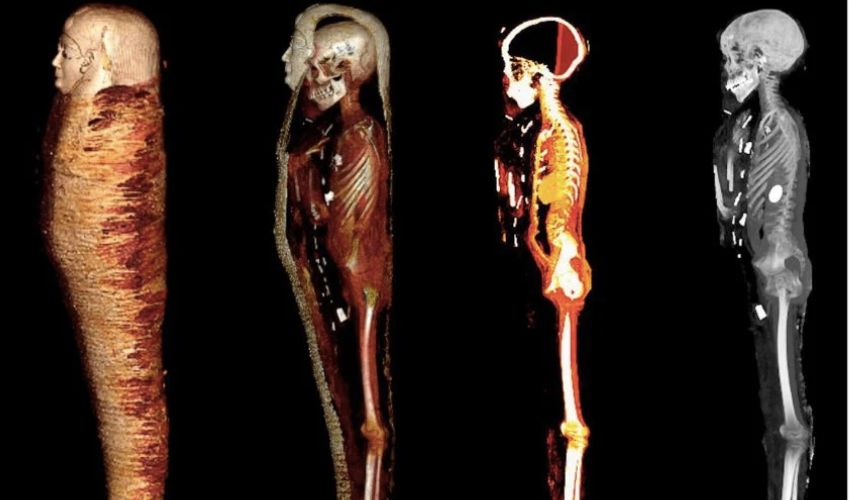
In ancient Egypt, preparation of the dead was an important occasion, one which would allow the person to pass into the afterlife. Embalmers performed mummification of deceased people, protecting the body from the decay of the human or often animal body. Despite the discovery of an increasing number of mummies as time continues, investigating these artefacts is challenging since with a wrong movement the mummy could be destroyed. That’s why researchers used CT scanning to study a mummy recovered in Upper Egypt in 1916, but also used 3D printing to reproduce an amulet found there.
Additive manufacturing has already been able to demonstrate its suitability for use in archaeology. But in this case, the researchers in Cairo explain that it was only after performing the CT scan that they came across what was actually special. The result of the scan revealed a total of 49 amulets placed inside the mummy and between the wrappings, which were given to the mummy in 21 different forms to take with him on his final journey. The “golden boy”, nicknamed for the 30 golden amulets it was buried with, provides further provide information about living conditions at that time. This was aided with the means of 3D scanning and printing.
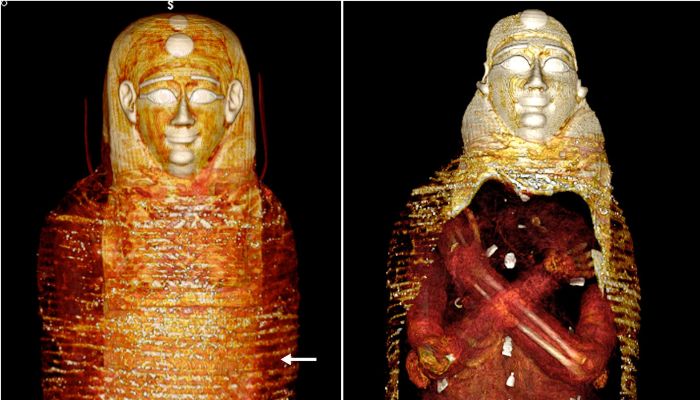
Left: the scan of the outermost bandages; right: the scan shows the crossed arms and the amulets.
The Procedure for Researching the “Golden Boy” Using 3D Printing
In their paper titled “Scanning and three-dimensional-printing using computed tomography of the “Golden Boy” mummy,” which appeared in the journal ‘Frontiers in Medicine,’ the researchers stated that after successfully scanning the selected object – in this case, the largest amulet located in the mummy – they transferred it into a printable format. Since this heart scarab was located in the chest cavity of the mummy, which was probably 14 to 15 years old at the time of death, the researchers indicated that the ancient Egyptians held their children in extremely high regard. One drawback noted by the research team is that due to the overlap of the 3D file of the amulet on the 2D X-ray film, there was a loss of data.
More from the desk
Six other notes from the rest of the bench.
 GuidesThe Personalities Who Shaped The Additive Manufacturing Market In 20222022 was an important year for the world of additive manufacturing. However, due to many uncertainties resulting from the health crisis of recent years as well as economic consequences of the war between Russia and Ukraine, it was also a…
 Printers3Dnatives Lab: Testing the Go!SCAN 3D scanner from CreaformFounded in 2002 in Quebec, Creaform is one of the pioneering manufacturers of metrology solutions. Acquired in 2012 by AMETEK Inc., a leading group in measuring instruments, over the years the company has developed several professional 3D scanners for industries…
 PrintersTaking a Closer Look at the POP 3D Scanner, Revopoint’s Affordable Consumer Grade ScannerThere are many 3D scanners on the market, but it can be difficult to decide which one to choose, especially when it comes to low-cost scanners. To combat this, certain companies have started to make themselves stand out thanks to…
 NewsHollywood, Ghost in the Shell and 3D printing3D printing has captured industries such construction, automotive, and medical. Giving us things from homes to skyscrapers. The limits of 3D printing are being broken and pushed to the next level with each passing day. So with all these developments,…
 SoftwareSTL vs. 3MF: Which Format to Choose for a 3D Model?STL and 3MF are the two most commonly used file formats in 3D printing. The STL format stores only the part’s geometry using triangles, while the 3MF format also stores color, materials, orientation, and print parameters in a single file.…
 GuidesThe Most Impressive 3D Printed Jewelry Designs on the MarketWhether in jewelry or jewelry, additive manufacturing is a technique increasingly used by professionals in the sector because of its ability to design complex and unique parts, all more quickly. It is used in particular to produce molds used later…